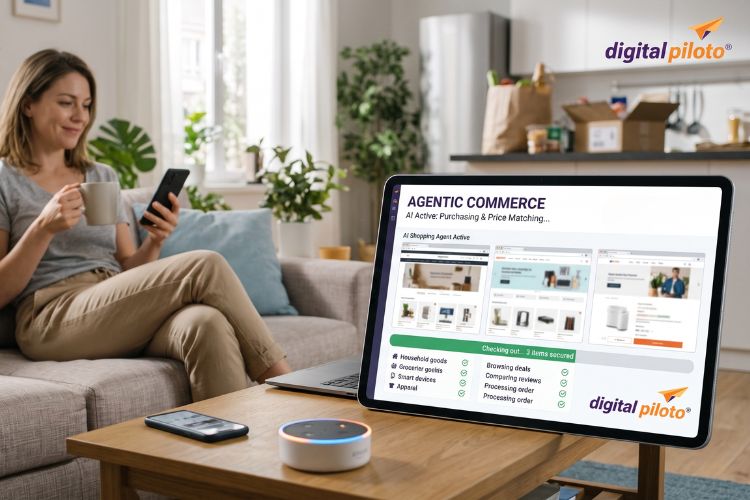
Imagine asking an AI assistant to find a reliable washing machine under ₹35,000, compare energy ratings, check delivery availability and place an order once you approve. You never visit five shopping websites or open a dozen product tabs. That is the promise of agentic commerce: a future where AI does not merely recommend what to buy, but can help buy it.
This shift could reshape how brands attract customers, present products and complete transactions. For businesses working with a best digital marketing agency India, understanding agentic commerce is becoming an important part of preparing for the next generation of digital buying behaviour.
From Shopping Assistant to Shopping Agent
There is a meaningful difference between asking AI for shopping advice and allowing it to act on your behalf.
A conventional AI shopping assistant might compare smartphones, explain camera specifications or suggest a model within your budget. You still visit a retailer, check availability, enter your delivery details and complete the payment yourself.
An AI shopping agent can potentially handle several of those steps. Given suitable permissions, it may search across products, compare prices, evaluate delivery options, select an appropriate item and initiate or complete a purchase through an authorised checkout process.
That is the defining idea behind agentic commerce. The customer communicates an objective, while an AI agent carries out a sequence of tasks to help achieve it.
Consider a household that regularly buys groceries online. Instead of rebuilding the same basket every week, the customer could ask an agent to identify familiar products, compare current prices, check delivery slots and prepare an order. The customer reviews the basket and approves it. Over time, the process could become considerably more convenient.
Of course, not every shopping decision should be automated. Buying toothpaste is different from choosing a laptop or booking an expensive holiday. The amount of freedom given to an agent should reflect the financial risk and personal importance of the purchase.
Why Agentic Commerce Is Gaining Attention
People are already becoming comfortable using AI to research products and narrow down choices. The next step is allowing these tools to participate more actively in the transaction.
A January 2026 study by the National Retail Federation and IBM, based on research involving 18,000 consumers, found that 41% used AI assistants to research products, 33% used them to look for reviews and 31% used them to find deals. These figures suggest that AI is already becoming part of the shopping decision process, even before fully autonomous purchasing becomes routine.
More recent research also indicates growing adoption in India. NielsenIQ’s Agentic Commerce India 2026 report, based on an August 2026 study across India’s eight largest metros, reports that 92% of surveyed consumers had used AI while shopping and 96% were open to AI-powered shopping tools. These findings reflect the study’s surveyed metropolitan audience, not every Indian consumer, but they point to substantial interest in AI-assisted discovery.
Convenience is only one part of the appeal. An agent could also reduce the mental effort involved in comparing dozens of similar products. Instead of asking customers to interpret every technical specification, it can filter choices against their actual requirements.
How an AI Agent Could Complete a Purchase
Agentic commerce is not simply a chatbot connected to a payment button. A useful shopping agent needs to understand instructions, retrieve reliable product information, evaluate alternatives and interact with systems that can carry out the transaction.
1. Understanding the customer’s objective
The process begins with a request. A customer might say, “Find me a comfortable office chair under ₹12,000, suitable for long working hours, with delivery to Kolkata this week.”
The agent must interpret several requirements: budget, intended use, comfort, delivery location and timing. It may also ask follow-up questions if important information is missing.
2. Searching and comparing products
Next, the agent searches available product information. It might compare prices, dimensions, materials, customer feedback, warranty terms and delivery options. Its recommendations are only as reliable as the information it can access.
3. Checking availability and purchase conditions
A product that looks attractive in a catalogue may be unavailable, incorrectly priced or unsuitable for the customer’s location. The agent needs current inventory, shipping information and clear purchase conditions before proceeding.
4. Obtaining permission and completing checkout
Finally, the agent prepares the order and follows the permissions granted by the customer. Depending on the platform and transaction rules, the customer may need to confirm the purchase or authorise payment. The system should provide a clear record of what was ordered and how to manage the transaction afterwards.
The most important principle is that convenience should never remove meaningful customer consent.
Product Data Becomes the New Storefront
In traditional ecommerce, a shopper can compensate for imperfect product information by opening another page, reading a description or asking a salesperson. An AI agent may not interpret vague product details in the same way a human shopper does.
If a merchant describes a chair as “premium and comfortable” but provides no dimensions, material information, weight capacity or adjustment details, the agent has little reliable evidence for comparing it with alternatives.
This makes product data quality a competitive advantage. Businesses should maintain accurate and structured information covering:
- Product identity: Correct product names, brands, model numbers, categories and variants.
- Specifications: Dimensions, materials, compatibility, technical features and relevant certifications.
- Commercial details: Current pricing, discounts, shipping charges, taxes and warranty conditions.
- Availability: Reliable stock information, delivery coverage and estimated fulfilment timelines.
- Customer evidence: Genuine reviews, clear return policies and useful product documentation.
Structured product feeds, accurate catalogue data and consistent product identifiers help merchants present information in a format that digital systems can interpret. This is not just a technical housekeeping exercise. It directly affects whether an agent can recognise a product as a suitable match.
New Commerce Standards Are Taking Shape
For agents to interact with retailers, product discovery, checkout and payment systems need ways to communicate securely. This is where emerging commerce protocols and integrations become important.
Google’s Universal Commerce Protocol (UCP) is an open standard designed to support agentic commerce experiences, including buying through eligible AI-powered surfaces. Its documentation describes how merchants can connect commerce capabilities while retaining their role in the transaction and maintaining control over customer relationships.
Protocols such as UCP represent an effort to make interactions between AI platforms and merchant systems more consistent. Rather than building a completely separate checkout experience for every AI tool, businesses can work towards compatible ways of sharing product information and enabling transactions.
However, adopting a protocol does not automatically make a business ready for agentic commerce. Product data, payment processes, inventory systems, fulfilment and customer support must still work reliably together.
Trust Will Decide How Much Customers Delegate
Giving an AI agent permission to research products is one thing. Allowing it to spend money is another.
Customers may happily delegate routine tasks but hesitate when the purchase is expensive, personal or difficult to reverse. An agent that chooses the wrong packet of detergent creates a minor inconvenience. One that books the wrong flight or orders an incompatible appliance can create a much bigger problem.
Worldpay’s 2026 Agentic Commerce Report highlights this tension. Among consumers open to AI shopping, 80% would allow an agent some role in payment, but 59% still want to approve every purchase individually. The report also identifies demand for purchase confirmation, access to human support and ways to reverse transactions.
For merchants and platforms, this creates several practical responsibilities:
- Clear permission settings: Customers should understand what an agent can search, select, purchase or change.
- Visible purchase confirmation: Important details such as price, quantity, delivery and payment should be available before approval.
- Secure authorisation: Payment credentials and customer information must be protected through appropriate controls.
- Transaction transparency: Customers should be able to see what the agent did and why.
- Human support: There must be a clear route to assistance when something goes wrong.
Trust is not a feature that can be added at the end of development. It needs to shape the entire buying experience.
What Agentic Commerce Means for Brands and Marketers
When a human browses a website, visual design, promotional banners and product storytelling can influence attention. When an AI agent compares products, it may place greater emphasis on measurable attributes, availability, price, compatibility and customer requirements.
This does not mean brand building becomes irrelevant. Quite the opposite. Brands still need to establish credibility, communicate meaningful differences and provide evidence that supports their claims. But they must make that information accessible to both human customers and automated systems.
A technology solutions company in India can help businesses connect ecommerce infrastructure, product information, customer data and automation into a more integrated digital experience.
Marketing teams should also reconsider how they measure visibility. Traditional website visits may no longer represent every meaningful product interaction. A customer could discover a product through an AI assistant and complete a purchase without following the familiar path from search result to landing page.
Brands should therefore pay attention to:
- Whether product information is accurate and discoverable across relevant AI platforms.
- How often products appear in relevant AI-generated comparisons and recommendations.
- Whether pricing, stock and delivery details remain consistent across channels.
- How many AI-influenced interactions lead to qualified purchases and repeat customers.
- Whether customers remain satisfied after agent-assisted transactions.
Prepare Your Ecommerce Business for Agent Buyers
Businesses do not need to automate every part of shopping immediately. A sensible starting point is to strengthen the foundations that make agent interaction possible.
First, clean up product catalogues and remove incomplete or contradictory information. Next, ensure inventory and pricing systems are updated reliably. Review checkout processes, payment security, fulfilment workflows and return policies. Finally, test how AI tools interpret your product pages and whether they can retrieve the details customers need.
Search visibility remains part of this preparation. Useful product descriptions, clear category pages, technical accessibility and credible brand information help customers discover and evaluate products. Effective SEO marketing in India can support that discoverability while businesses adapt their content and product data for AI-driven shopping journeys.
Think of agentic commerce as another customer-facing channel, not a replacement for the website, marketplace or physical store. The strongest businesses will connect these experiences rather than treating them as separate worlds.
Frequently Asked Questions
1. What is agentic commerce?
Agentic commerce is a form of digital shopping in which AI agents can perform tasks on behalf of customers, such as finding products, comparing options, checking availability and, with appropriate permission, completing purchases.
2. How is agentic commerce different from AI-assisted shopping?
AI-assisted shopping generally helps customers research products and make decisions, while agentic commerce allows AI systems to take actions within the shopping journey. These actions can include preparing orders and completing authorised transactions.
3. Is agentic commerce safe for online shoppers?
It can be designed securely, but safety depends on reliable payment authorisation, clear permissions, transparent transaction records, accurate product information and access to customer support. Shoppers should retain control over important purchase decisions.
4. How can ecommerce businesses prepare for agentic commerce?
Businesses should improve product data quality, maintain accurate inventory and pricing, strengthen checkout security, review fulfilment systems and make product information accessible to AI platforms. They should also develop clear policies for agent-assisted transactions.
Final Thoughts
Agentic commerce moves online shopping from a process people operate to one they can increasingly delegate. That change creates opportunities for convenience, discovery and smarter purchasing, but it also raises the bar for accurate data, secure transactions and customer trust. Businesses that prepare their systems now will be better positioned when AI agents become regular participants in the buying journey.
Blog Development Credits
Conceptualised by Amlan Maiti, this article was developed using ChatGPT, Google Gemini and Copilot, with final SEO refinement by Digital Piloto Private Limited.