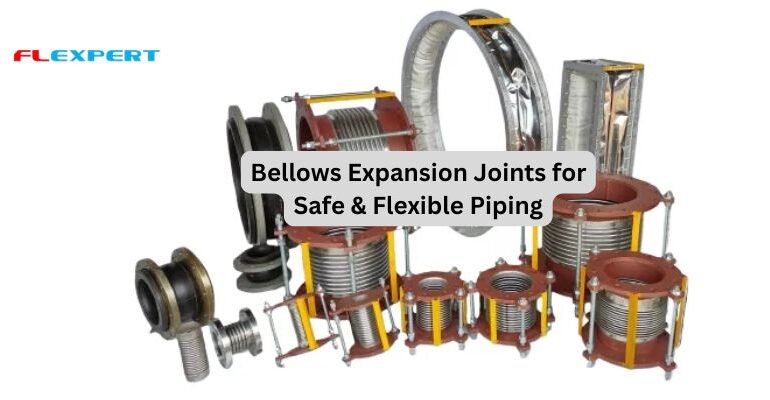
Industrial piping rarely stays perfectly still. Temperature changes, pressure shifts, equipment vibration, and everyday operation can all create movement that rigid pipes cannot comfortably absorb. That is where Bellows Expansion Joints make a practical difference, giving piping systems room to move while helping maintain reliability.
Why Do Piping Systems Need Flexibility?
Imagine installing a long metal pipeline on a hot summer afternoon. Once the system starts carrying a high-temperature fluid, the pipe heats up and expands. When the process cools, it contracts again. The movement may seem small, but across a long pipeline, even minor dimensional changes can create considerable stress.
Rigid piping can transfer that stress to connected equipment, flanges, pumps, valves, or supports. Over time, this may contribute to fatigue, leakage, misalignment, or premature component wear. Bellows expansion joints work as controlled movement absorbers, allowing the piping system to accommodate thermal and mechanical changes instead of forcing every component to carry the load.
- Thermal movement: Helps accommodate expansion and contraction caused by changing temperatures.
- Vibration: Can reduce the transmission of unwanted mechanical movement between connected equipment.
- Alignment tolerance: Properly selected designs can accommodate certain piping movements and installation variations.
How Bellows Expansion Joints Improve Piping Safety?
The heart of an expansion joint is its flexible bellows element. Instead of treating flexibility as a weakness, the design uses controlled movement to protect the larger piping arrangement. Think of it like a shock absorber in a vehicle: it does not eliminate movement, but manages it so the rest of the system experiences less strain.
Managing Thermal Expansion
Temperature is one of the most common causes of movement in industrial piping. Steam lines, exhaust systems, chemical processing equipment, and high-temperature fluid lines can all experience significant thermal cycling.
A correctly engineered bellows joint can absorb axial movement created by this temperature variation. In more complex installations, the joint may also be designed for lateral or angular movement, depending on the piping layout and operating conditions.
Reducing Stress at Equipment Connections
Pumps, turbines, compressors, boilers, and other equipment generally perform better when excessive piping loads are kept under control. A properly positioned expansion joint can help isolate movement and reduce the mechanical forces transferred into sensitive connections.
Of course, an expansion joint is not a universal fix. Its location, movement capacity, pressure rating, material, and surrounding guides and supports all need to work together. Poor installation can undermine even a well-designed product.
Choosing the Right Expansion Joint
Not every piping system moves in the same way. Before selecting a joint, engineers typically consider the operating temperature, pressure, media, available space, expected movement, cycle frequency, and piping configuration.
- Identify the movement: Determine whether the system requires axial, lateral, angular, or combined movement.
- Check operating conditions: Consider temperature, pressure, fluid characteristics, and corrosion exposure.
- Review the piping layout: Guides, anchors, supports, and joint placement can strongly influence performance.
- Consider service life: Repeated movement creates cycles, so fatigue resistance matters in demanding applications.
For a more detailed selection approach, read How to Select the Right Metal Joint for Your Project? before finalizing a product for a specific application.
Where Are Bellows Expansion Joints Used?
The versatility of metal bellows makes them useful across a wide range of industrial environments. They are often considered where piping must handle movement without sacrificing a compact installation.
- Power plants: Used in steam, turbine, exhaust, and associated piping systems.
- Petrochemical facilities: Suitable for process lines where temperature and pressure changes can be demanding.
- HVAC systems: Help accommodate thermal movement and vibration in selected heating and cooling installations.
- Chemical industries: Material selection can be matched to the process environment and operating media.
- Industrial exhaust systems: Can accommodate thermal movement and equipment-related vibration.
Why Work With an Experienced Manufacturer?
Expansion joints may look deceptively simple. In reality, bellows geometry, material thickness, ply construction, pressure conditions, movement requirements, and fatigue behavior can all influence performance. This is why choosing an experienced Expansion Bellows Manufacturer can be an important part of the procurement process.
A knowledgeable manufacturer should be able to understand the application rather than simply supply a standard component. Providing accurate operating information at the quotation stage can make a big difference. Temperature, pressure, pipe size, movement, medium, connection details, and installation conditions are all useful inputs.
Installation Matters More Than It Seems
Even a high-quality joint can perform poorly when installed incorrectly. Piping guides should control movement in the intended direction, while anchors and supports need to be positioned according to the system design. The bellows should not be treated as a convenient substitute for missing pipe supports.
A practical installation checklist includes:
- Verify the joint orientation and movement direction.
- Confirm anchors and guides are correctly positioned.
- Protect bellows from welding sparks, impact, and contamination during installation.
- Never force the joint to compensate for major piping misalignment.
- Inspect the assembly before commissioning and during planned maintenance.
Frequently Asked Questions
What is a bellows expansion joint?
A bellows expansion joint is a flexible piping component designed to accommodate controlled movement caused by factors such as thermal expansion, contraction, vibration, and selected mechanical movements.
What materials are used for metal bellows?
Material selection depends on temperature, pressure, corrosion conditions, and the process medium. Stainless steel and other suitable alloys may be selected according to the application’s engineering requirements.
Can one expansion joint handle every type of movement?
No. Different designs are intended for different movement patterns. Axial, lateral, and angular movements require appropriate joint configurations, and combined movement must be evaluated carefully during system design.
Why are anchors and pipe guides important?
Anchors and guides help direct the movement toward the expansion joint and prevent uncontrolled pipe displacement. Without proper support and guiding, the joint may experience loads or movements beyond its intended design.
Final Thoughts
Safe piping is not always about making a system more rigid. Sometimes, reliability comes from giving the system controlled freedom to move. Bellows expansion joints provide that flexibility while helping manage thermal movement, vibration, and mechanical stress. With correct selection, engineering, installation, and maintenance, they can become a quiet but valuable part of a dependable industrial piping system.
Full Audio Version: Click Here