G.D. Birla Centre for Education believes that a future-ready senior school should prepare students for more than examinations. Strong board results matter, but so do critical thinking, emotional resilience, communication, and the ability to make sound decisions. For parents exploring ICSE Higher Secondary Schools in Kolkata, the real question is whether a school prepares young people to handle life beyond the classroom.
What Does a Future-Ready Senior School Really Mean?
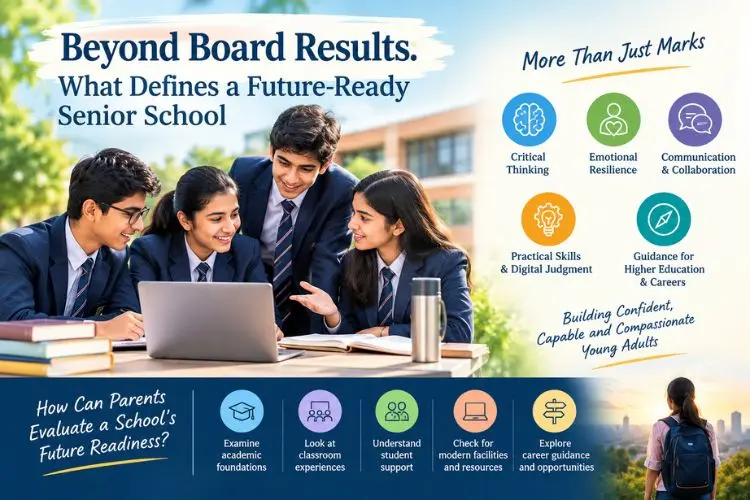
A future-ready senior school is one that combines academic achievement with practical skills, independent thinking, emotional maturity, and responsible decision-making. It equips students to adapt to changing career opportunities, evaluate information, collaborate with others, and continue learning long after graduation.
Think about two students preparing for the same examination. Both earn excellent marks. One can also analyse unfamiliar problems, explain an argument clearly, manage competing deadlines, and learn from setbacks. The other struggles when a question falls outside familiar patterns. Their results may look identical, but their readiness for the next stage of life is different.
This is why parents should look beyond a school’s published results when evaluating senior secondary education. Academic performance provides an important measure of learning, but it cannot describe every quality a young person needs to thrive.
Why Are Board Results Important but Not Enough?
Board examinations provide a useful benchmark. They encourage subject knowledge, disciplined preparation, and the ability to perform under pressure. Strong results can also support students as they apply for higher education.
However, marks alone cannot show whether a student can evaluate conflicting information, work through an unfamiliar challenge, or communicate an idea persuasively. These abilities become increasingly important at university and in professional life.
A meaningful school experience should therefore connect examination preparation with deeper understanding. Instead of memorising a scientific concept solely to reproduce it in an answer, students should also understand how that concept works in a real situation. Instead of learning an argument by heart, they should be able to examine evidence and explain their reasoning.
The goal is not to reduce the importance of results. It is to make sure that academic success develops into lasting capability.
Five Qualities That Define a Future-Ready School
1. Critical Thinking and Independent Learning
Students need opportunities to ask questions, challenge assumptions respectfully, and compare possible solutions. A classroom that welcomes thoughtful questions teaches students that learning is an active process rather than a simple transfer of information.
Parents can look for research assignments, analytical discussions, practical investigations, and projects that require students to explain how they reached a conclusion.
2. Communication and Collaboration
Knowledge becomes more useful when students can express it clearly. Presentations, group projects, debates, and structured discussions help learners organise their thoughts, listen to different perspectives, and contribute constructively.
These experiences also teach an important lesson: collaboration does not mean agreeing with everyone. It means working towards a shared goal while respecting different viewpoints.
3. Emotional Resilience and Well-Being
Senior school years can bring considerable pressure. Students may be balancing demanding subjects, competitive entrance examinations, friendships, and uncertainty about their future.
A supportive school recognises that well-being and learning are connected. Approachable teachers, appropriate pastoral support, and a culture where asking for help is acceptable can make it easier for students to recover from setbacks and stay engaged with their studies.
4. Practical Skills and Digital Judgment
Students increasingly encounter digital tools, online information, and artificial intelligence. Being future-ready means knowing how to use these resources thoughtfully, check claims against reliable evidence, protect personal information, and recognise when technology cannot replace human judgment.
Financial awareness, time management, research skills, and responsible digital behaviour are equally valuable. Schools can introduce these abilities through projects, presentations, supervised research, and everyday learning activities.
5. Guidance for Higher Education and Careers
Choosing subjects and planning for university can feel overwhelming when students have little opportunity to explore their interests. Useful career guidance helps them understand subject combinations, entry requirements, possible career pathways, and the skills different fields demand.
The strongest guidance does not push every student towards the same definition of success. It helps each learner make informed choices based on aptitude, interests, values, and realistic opportunities.
How Can Parents Evaluate a School’s Future Readiness?
Parents do not need to rely on brochures or impressive examination statistics alone. A more useful approach is to look for evidence of how students learn, interact, and prepare for life after school.
Use these five steps when comparing senior secondary schools:
- Examine academic foundations. Ask how teachers build subject understanding, address learning gaps, and prepare students for board examinations without relying exclusively on rote learning.
- Ask about classroom experiences. Find out how often students participate in projects, practical investigations, discussions, presentations, and independent research.
- Understand student support. Ask how teachers respond when students struggle academically, experience stress, or need guidance with subject choices.
- Explore future planning. Look for career counselling, higher education guidance, exposure to different fields, and support with understanding admission requirements.
- Look for consistent evidence. Ask for concrete examples of student activities and learning opportunities rather than accepting broad claims about excellence.
These steps help families compare schools on what they actually provide, not simply on how confidently they describe themselves.
Why Does the Learning Environment Matter?
A school’s environment influences how students participate in learning. Well-maintained classrooms, suitable learning resources, access to laboratories and libraries, and opportunities for sports and creative activities can support different aspects of development.
Equally important is the culture within those spaces. Students should feel comfortable asking questions, making reasonable mistakes, and seeking clarification. Teachers who set high expectations while offering constructive feedback can help students become more confident and independent.
Parents considering a Best English Medium Middle School for Girls should also think about continuity. The habits developed during middle school—curiosity, organisation, confidence, and a willingness to participate—can influence how comfortably students approach the demands of senior classes.
When exploring ICSE Board Schools in Kolkata, families should therefore consider the complete learning journey, from foundational skills to senior secondary preparation.
What Should Students Be Able to Do by Graduation?
A useful way to judge future readiness is to consider the capabilities students should gradually develop before leaving school. Ideally, they should be able to:
- Explain complex ideas clearly in writing and conversation.
- Research a question, assess evidence, and reach a reasoned conclusion.
- Manage deadlines and take responsibility for their learning.
- Work with others while respecting differences of opinion.
- Respond constructively to mistakes, feedback, and unexpected challenges.
- Make informed decisions about further education and career possibilities.
These outcomes do not emerge from a single workshop or annual event. They develop through repeated practice, thoughtful teaching, meaningful feedback, and opportunities to take responsibility.
Frequently Asked Questions
Q. What makes a senior school future-ready?
A. A future-ready senior school combines strong academics with critical thinking, communication, digital literacy, emotional resilience, and guidance for higher education and careers.
Q. Are board examination results enough to judge a senior school?
A. No. Board results indicate academic performance, but parents should also assess teaching quality, practical learning opportunities, student support, and preparation for life beyond school.
Q. Which skills should students develop before graduating?
A. Students should develop independent thinking, communication, collaboration, research skills, time management, responsible technology use, and informed decision-making.
Q. How can parents identify a future-ready school?
A. Parents can ask about classroom activities, practical projects, career counselling, student well-being, learning resources, and how teachers help students understand concepts rather than memorise answers.
Q. Why is career guidance important in senior school?
A. Career guidance helps students understand subject requirements, explore educational pathways, identify their interests, and make informed decisions about their next steps.
Conclusion
A future-ready senior school does more than help students achieve good marks. It helps them become thoughtful learners, confident communicators, responsible decision-makers, and adaptable young adults.
For parents, the most valuable question is not simply how well a school performs in examinations, but what its students learn to do with their education. Board results may open doors, but the knowledge, judgment, and character developed along the way help students decide where to go next.
Blog Development Credit
This blog was developed with insights from ChatGPT and Google Gemini, while content strategy, SEO optimisation, editorial refinement, and final publishing were managed by G.D. Birla Centre for Education.