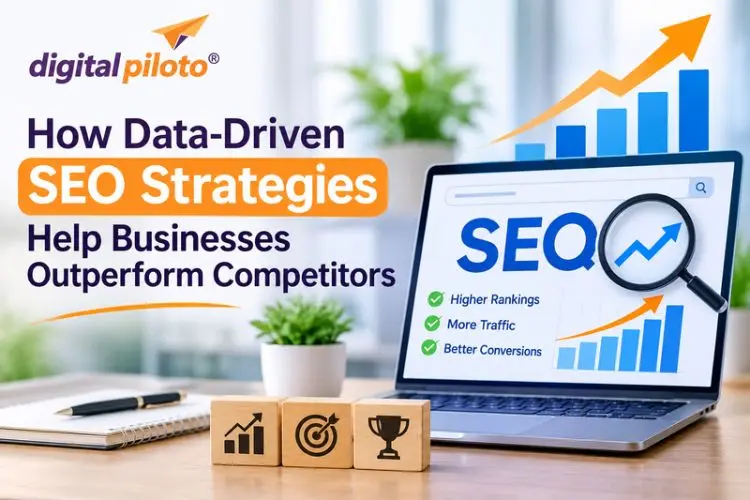
Data-driven SEO strategies help businesses outperform competitors by replacing assumptions with measurable insights. They reveal what customers search for, which pages attract qualified visitors, where competitors gain visibility, and what encourages users to convert. When businesses use these insights to guide content, technical improvements, and keyword decisions, they can build stronger organic visibility and sustainable growth.
Working with an experienced SEO Company can help businesses turn scattered search data into a practical growth strategy. However, the real advantage comes from understanding what the numbers mean and making better decisions consistently.
What Is Data-Driven SEO?
Data-driven SEO is the practice of using measurable information, including keyword performance, user behaviour, search trends, competitor activity, and conversion data, to improve a website’s organic search performance.
Instead of choosing keywords simply because they receive high search volumes, businesses examine whether those searches represent genuine customer interest. They also evaluate how visitors interact with landing pages, which content attracts backlinks, and where potential customers leave the website.
Think of it this way: traditional SEO may tell you which keywords to target, while data-driven SEO helps explain why those keywords matter, which pages deserve attention, and whether the resulting traffic contributes to business growth.
Why Does Data Give Businesses an SEO Advantage?
Search competition is rarely won by publishing the largest number of articles or targeting every popular keyword. Businesses gain an advantage when they understand their market more accurately than competing websites.
1. Better Keyword Decisions
Keyword research becomes more valuable when businesses consider search intent alongside search volume. Someone searching for “what is website hosting” is probably looking for information, while someone searching for “website development company in Hyderabad” may be comparing service providers.
These users need different content. Analysing keyword intent helps businesses create relevant landing pages, educational articles, and service descriptions instead of forcing every visitor towards the same sales message.
2. Discovering Competitor Opportunities
Competitor analysis is not about copying another company’s content. It is about identifying what competitors are doing well and finding areas they have overlooked.
For example, a competitor may rank for broad industry keywords but have limited content addressing specific customer problems. A business can use this information to develop more useful pages that answer those questions directly.
Useful competitor insights include:
- Keywords competitors rank for but your website does not.
- Pages attracting relevant organic traffic and quality backlinks.
- Content gaps where customer questions remain unanswered.
- Search results where competing pages provide outdated or incomplete information.
3. More Qualified Organic Traffic
High website traffic does not automatically mean business growth. A website receiving 10,000 irrelevant visits may generate fewer enquiries than another receiving 2,000 visitors with strong purchasing intent.
Data helps businesses distinguish between visibility and commercial value. By tracking enquiries, form submissions, calls, and other meaningful actions, marketers can identify which organic search campaigns attract potential customers rather than simply increasing visitor numbers.
How to Build a Data-Driven SEO Strategy Step by Step
A successful strategy does not require complicated reports or endless dashboards. It requires a repeatable process that connects search insights with business objectives.
Step 1: Establish Your Current SEO Performance
Start by understanding how your website performs before introducing changes. Google Search Console can reveal impressions, clicks, average positions, and search queries. Google Analytics 4 helps evaluate website engagement and conversions.
Record your existing performance so future improvements can be measured against a reliable starting point.
Step 2: Identify Valuable Search Opportunities
Combine keyword research with customer questions, competitor analysis, and existing website performance. Look for relevant searches where your website has visibility but receives relatively few clicks, as well as valuable topics where competitors have stronger coverage.
Step 3: Improve Content Based on Search Intent
Review whether each important page actually answers the question behind its target keyword. Improve missing explanations, add useful examples, remove unnecessary repetition, and organise information with descriptive headings.
For instance, a business offering web development should explain its process, technical capabilities, project approach, and support rather than relying on a page filled with generic promotional language.
Step 4: Strengthen Technical and User Experience Signals
Even excellent content can struggle when a website loads slowly, displays poorly on mobile devices, or makes important information difficult to find.
Analyse Core Web Vitals, mobile usability, indexing issues, broken links, internal navigation, and page structure. Technical improvements should make the website easier for both search engines and visitors to use.
Businesses planning these improvements should also consider working with a Hyderabad website design company to create a technically sound website that supports long-term SEO performance.
Step 5: Measure Results and Refine the Strategy
SEO is not a one-time activity. Compare performance regularly, identify changes, and investigate why certain pages improve while others lose visibility.
For example, if a service page receives increasing impressions but few clicks, its title and description may need improvement. If visitors arrive but rarely submit enquiries, examine the page’s relevance, messaging, trust signals, and conversion journey.
Which SEO Metrics Should Businesses Track?
Not every SEO metric deserves equal attention. The most useful measurements connect search visibility with actual business outcomes.
- Organic clicks: Show how many visitors reach your website through unpaid search results.
- Search impressions: Indicate how frequently your pages appear for relevant queries.
- Click-through rate: Helps evaluate how effectively search listings attract attention.
- Keyword rankings: Provide context about your visibility for important search terms.
- Organic conversions: Measure enquiries, purchases, bookings, and other valuable actions.
- Engagement and landing-page performance: Help identify whether visitors find the information they expected.
One important distinction: a ranking improvement is not necessarily a business improvement. The strongest SEO reports connect visibility, relevant traffic, and conversions instead of presenting rankings as the final measure of success.
How Does Data-Driven SEO Work Across Different Industries?
The strategy remains similar across industries, but the information businesses prioritise changes according to their customers and buying decisions.
Consider a hotel competing in a crowded destination. Search data may reveal that potential guests look for location-specific accommodation, family facilities, pricing information, and nearby attractions. Instead of publishing another generic hotel description, the business can develop useful pages addressing these specific needs.
For such businesses, targeted hotel promotion services in Hyderabad can support a more focused approach to search visibility and customer acquisition.
A similar approach works for healthcare providers, local service companies, educational institutions, and e-commerce businesses. The objective is to understand customer behaviour and build pages around genuine demand.
Common Mistakes That Weaken Data-Driven SEO
Collecting information is easy. Interpreting it correctly is where experience matters.
- Chasing search volume: Popular keywords may attract visitors who have no interest in your services.
- Ignoring conversion data: More clicks mean little if they do not contribute to business goals.
- Making decisions too quickly: Short-term ranking fluctuations do not always indicate a meaningful trend.
- Copying competitors: Their strategy may suit their audience, authority, and business model but not yours.
- Publishing without reviewing performance: Content should evolve as customer needs and search behaviour change.
Another common mistake is treating every metric as equally important. A useful SEO strategy prioritises evidence that supports a clear business decision rather than creating reports simply to show activity.
Frequently Asked Questions
Q. How does data-driven SEO improve search rankings?
A. It identifies relevant keywords, content gaps, technical problems, and user experience issues. Addressing these areas helps search engines understand website content and improves its ability to compete for relevant searches.
Q. Which tools are useful for data-driven SEO?
A. Google Search Console and Google Analytics 4 provide valuable performance insights. Tools such as Ahrefs, Semrush, and Screaming Frog can support keyword research, competitor analysis, backlink evaluation, and technical audits.
Q. How often should businesses review SEO data?
A. Businesses should monitor important performance indicators regularly and conduct a deeper SEO review monthly or quarterly. The review frequency depends on website size, competition, and marketing objectives.
Q. Can small businesses compete with established brands using data-driven SEO?
A. Yes. Small businesses can identify specific search opportunities, serve local audiences, and create more relevant content around specialised customer needs. They do not need to compete for every broad keyword to build meaningful organic visibility.
Q. How long does it take to see results from data-driven SEO?
A. SEO results depend on website condition, competition, content quality, technical issues, and industry demand. Some improvements may become visible within weeks, while meaningful and consistent organic growth often requires several months of ongoing work.
Conclusion:
Data-driven SEO gives businesses a practical way to compete more intelligently. It replaces guesswork with evidence, helps uncover overlooked opportunities, and connects search performance with customer needs.
The real competitive advantage does not come from collecting the most data. It comes from asking better questions, interpreting the answers correctly, and acting on what matters. Businesses that make this a consistent part of their SEO approach are better positioned to build lasting search visibility and sustainable growth.
Blog Development Credits:
The foundation of this content was laid by Amlan Maiti, with creation supported by AI technologies including ChatGPT, Gemini, and Copilot, and final refinement carried out by the SEO professionals at Digital Piloto Private Limited.