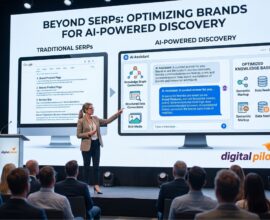
To optimize a website for ChatGPT, Google AI Overviews, and Gemini, focus on the fundamentals that make content easy to discover, understand, verify, and cite: strong technical SEO, clear answers, original expertise, structured information, and authoritative context. There is no secret “AI ranking” markup. The real opportunity is to make your website the clearest, most useful source for the questions your audience asks.
That is where a digital marketing company in Kolkata needs to rethink SEO. AI search is changing how people discover information, but it has not eliminated the importance of crawlability, relevance, helpful content, internal linking, and trust.
What Does AI Search Optimization Actually Mean?
Definition: AI search optimization is the process of improving a website so that search and generative AI systems can discover its content, understand its meaning, identify its authority, and use it as a relevant source when answering user questions.
That sounds similar to SEO because, fundamentally, it is.
Google explicitly says its AI Overviews and AI Mode rely on existing Search systems and that there are no additional technical requirements or special schema required to appear in these experiences. OpenAI likewise states that allowing OAI-SearchBot to crawl a public website helps make its content discoverable in ChatGPT Search. :contentReference[oaicite:0]{index=0}
So be skeptical of anyone promising a magic “GEO hack.” The better approach is to make your website genuinely useful and technically accessible.
1. Make Your Content Easy for AI Systems to Understand
AI systems need to interpret the relationship between your questions, answers, entities, products, services, and supporting evidence.
A page that jumps between unrelated subjects creates unnecessary ambiguity. A well-structured page makes the hierarchy obvious.
For example, instead of writing one long section about digital marketing, separate it into meaningful questions:
- What is digital marketing?
- Which channels does it include?
- How does it generate leads?
- How much does it typically cost?
- When should a business outsource it?
This structure helps human readers scan the page and makes individual concepts easier to interpret.
2. Answer the Question Before Explaining It
One of the simplest improvements is also one of the most overlooked: answer the user’s question early.
If the heading asks, “What is technical SEO?”, the first paragraph should define technical SEO clearly. Do not make the reader scroll through three paragraphs of background first.
This is especially useful for AI-driven search experiences because modern search can break complex questions into related sub-questions. Google describes this as query fan-out, where related searches may be used to gather information from multiple sources before generating a response. :contentReference[oaicite:1]{index=1}
Write sections that can stand on their own without losing their connection to the larger topic.
3. Build Content Around Real Questions, Not Just Keywords
Traditional keyword research often starts with a phrase. AI-era content should start with the underlying question.
Consider the difference between targeting:
“SEO agency Kolkata”
and developing content that also addresses:
- How do I choose an SEO agency?
- What should an SEO agency actually deliver?
- How long does SEO take to generate results?
- How can I measure SEO ROI?
- What are the warning signs of poor SEO work?
The second approach creates a deeper topical relationship around the subject.
It also mirrors how people increasingly use conversational interfaces: they ask follow-up questions, add constraints, compare alternatives, and explore a topic from several angles.
4. Demonstrate First-Hand Expertise
AI systems can summarize generic information very easily. Your competitive advantage is information that is difficult to reproduce without actual experience.
That means your website should contain observations, examples, processes, original research, case studies, expert opinions, and practical lessons wherever appropriate.
Instead of writing, “Page speed is important,” explain what happens when a slow page affects a lead-generation website. Show the problem, the diagnosis, the fix, and the measurable outcome if you have reliable data.
Information gain is your moat.
If ten competitors can publish the same advice from the same obvious sources, your version needs a reason to exist.
5. Strengthen Entity and Business Clarity
AI search does not only need to understand individual pages. It needs context about the entities mentioned within them.
Make it clear:
- Who your company is
- What products or services you provide
- Which locations you serve
- What industries or audiences you specialize in
- Who your authors and subject experts are
- How your different pages relate to one another
This is particularly important for local businesses. Your website, Google Business Profile, contact information, service descriptions, and other business references should communicate consistent information.
6. Use Structured Data—But Don’t Treat It as a Shortcut
Structured data can help search engines understand information on a page, but it should not be confused with an “AI visibility switch.”
Google specifically advises that structured data should match the visible content on the page. It also states that there is no special schema required specifically for AI Overviews or AI Mode. :contentReference[oaicite:2]{index=2}
Use appropriate structured data where it genuinely describes the page, and keep the markup accurate.
7. Make Your Website Technically Accessible
Brilliant content cannot be cited if crawlers cannot properly access or index it.
Start with the basics:
- Allow appropriate search crawlers to access important pages.
- Check robots.txt and indexing directives.
- Make important information available as text.
- Maintain useful internal links.
- Fix broken pages and incorrect canonicalization.
- Ensure important pages return successful HTTP responses.
- Monitor indexing through Google Search Console.
Google’s guidance makes this point clearly: pages need to be indexed and eligible for normal Search before they can be considered as supporting links in AI Overviews or AI Mode. :contentReference[oaicite:3]{index=3}
8. Build a Website That Answers Follow-Up Questions
This is where many websites still think too narrowly.
Someone searching “SEO audit” may next ask:
What does an SEO audit include?
Then:
How often should I perform one?
Then:
Can an audit identify why my leads are declining?
A strong website anticipates this progression and creates connected content around the entire decision journey.
Think of your website as an interconnected knowledge system rather than a collection of isolated blog posts.
Step-by-Step: Prepare a Website for AI Search
- Audit technical accessibility: Make sure important pages can be crawled and indexed.
- Map your core entities: Clarify your business, services, products, locations, experts, and relationships.
- Research conversational questions: Identify the questions customers ask before, during, and after choosing a solution.
- Build topic clusters: Connect foundational content with problem-solving and commercial pages.
- Improve answer clarity: Put concise definitions and direct answers near relevant headings.
- Add original expertise: Strengthen pages with examples, evidence, processes, and first-hand insights.
- Connect the journey: Use internal links to help users move naturally from information to evaluation and action.
- Measure outcomes: Track qualified traffic, enquiries, conversions, and AI-search visibility where available.
What About PPC in an AI-First Search Environment?
Paid search still has an important role because not every high-intent query will produce an organic or AI citation that immediately leads to a conversion.
Well-managed PPC services can capture demand while your organic strategy builds longer-term visibility and authority.
There is also a useful feedback loop. Paid campaigns can reveal which questions, messages, objections, and offers attract qualified prospects. Those insights can then influence your organic content.
How Should You Measure AI Search Visibility?
Do not reduce AI optimization to “How many times did ChatGPT mention my brand?”
Measure the business impact.
- Organic and AI-assisted referral traffic
- Qualified leads
- Conversion rates
- Engagement with commercial pages
- Brand searches and direct traffic
- Mentions or citations for important customer questions
- Revenue influenced by organic discovery
Google began rolling out dedicated Search Console reporting for visibility in generative AI features, including AI Overviews and AI Mode, in 2026, although availability is being expanded gradually. :contentReference[oaicite:4]{index=4}
The bigger lesson is simple: AI visibility should ultimately be connected to business outcomes, not treated as a vanity metric.
Does AI-Generated Content Help With AI Search?
Using AI tools for research, outlining, or editing can be useful. But publishing large volumes of generic AI-generated pages is not a shortcut to visibility.
Google’s current guidance emphasizes original, helpful, people-first content and warns that scaled content produced without adding value can violate its spam policies. :contentReference[oaicite:5]{index=5}
Use AI to accelerate your workflow if it helps. Then add what AI cannot know about your business: experience, judgment, evidence, original observations, and real customer understanding.
Frequently Asked Questions
How do I get my website into ChatGPT Search?
Make your public content accessible to OAI-SearchBot, maintain strong technical SEO, and publish relevant, trustworthy information. OpenAI notes that there is no guaranteed top placement in ChatGPT Search. :contentReference[oaicite:6]{index=6}
Do I need special schema for Google AI Overviews?
No. Google says there are no additional technical requirements or special schema specifically needed for AI Overviews or AI Mode. Foundational SEO remains important. :contentReference[oaicite:7]{index=7}
Is traditional SEO still important for AI search?
Yes. Google’s current guidance states that existing SEO best practices remain relevant because its generative AI search experiences are grounded in Search systems and indexed web content. :contentReference[oaicite:8]{index=8}
How can I make content easier for AI systems to understand?
Use clear headings, direct answers, logical sections, descriptive internal links, accurate structured data, consistent entity information, and original supporting evidence.
Can small businesses compete in AI search?
Yes. Smaller businesses can differentiate themselves through specific expertise, local knowledge, first-hand experience, original evidence, and highly relevant answers to the questions their customers actually ask.
Conclusion
Optimizing for ChatGPT, Google AI Overviews, and Gemini is not about writing for machines instead of people. It is about making your expertise easier for modern discovery systems to find, understand, verify, and connect with the right questions. The best AI-search strategy is still remarkably human: be useful, be specific, be trustworthy, and give people a reason to choose your source over the next one.
A strong SEO service strategy should therefore evolve beyond rankings alone and focus on becoming a reliable source across the increasingly conversational search journey.
Blog Development Credits
This article was conceived by Amlan Maiti, developed with AI-assisted research, and finally refined for SEO quality by Digital Piloto Private Limited.