When customers ask an AI assistant for recommendations, does your brand come to mind? That question is becoming increasingly important as people use large language models to research products, compare providers, and explore unfamiliar markets. Digital visibility is no longer only about appearing in search results; it is also about whether AI systems recognize and mention your brand when relevant questions arise.
For businesses investing in long-term growth, this introduces a new dimension of discovery: LLM brand recall. Traditional rankings and website traffic still matter, but companies must also understand how their names, expertise, and offerings appear in AI-generated responses. A strategic approach to SEO marketing in India can help establish the content quality and brand consistency needed to compete across evolving search experiences.
What Is LLM Brand Recall?
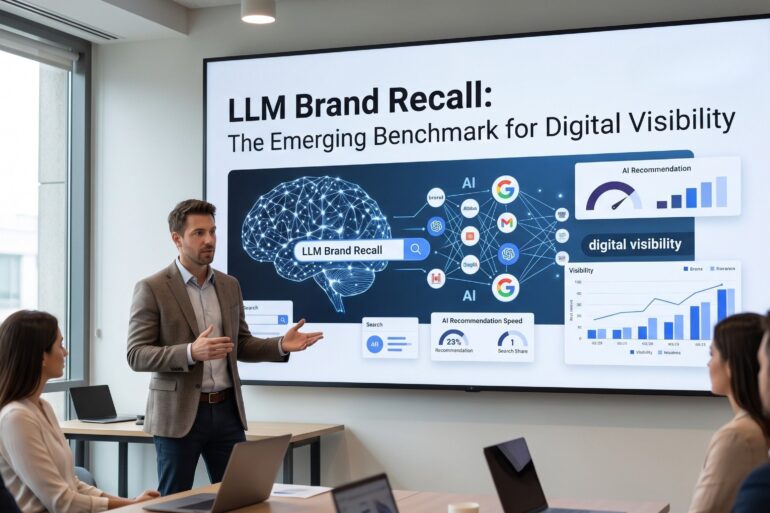
LLM brand recall describes how consistently a large language model identifies, mentions, or associates a brand with a relevant topic, product category, service, or customer need. For example, when someone asks an AI assistant to suggest reliable accounting software for a small business, which companies appear in the answer?
The concept is related to brand awareness, but the two are not identical. Traditional brand awareness explores whether people recognize or remember a company. LLM brand recall examines whether a brand appears in AI-generated responses to relevant prompts.
It is important to be precise here. An AI model mentioning a business does not prove that the model remembers it in the human sense. Responses may be influenced by available web information, retrieval systems, prompt wording, product-specific data, and other factors. Therefore, LLM brand recall is best treated as a practical measurement concept rather than a universal technical score.
Businesses can use it to investigate a straightforward commercial question: when people ask AI tools about the problems we solve, are we represented accurately and consistently?
Why Brand Recall Is Becoming More Important
Digital discovery is expanding beyond the familiar pattern of searching, clicking, and browsing several websites. AI assistants can summarize options, explain differences, and help users narrow their choices within a conversation.
Imagine a business owner researching agencies to improve online visibility. Instead of opening ten search results, the owner asks an AI assistant to compare providers based on technical expertise, industry experience, and reporting capabilities. If your company is absent from that response, you may lose an opportunity to enter the consideration set—even if your website performs well for some traditional keywords.
This does not mean that every AI recommendation replaces a website visit or a conventional search. Many users still verify claims, read reviews, inspect service pages, and contact providers directly. However, being mentioned during the research stage can influence which brands a person investigates next.
Visibility is becoming more than a ranking position
A high ranking remains valuable, but it does not tell the whole story. Brands should also examine whether AI-generated answers associate them with the correct services, industries, locations, and areas of expertise.
For instance, a software company might rank for general development terms but rarely appear when users ask about inventory automation for regional retailers. That gap could reveal an opportunity to improve its relevant content, product explanations, industry positioning, or external brand information.
There is no guarantee that improving these areas will lead to a recommendation. Still, measuring the gap gives marketers a more useful starting point than guessing why competitors appear in AI answers.
How Large Language Models Form Brand Associations
Different AI products operate in different ways. Some responses may draw heavily on information learned during model training; others may retrieve current web pages, consult connected databases, or combine several sources. Many systems use a mixture of approaches.
As a result, a brand’s visibility can depend on more than one source of information. Its website might explain its services clearly, while third-party publications, professional directories, reviews, and other credible references may provide additional context.
Four influences worth examining
- Clear brand information: The company name, services, location, and expertise should be described accurately and consistently.
- Relevant website content: Detailed service pages and genuinely useful articles help explain what the business does and which problems it addresses.
- Independent references: Credible third-party coverage and relevant professional mentions can help users verify a brand’s claims. Their influence on any particular AI system is not guaranteed.
- Contextual relevance: A brand must be relevant to the question being asked. A company specializing in ecommerce integrations may be a sensible candidate for one prompt and irrelevant to another.
The practical lesson is simple: brand visibility depends on the context in which a question is asked. Repeating a company name across hundreds of low-quality pages is unlikely to be a dependable long-term strategy. Accurate information and meaningful relevance are much stronger foundations.
Build Content That Makes Your Expertise Recognizable
LLM brand recall should not be approached as a keyword-stuffing exercise. If a business wants to be associated with a particular problem, it should demonstrate a credible understanding of that problem and explain how its services address it.
Consider a company that offers customer relationship management consulting. A single page saying “We are CRM experts” provides little context. A more useful content library might explain CRM implementation, data migration, sales pipeline design, automation, staff adoption, and common integration failures.
Each resource helps clarify a different aspect of the company’s expertise. Together, they give customers a more complete picture of what the business can do.
Develop a recognizable subject area
Start by identifying the topics most closely connected to your products, services, and customer needs. Create a central guide for each important subject, then develop supporting pages that answer specific questions in greater detail.
For example, a cybersecurity provider could cover risk assessments, employee awareness, endpoint protection, incident response, and recovery planning. The aim is not to publish everything imaginable about cybersecurity. It is to build a credible and useful collection around the areas the company genuinely serves.
Use descriptive headings, direct explanations, accurate examples, and relevant internal links. Keep related pages connected, but give every page a distinct purpose. This approach supports topical authority and makes the business’s expertise easier for human readers to understand.
Strengthen Brand Identity Beyond Your Website
Your website is a central source of information, but it is not the only place people encounter your brand. Prospective customers may consult industry publications, business directories, professional profiles, customer reviews, and partner websites before deciding whether to trust a company.
Inconsistent information creates unnecessary confusion. If one page describes a business as a software development firm while another presents it primarily as a digital marketing provider, customers may struggle to understand its main expertise.
Review the information your business publishes and maintain consistency where appropriate. Keep your official name, service descriptions, contact information, location details, and company profiles accurate. Where multiple brands or divisions exist, explain their relationships clearly.
For organizations combining marketing, technology, and customer experience, a technology solutions company in India can help align digital infrastructure with the way the business communicates its expertise across channels.
Consistency does not mean copying the same paragraph everywhere. Each profile should suit its audience and purpose while accurately describing the same underlying business.
Use Technical SEO to Support AI Discovery
Brand storytelling needs a technically sound website behind it. Important pages should be accessible, well organized, and understandable to relevant search systems. Technical SEO cannot guarantee AI mentions, but it can help prevent avoidable discovery problems.
Focus on the essentials:
- Make important pages crawlable and indexable where appropriate.
- Use descriptive page titles, headings, and URLs.
- Connect related content with useful internal links.
- Keep business information accurate and easy to locate.
- Implement structured data only when it accurately describes visible page content.
- Review mobile usability, broken links, redirects, and page performance.
Google’s SEO Starter Guide explains foundational practices for helping search engines discover and interpret web content. Its guidance on helpful, reliable, people-first content also reinforces the importance of serving real information needs.
Structured data can clarify supported details about an organization, product, or page, but it is not a guaranteed route into AI-generated recommendations. Likewise, there is no universal markup that ensures a language model will identify a brand in every relevant response.
How to Measure LLM Brand Recall
Because LLM brand recall is an emerging measurement concept, businesses should define their own testing process instead of assuming there is one standard score accepted by every platform.
Begin with a representative set of questions real customers might ask. Include broad discovery questions, service-specific questions, comparison prompts, and questions related to the problems your business solves.
For each prompt, record whether the brand appears, whether the description is accurate, and whether the response includes a source or link. Repeat the tests over time and across the AI platforms that matter to your audience.
Useful measures include:
- Mention rate: The share of tested prompts in which your brand appears.
- Context accuracy: Whether the AI correctly describes your services, products, expertise, or market.
- Competitive presence: How often your brand appears compared with relevant alternatives under comparable prompts.
- Citation presence: Whether your website or other credible sources are linked or referenced in responses.
- Business impact: Qualified visits, enquiries, conversions, and assisted outcomes where reliable attribution is available.
These measures need careful interpretation. Prompt selection can affect the results, and responses may vary with location, wording, model updates, and available information. A brand mention does not prove that a customer saw the answer or chose the company because of it.
A digital marketing agency in India can help connect AI visibility observations with wider search, analytics, and lead-generation reporting. The goal is to understand the relationship between discovery and outcomes, not to claim causation where the evidence is incomplete.
Common Mistakes That Distort Brand Visibility
As interest in AI recommendations grows, some businesses may be tempted to chase mentions instead of improving the underlying reasons a brand deserves attention.
- Testing only favorable prompts: Questions written to include your brand are unlikely to reveal how customers discover unfamiliar providers.
- Publishing repetitive content: Multiple near-identical articles can dilute quality rather than demonstrate genuine expertise.
- Ignoring inaccurate descriptions: Incorrect service details or outdated information can confuse potential customers.
- Obsessing over a single platform: Results from one AI assistant may not represent other systems or the behavior of your full audience.
- Equating mentions with sales: Visibility is an intermediate signal, not proof of commercial success.
Instead, combine consistent testing with thoughtful content improvements, clear brand positioning, and accurate business information. Treat unexpected results as signals to investigate rather than proof that one tactic works universally.
Frequently Asked Questions
1. What is LLM brand recall?
LLM brand recall is a practical way to measure how often AI language models mention or associate a business with relevant questions, topics, or services. It is a measurement concept, not a universal technical score or proof of human-like memory.
2. How can a brand improve its visibility in AI answers?
Publish useful, accurate content, explain your expertise clearly, maintain consistent business information, strengthen technical SEO, and earn credible references where appropriate. These steps can improve your digital foundations but cannot guarantee mentions or recommendations from a particular AI system.
3. Is LLM brand recall more important than Google rankings?
Neither metric replaces the other. Traditional search rankings can drive valuable traffic, while AI brand mentions may provide additional discovery opportunities. Businesses should measure both alongside qualified leads, conversions, and other outcomes relevant to their goals.
4. How often should businesses test LLM brand recall?
Start with a baseline and repeat tests on a consistent schedule, such as monthly, while monitoring significant changes in your market or content. Use the same core prompts for comparisons and document platform, wording, and date so results remain interpretable.
Final Thoughts
LLM brand recall offers businesses another way to examine digital visibility as customers increasingly use AI to explore and compare options. The strongest response is not to chase mentions at any cost, but to make the brand clear, credible, and genuinely useful within its area of expertise. When content quality, technical SEO, and consistent measurement work together, businesses are better prepared for an evolving discovery landscape.
Blog Development Credits
Amlan Maiti developed the original concept, with AI-assisted research and drafting followed by editorial refinement and search optimization from Amlan Maiti and Digital Piloto Private Limited.