Imagine visiting a travel website without actually opening it yourself. Your AI assistant checks available hotels, compares prices, reviews cancellation policies, and prepares a booking while you continue working. You only step in when a decision needs your approval. It sounds futuristic, but the technology required for parts of this experience is already taking shape.
This emerging model is known as the Agentic Web. It could change the way businesses design websites, provide information, and connect with customers. For organizations investing in digital marketing services in India or expanding into international markets, the challenge is no longer limited to attracting human visitors. Websites may increasingly need to serve intelligent systems acting on those visitors’ behalf.
But does that mean websites will eventually become invisible interfaces used primarily by machines? Not necessarily. The more interesting possibility is that the internet will develop two connected experiences: one designed for human exploration and another supporting machine-assisted actions.
What Is the Agentic Web?
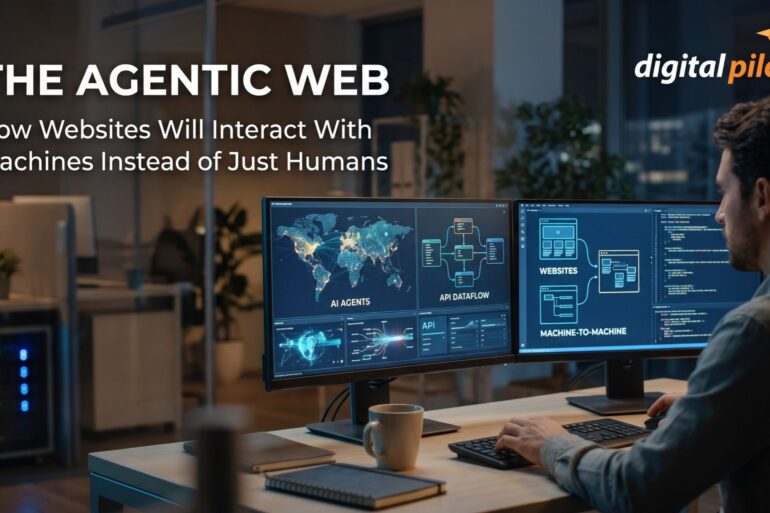
The Agentic Web is an emerging model of the internet in which AI agents can discover information, interact with websites or connected services, and perform authorized tasks on behalf of people or organizations. Instead of merely displaying content for visitors to read, websites may also expose information and capabilities that intelligent software can use.
Consider the difference between searching for a product and asking an assistant to help purchase it.
In conventional ecommerce, customers typically visit a website, compare products, select variations, add items to a cart, and proceed to checkout. In an agent-assisted experience, software may handle selected stages, such as gathering specifications or assembling options, before asking the customer to approve the purchase.
The website still performs essential business functions. Its role simply extends beyond displaying pages to people.
From the Readable Web to the Actionable Web
For decades, websites have focused on helping people find and consume information. Search engines introduced another important audience: automated crawlers that discover pages and organize their contents.
AI agents introduce an additional category of interaction.
A search crawler generally discovers information for indexing or retrieval. A user-directed agent may need to accomplish a particular task, such as comparing available appointments, creating a reservation request, or retrieving an order status.
That changes what successful interaction looks like.
For a crawler, discovering an accurate service page may be enough. For an authorized booking agent, understanding the service is only the beginning. It must also navigate availability, permissions, booking requirements, and confirmation steps.
The Agentic Web is therefore not simply another name for AI search. It describes a broader possibility: websites becoming participants in software-assisted workflows.
Why the Traditional Website Model Is Evolving
Think about a customer planning to renovate a home. They might visit several websites to explore interior design companies, compare project portfolios, review services, and request estimates.
Each website offers useful information, but the customer has to coordinate the entire process.
An AI assistant could potentially help organize that research, identify suitable providers, prepare questions, and submit enquiries through supported interfaces.
For the customer, the advantage would be less administrative effort. For the business, the opportunity could involve receiving enquiries from people who have already clarified their requirements.
However, the results would depend on information quality, agent capabilities, website accessibility, and customer authorization.
Not every interaction would benefit from automation. Many customers still want to browse, evaluate portfolios visually, speak directly with experts, and develop confidence before making a decision.
The Rise of Machine-Initiated Website Activity
Machine-generated traffic is already an important part of internet infrastructure, although not all automated requests come from AI agents.
In an August 2026 analysis, Cloudflare reported that fewer than half of the HTML page requests within its measured traffic came from humans.
This finding requires careful interpretation. The measurement concerns requests observed on Cloudflare’s network, and non-human requests include different kinds of automated systems. It does not demonstrate that autonomous AI shopping agents are responsible for most web traffic.
Nevertheless, it highlights an important reality: human visitors are not the only systems interacting with websites.
The next challenge is distinguishing ordinary crawling, automated monitoring, malicious bots, and legitimate agents acting on behalf of customers.
How Will AI Agents Interact With Websites?
There is unlikely to be one universal method through which every AI agent communicates with every website.
Different systems already use different approaches, including browser-based interaction, structured APIs, connected applications, and emerging protocols.
Understanding these differences is essential for businesses deciding where to invest.
1. Browser-Based Interaction
Some AI agents interact with websites through browser interfaces, much as a person would.
They may navigate pages, interpret visible information, select controls, and complete permitted steps within a workflow.
OpenAI’s agent-access documentation describes cloud-browser visits that occur on a user’s behalf and are distinct from its regular search crawlers.
This distinction matters to website owners.
A site that is accessible to a search crawler may still present difficulties to a browser-based agent because of complicated forms, inaccessible controls, security challenges, or unexpected interaction patterns.
The solution is not to remove security measures. It is to ensure that legitimate interactions remain understandable and appropriately authorized.
2. API-Based Communication
An application programming interface, or API, provides a structured way for software systems to exchange information or request actions.
Instead of navigating a hotel’s booking interface visually, an authorized agent might communicate with a supported availability API.
The API could return available rooms, rates, conditions, or other permitted information in a structured format.
This approach may be more predictable for particular workflows because the interface defines expected inputs, outputs, and errors.
However, APIs require appropriate authentication, validation, rate limiting, maintenance, and commercial agreements where relevant.
A business should not expose sensitive operations merely to make its website appear more agent-friendly.
3. Agent Protocols and Connected Tools
Emerging technical standards are also attempting to make interactions between AI systems and external tools more consistent.
The Model Context Protocol (MCP) provides a standardized approach for connecting AI applications with tools and data sources.
Meanwhile, Google’s Agent2Agent protocol, announced in April 2025, focuses on enabling agents from different systems to communicate and coordinate work.
These protocols address related but distinct technical problems.
MCP can support connections between AI applications and available tools. A2A focuses on cooperation between agents. Neither means that every ordinary business website must immediately implement a new protocol to remain searchable.
What Makes a Website Agent-Ready?
An agent-ready website is one that supports the information access and legitimate interactions required by the AI agents relevant to its users.
That does not necessarily require a dedicated AI interface.
For many organizations, improving existing website fundamentals may be the most valuable first step.
An ecommerce store, for example, needs accurate prices, product identifiers, stock information, and clear purchase conditions. A service provider may need understandable service descriptions, legitimate location information, enquiry methods, and reliable contact details.
The appropriate technical requirements depend on what customers want agents to accomplish.
Four Practical Layers of Agent Readiness
| Readiness Layer | Main Requirement | Business Example |
|---|---|---|
| Accessibility | Legitimate systems can retrieve relevant information | An agent can access a public product description |
| Understandability | Information is accurate, clear, and appropriately structured | A product’s size and specifications can be identified |
| Actionability | Supported operations can be performed through approved interfaces | An authorized agent prepares a booking request |
| Governance | Access, authentication, permissions, and consequences are controlled | A purchase requires confirmation before payment |
These four layers are a practical website evaluation framework, not official search-engine ranking factors.
They help businesses distinguish between a website that can be read by software and one that can safely participate in a transaction.
Why Structured Information Matters More Than Ever
Websites frequently contain valuable information that is difficult to interpret without additional context.
A hotel may advertise accommodation starting from a particular price, but that price could apply only on selected dates. A supplier might list several product variants without explaining which specifications belong to each one.
These ambiguities can confuse human visitors and complicate automated interpretation.
Structured product records, clear headings, descriptive labels, accurate metadata, and relevant structured data can help communicate information more consistently.
For example, a machine-readable product catalog may distinguish the product name from its price, availability, dimensions, and delivery conditions.
Still, structured data must accurately represent the underlying content.
Adding markup to a website does not guarantee AI visibility, and invalid or misleading information may create additional problems rather than resolve them.
Human-Friendly and Machine-Readable Are Not Opposites
A common misconception is that agent-ready websites must abandon visual design and become technical databases.
In reality, a website can provide a rich visual experience while maintaining clear content, accessible controls, and structured information.
A furniture store might offer interactive room inspiration for human visitors while keeping product dimensions, materials, prices, and availability consistently accessible to supported systems.
The objective is not to build two unrelated websites.
It is to maintain one dependable source of business information that can support different forms of interaction.
Will AI Agents Replace Website Visitors?
AI agents may handle more browsing and research tasks, but there is no reliable evidence that human website visits will disappear.
People visit websites for reasons that extend beyond completing transactions.
They explore brands, seek reassurance, evaluate design, read customer experiences, and sometimes enjoy the process of discovering something new.
Consider someone choosing an interior designer for a family home. An agent might compare services and shortlist companies, but the customer may still want to explore completed projects and speak with the design team.
Similarly, an AI assistant could help identify suitable wedding photographers without replacing the emotional response people have when viewing portfolios.
Agentic interaction is therefore better understood as an additional route through the customer journey, not an inevitable replacement for the human experience.
The Agentic Web Could Change Ecommerce
Ecommerce is one of the most tangible areas where AI-assisted website interaction is developing.
Instead of moving manually through separate product pages, customers may increasingly use conversational assistants to identify products, compare alternatives, and complete supported purchasing workflows.
In September 2025, OpenAI introduced Instant Checkout alongside the Agentic Commerce Protocol, developed with Stripe.
The official OpenAI announcement described a framework for connecting AI-assisted shopping with merchant transactions.
Google has also published its Universal Commerce Protocol, which supports compatible commerce interactions involving AI experiences, merchant systems, and checkout processes.
These developments demonstrate meaningful progress, but merchant eligibility and the available capabilities depend on platform-specific integrations.
What Happens to the Traditional Shopping Funnel?
The conventional ecommerce funnel often moves from discovery to product evaluation, cart creation, checkout, and order fulfillment.
An AI-assisted experience can potentially bring several stages into one conversation.
For example, a customer could ask an assistant to find a durable office chair within a specified budget, compare warranty conditions, and prepare an order.
An authorized system might retrieve product information from participating merchants and guide the customer toward a supported checkout process.
However, the merchant remains responsible for providing accurate information and fulfilling its commercial obligations.
Autonomous purchasing also introduces additional questions about payment authorization, delivery instructions, returns, customer identity, and dispute handling.
Convenience alone will not solve those problems.
How the Agentic Web Could Change SEO and GEO
For years, SEO has helped businesses make useful pages discoverable through search engines.
The Agentic Web introduces an additional concern: can an intelligent system not only locate the information but also understand it accurately and interact with the relevant service?
This creates a useful distinction between conventional search visibility and agentic task completion.
A website may be indexed in Google Search while lacking any supported interface for scheduling an appointment automatically.
Likewise, a website might offer an excellent API without having informative public pages that answer customers’ questions.
Both capabilities can matter, but they serve different purposes.
Traditional SEO Remains a Foundation
Google’s official AI Search optimization guide continues to emphasize useful original content, crawlability, technical clarity, and reliable information.
These principles remain relevant because AI-supported discovery still depends on the availability and usefulness of information.
Google does not require every website to implement MCP, A2A, or a special AI file for inclusion in its generative Search experiences.
Businesses should therefore avoid confusing experimental agent protocols with mandatory SEO requirements.
AI Search Visibility Requires Platform-Specific Thinking
Google Search, ChatGPT, Perplexity, and Bing/Copilot do not operate through one publicly documented universal retrieval system.
OpenAI, for instance, distinguishes its search crawler from user-triggered fetching and other agent interactions.
Organizations exploring a ChatGPT business listing agency should first examine the accuracy of their public business information, relevant search accessibility, and how their brand is represented in actual AI responses.
No agency can guarantee that a particular business will be cited, recommended, or selected by every AI platform.
A credible strategy should separate technical access, information accuracy, search visibility, user-directed interactions, and commercial results.
Security Could Become the Biggest Agentic Web Challenge
A website reading information and a website performing actions are two very different risk situations.
An AI agent comparing published product specifications usually needs limited access. An agent updating customer information or placing an order may require authentication and permission to perform consequential actions.
Those actions can affect real people, financial transactions, and business operations.
A poorly controlled integration could allow unintended changes, excessive data access, or transactions without adequate confirmation.
Businesses need to determine which operations agents may perform, what information they may access, and when human authorization is required.
Agent Identity and Verification
One emerging challenge is identifying whether an automated visitor is genuinely associated with a trusted system.
User-agent strings alone are not always sufficient proof of identity because they can be imitated.
Cloudflare has discussed Web Bot Auth as an approach to improving agent authentication and publisher control.
For website owners, the broader principle is straightforward: identity and permissions should be verified through appropriate security mechanisms rather than trusting a request simply because it claims to come from an AI agent.
Human Approval for Important Actions
Some tasks can reasonably be automated with limited risk. Others require explicit confirmation.
Preparing a comparison report is different from authorizing a payment. Checking available appointment times is different from canceling an existing booking.
The more significant the consequence, the stronger the case for clear authorization, validation, logging, and recovery procedures.
An agent-friendly website must also remain a secure website.
Should Every Business Build an Agent-Ready Website?
Every business should consider whether its website provides accurate, accessible information. Not every business needs to invest immediately in advanced agent-specific infrastructure.
The decision depends on customer needs, transaction complexity, existing technology, and the availability of genuinely supported integrations.
A publishing website may benefit primarily from clear content, reliable metadata, and appropriate crawler access.
An ecommerce company may have stronger reasons to investigate structured product feeds and supported commerce protocols.
A travel business could eventually benefit from authorized availability and booking integrations.
A professional services company may find that improving enquiry forms and service information creates more value than developing autonomous transaction capabilities.
The correct investment should follow the customer journey, not the latest technology headline.
A Practical Framework for Agentic Website Readiness
Businesses can begin by assessing their current technical foundation before introducing more advanced integrations.
The following process is intended as a practical planning framework, not a mandatory checklist imposed by a search engine.
- Audit the website’s public information. Check service details, product descriptions, prices, locations, contacts, and applicable policies.
- Review technical accessibility. Examine important URLs, server responses, rendering, navigation, and relevant crawler permissions.
- Check structured information. Ensure applicable schema, product feeds, and internal data accurately represent visible business facts.
- Map possible agent tasks. Identify customer activities that could benefit from assisted research, form completion, booking, or supported transactions.
- Define authorization boundaries. Decide which actions require authenticated access, customer approval, or staff review.
- Evaluate integrations selectively. Investigate relevant APIs or protocols only when supported by the intended platform and justified by business needs.
- Test and measure. Review accessibility, task success, errors, security behavior, customer experience, and commercial outcomes.
This approach allows a business to improve its existing website while making evidence-based decisions about future agent capabilities.
What Should Website Developers Prioritize?
Developers preparing websites for AI-assisted interaction should concentrate on reliable interfaces and clearly defined behavior.
Accessible HTML, properly labeled form elements, meaningful navigation, and predictable error handling already help human visitors and assistive technologies.
These foundations may also improve the reliability of certain browser-based agent interactions.
Developers should additionally consider API security, authentication, rate limits, data validation, consent management, and operational monitoring where external actions are supported.
Modern websites frequently use JavaScript frameworks, and those technologies are not automatically incompatible with search or AI agents.
The correct approach is to test how important information and controls are exposed in the actual environment.
WebMCP and Emerging Browser Capabilities
Another development worth watching is WebMCP, an emerging proposal involving browser-accessible tools that websites can expose to AI agents.
The World Wide Web Consortium discussed WebMCP in October 2026 as an incubating interface that could allow web applications to describe available functionality in structured forms.
This is relevant because an agent may be able to use a defined action rather than relying exclusively on visual navigation.
However, WebMCP remains an emerging area. Website owners should not assume universal browser support or treat it as an established SEO requirement.
How Businesses Can Measure Agentic Web Performance
One of the biggest challenges will be measuring whether AI-agent interactions produce meaningful business value.
Traditional website analytics frequently focus on visits, engagement, traffic sources, and conversions.
Agent-assisted journeys can create additional measurement requirements.
An assistant may research several websites without generating an ordinary referral visit. In other circumstances, a customer might arrive directly from an AI response. Supported transaction integrations may also generate merchant-side events that differ from conventional web sessions.
Businesses should distinguish these outcomes rather than combining them under one vague AI visibility score.
Useful measurements may include verified agent requests, successful task completion, failed actions, authorized transactions, AI-referred customer sessions, order value, qualified enquiries, and support incidents.
The measurement approach must reflect the actual integration and respect user privacy.
The Future of Websites: Human Experience and Machine Collaboration
It is tempting to imagine that future websites will become invisible databases while AI assistants handle every interaction.
Some routine tasks may move in that direction, particularly where customers value speed and the actions can be standardized safely.
But the web supports much more than efficient transactions.
People use websites to discover ideas, explore creative work, understand organizations, seek expertise, and develop relationships with brands.
A beautifully designed travel website may inspire someone to visit a destination they had never considered. An architectural portfolio may communicate taste and craftsmanship in ways that a brief AI summary cannot fully reproduce.
The most useful future is therefore not necessarily a machine-only web.
It may be a web in which websites provide both rich human experiences and secure, structured capabilities for authorized software interactions.
Digital Piloto’s Strategic Perspective
For businesses planning their next website investment, the sensible approach is to build on existing SEO, content, accessibility, security, and conversion fundamentals.
Agent readiness should be evaluated according to actual business requirements rather than speculative ranking advantages.
Digital Piloto’s recommended approach is to connect website strategy with search discoverability, accurate business information, relevant AI retrieval systems, and customer-centered interactions.
Companies searching for best SEO services India should evaluate whether a provider can explain the differences between conventional SEO, generative search visibility, and agent-specific website capabilities.
These disciplines overlap, but they are not interchangeable.
A useful website modernization plan begins by identifying customer problems and technical limitations before recommending additional integrations.
Frequently Asked Questions
What is the Agentic Web?
The Agentic Web is an emerging model in which AI agents can access website information and perform supported tasks on behalf of users. Depending on the system, interactions may occur through browser interfaces, APIs, or specialized protocols. Important actions still require appropriate permissions and safeguards.
How is the Agentic Web different from traditional SEO?
Traditional SEO focuses on making useful content discoverable and eligible for relevant search experiences. Agentic website readiness considers whether authorized software can also complete defined tasks. The two areas share technical foundations, but agent interaction introduces additional requirements involving permissions, interfaces, and security.
Do websites need MCP or A2A to become agent-ready?
No. MCP and A2A address particular forms of tool integration and agent communication. They are not universal requirements for every website or for Google Search visibility. Businesses should evaluate these technologies only when their actual use cases and supported platforms justify implementation.
Will AI agents replace human website visitors?
AI agents may handle more research and routine transactions, but human website experiences remain important for discovery, evaluation, creativity, trust, and complex decisions. The likely direction is a combination of human browsing and machine-assisted interaction rather than complete replacement.
How can an ecommerce website prepare for agentic shopping?
An ecommerce business can begin with accurate product information, reliable inventory, clear policies, technical accessibility, and secure checkout processes. Supported agentic commerce integrations can then be evaluated according to merchant eligibility, customer demand, implementation cost, and operational readiness.
Can making a website agent-friendly guarantee AI visibility?
No. Agent-friendly design, structured information, and appropriate technical access can support particular interactions, but they do not guarantee search rankings, AI citations, recommendations, or transactions. Results depend on platform behavior, customer needs, competition, technical implementation, and other factors.
Final Thoughts: The Web Is Becoming More Interactive
The Agentic Web represents an important evolution in how people and software may interact with online businesses.
Instead of relying entirely on manual navigation, customers may increasingly delegate selected tasks to intelligent assistants. Websites that support those interactions could create new opportunities for convenience, service delivery, and commerce.
But readiness should never come at the expense of accuracy, security, accessibility, or customer trust.
The strongest websites will continue serving people while gradually introducing reliable capabilities for the machines acting on their behalf.
The future of the web is not humans versus AI agents. It is a more connected digital environment where both can interact with businesses effectively.
For businesses evaluating this transition, Digital Piloto can help assess existing website fundamentals, SEO visibility, AI search readiness, and appropriate opportunities for modernization.