
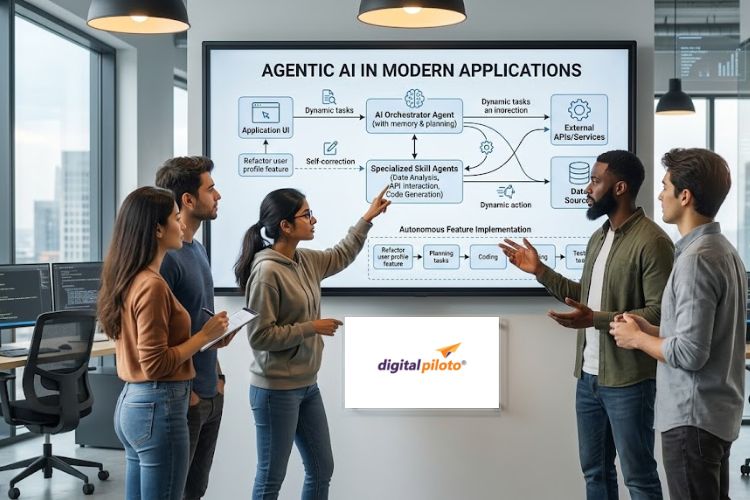
Agentic AI is changing the way software works by enabling systems to make decisions, take actions, adapt to situations, and complete goals with minimal human intervention. Unlike traditional AI models that simply respond to commands, Agentic AI can plan, reason, execute tasks, and improve outcomes through continuous interaction with its environment.
This shift is already influencing industries ranging from healthcare and finance to logistics and customer service. Businesses investing in intelligent systems and Custom App Development are increasingly exploring how autonomous AI agents can reduce manual effort while improving speed, accuracy, and scalability.
What Is Agentic AI?
Definition
Agentic AI refers to artificial intelligence systems that can independently pursue goals, make decisions, execute actions, and adjust strategies without requiring constant human instructions.
Traditional AI answers questions or performs isolated tasks. Agentic AI goes a step further by deciding what actions should happen next in order to achieve a defined objective.
Think of it as the difference between a calculator and a project manager. One performs a calculation when asked. The other organizes tasks, coordinates actions, and works toward an outcome.
Why Is Agentic AI Emerging Now?
The rise of large language models, improved reasoning capabilities, and access to connected business systems has created the ideal environment for Agentic AI.
Organizations no longer want AI that simply generates content or summarizes information. They want AI systems that can execute workflows, automate decisions, and handle operational complexity.
Several factors are driving adoption:
- Improved language reasoning capabilities.
- Integration with APIs and business software.
- Growing demand for automation.
- Increasing operational costs.
- Advancements in machine learning infrastructure.
The market is moving from AI assistance toward AI execution.
How Does Agentic AI Work?
Step-by-Step Process
- The AI receives a goal or objective.
- It analyzes available information and constraints.
- It creates an execution plan.
- It performs actions using connected tools or systems.
- It evaluates outcomes and adjusts if necessary.
- It continues until the objective is achieved or intervention is required.
This ability to plan and adapt is what separates Agentic AI from traditional automation systems.
Real-World Applications of Agentic AI
While the concept sounds futuristic, many organizations are already implementing practical use cases.
Customer Service Automation
AI agents can resolve support tickets, escalate complex issues, retrieve information from internal systems, and follow up with customers automatically.
Supply Chain Optimization
Agentic systems can monitor inventory levels, predict shortages, and reorder stock based on demand forecasts.
Healthcare Coordination
AI agents can assist with appointment scheduling, patient communication, documentation, and administrative workflows.
Financial Operations
Businesses use AI agents to identify anomalies, process transactions, and generate compliance reports.
Marketing Campaign Management
Future AI systems may launch campaigns, adjust budgets, optimize targeting, and report results with limited human supervision.
How Agentic AI Differs from Traditional AI
| Traditional AI | Agentic AI |
|---|---|
| Responds to prompts | Pursues goals autonomously |
| Performs single tasks | Manages workflows |
| Requires frequent instructions | Operates with minimal guidance |
| Limited context awareness | Adapts based on changing conditions |
This evolution represents one of the most important transitions in artificial intelligence since the introduction of machine learning models.
What Challenges Must Businesses Consider?
Greater autonomy creates greater responsibility.
Organizations implementing Agentic AI must consider governance, transparency, security, and human oversight from the beginning.
Important considerations include:
- Decision transparency and explainability.
- Data privacy and security.
- Regulatory compliance.
- Human intervention mechanisms.
- Performance monitoring.
The most successful implementations combine AI autonomy with human accountability.
The Role of Software Development in Agentic AI
Agentic AI systems rely heavily on robust infrastructure and seamless integration with business applications.
Organizations investing in Custom Software Development are increasingly designing applications that allow AI agents to communicate with databases, APIs, customer platforms, and operational systems.
The future will likely belong to businesses that build software ecosystems designed specifically for autonomous collaboration between humans and AI agents.
What Does the Future Look Like?
Over the next few years, we are likely to see AI agents move from assistants to digital teammates.
They may manage projects, coordinate departments, optimize workflows, and support strategic decisions in ways that feel remarkably human.
The businesses that prepare early will have an opportunity to redesign processes rather than simply automate existing inefficiencies.
Frequently Asked Questions
What is Agentic AI?
Agentic AI refers to AI systems capable of making decisions and taking actions independently to achieve specific goals.
How is Agentic AI different from generative AI?
Generative AI creates content or responses, while Agentic AI plans, executes tasks, and manages workflows autonomously.
Which industries can benefit from Agentic AI?
Healthcare, finance, logistics, retail, manufacturing, and customer service are among the industries already exploring its applications.
Will Agentic AI replace human workers?
Most implementations focus on augmenting human capabilities by automating repetitive work and improving productivity.
Is Agentic AI safe for business use?
Yes, provided organizations implement governance frameworks, monitoring systems, and human oversight mechanisms.
Conclusion
The rise of Agentic AI represents a significant shift in how software interacts with the world around it. Instead of waiting for instructions, modern AI systems are beginning to understand objectives and work toward outcomes. Businesses that embrace this transition thoughtfully may discover that the next generation of applications will not simply support decisions—they will actively participate in achieving them.
Blog development Credits
This article was inspired by the strategic vision of Amlan Maiti, developed using insights from advanced AI technologies and refined with final optimization expertise from Digital Piloto.