
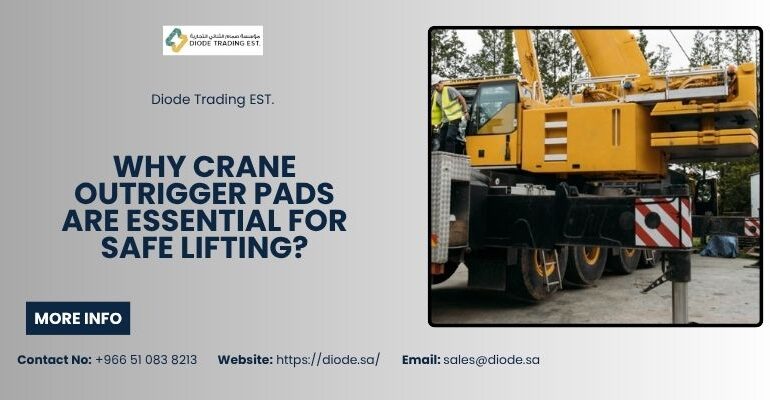
Crane outrigger pads are essential for safe lifting because they distribute the crane’s concentrated outrigger loads over a larger ground area, helping reduce excessive ground pressure, settlement, and instability. When correctly selected and used, a Crane Outrigger Pad in Saudi Arabia can provide a more stable interface between the crane and the supporting surface.
What Are Crane Outrigger Pads?
Crane outrigger pads are load-spreading supports positioned beneath a crane’s outriggers. They provide a larger contact area between the outrigger and the ground, helping transfer concentrated loads into the supporting surface more effectively.
This matters because a crane does not distribute its operating weight evenly across the entire machine footprint. During lifting, substantial forces can be concentrated through individual outriggers, especially when the boom is extended and the load is positioned away from the crane’s center.
Why Do Outriggers Need Additional Ground Support?
Outriggers extend from the crane to improve stability by creating a wider support footprint. However, simply extending them does not guarantee that the ground can safely carry the resulting load.
Consider a crane positioned on compacted soil. Even if the surface appears firm, concentrated outrigger pressure can cause localized settlement. If one support settles more than another, the crane’s level and stability can change during the lift.
Outrigger pads address this problem by increasing the effective bearing area and helping distribute the load more broadly.
The key safety benefits include:
- Load distribution: Spreads concentrated outrigger forces over a larger area.
- Reduced ground pressure: Helps lower the pressure applied at the supporting surface.
- Improved stability: Helps maintain a more consistent support condition during lifting.
- Ground protection: Can reduce surface damage, rutting, and localized deformation.
- Better setup control: Provides a defined support interface beneath each outrigger.
How Do Outrigger Pads Improve Crane Stability?
The basic principle is straightforward: pressure depends on both load and contact area. Increasing the area over which an outrigger load is transferred can reduce the average pressure applied to the supporting ground.
For example, placing an outrigger directly on a relatively small contact point can concentrate force into a limited area. A properly designed pad creates a larger bearing surface, allowing the force to be distributed more widely.
However, an important engineering point is often missed: a larger pad does not automatically make every lift safe. The pad must have sufficient capacity and stiffness, and the supporting ground must also be capable of carrying the transferred load.
How Should Crane Outrigger Pads Be Selected?
Pad selection should be based on the actual lifting conditions rather than simply choosing the largest or thickest available option.
Step 1: Determine the outrigger reaction
The maximum expected load at each outrigger should be established from the crane configuration, load chart, operating radius, boom arrangement, and planned lift.
Step 2: Assess the supporting surface
Consider whether the crane will operate on compacted soil, asphalt, concrete, gravel, or another surface. Ground condition can vary significantly even within the same worksite.
Step 3: Calculate the required bearing area
The required pad size should be evaluated against the anticipated outrigger reaction and allowable ground bearing pressure. This is where proper engineering judgment becomes important.
Step 4: Check pad capacity and stiffness
The pad must be strong enough to carry the load without excessive bending, cracking, crushing, or other failure. A pad that looks substantial may still be unsuitable if its material or construction cannot handle the actual loading condition.
Step 5: Verify the final setup
Before lifting, confirm that each pad is properly positioned, fully supported, and appropriately aligned with the outrigger. The crane should be configured according to the manufacturer’s instructions and the site’s lifting plan.
Why Pad Material Matters?
Crane pads are available in different materials and designs, including engineered plastics, composite materials, timber-based solutions, and other load-bearing systems. The right choice depends on the application and required load capacity.
A quality pad should offer a combination of load capacity, dimensional stability, durability, and practical handling characteristics. In busy industrial environments, lighter engineered pads can also be easier to transport and position than very heavy traditional alternatives.
For projects requiring dependable equipment support, working with an experienced Outrigger Pads Supplier in Saudi Arabia can help ensure that the selected product matches the intended crane application.
What Can Happen Without Proper Outrigger Support?
Using inadequate support can create several risks. The most obvious is ground settlement, but the consequences can extend beyond surface damage.
- Outrigger pads may sink or tilt under load.
- The crane may move away from its intended level position.
- Ground deformation can reduce effective support during the lift.
- Asymmetric settlement can affect crane stability.
- Expensive surfaces such as asphalt or finished concrete may be damaged.
These risks become particularly important when working near excavations, underground services, weak fill, drainage structures, or recently disturbed ground.
How Can Operators Use Outrigger Pads More Effectively?
Using the right pad is only part of the safety equation. Installation and site preparation matter just as much.
Before deployment, inspect the support area for voids, soft spots, slopes, debris, underground hazards, and other conditions that could compromise bearing. Pads should sit as intended and should not bridge unsupported areas.
Operators should also follow the crane manufacturer’s setup requirements and the project’s approved lifting plan. Outrigger pads are an engineering control, not a substitute for proper crane operation or ground assessment.
When Are Crane Outrigger Pads Especially Important?
Outrigger pads become particularly valuable when a crane is operating on surfaces where concentrated loading could cause deformation or when ground capacity is a significant consideration.
- Construction sites with variable soil conditions.
- Heavy lifting operations with high outrigger reactions.
- Work near roads, paved areas, or finished surfaces.
- Sites where repeated crane setups can damage the ground.
- Projects requiring controlled and repeatable crane positioning.
Frequently Asked Questions(FAQs):
1. What is the main purpose of a crane outrigger pad?
Its main purpose is to spread the outrigger load over a larger area, helping reduce concentrated ground pressure and improve the stability of the crane setup.
2. Are larger outrigger pads always safer?
No. Pad size must be matched to the outrigger load, pad capacity, and supporting ground conditions. Oversizing alone does not guarantee safe lifting.
3. Can outrigger pads prevent ground damage?
They can significantly reduce localized pressure and help minimize deformation, but they cannot compensate for ground that is fundamentally unsuitable for the crane load.
4. What should be considered when choosing an outrigger pad?
Important factors include maximum outrigger reaction, ground bearing capacity, pad dimensions, material strength, stiffness, durability, and the specific crane configuration.
5. Are outrigger pads required for every crane lift?
The requirement depends on the crane manufacturer’s instructions, site conditions, lifting plan, and applicable safety requirements. A competent person should determine the appropriate support arrangement.
Final Thoughts
A crane’s lifting performance depends on more than its boom, hook, and load chart. The ground beneath its outriggers is part of the lifting system too. Properly selected crane outrigger pads help create a stronger, more controlled connection between the machine and the supporting surface.
The practical lesson is simple: never treat ground support as an afterthought. Assess the load, understand the ground, select suitable pads, and follow the approved lifting procedure. That combination is what turns outrigger support from a simple accessory into an important part of safe crane operations.
Full Audio Version:- Click Here