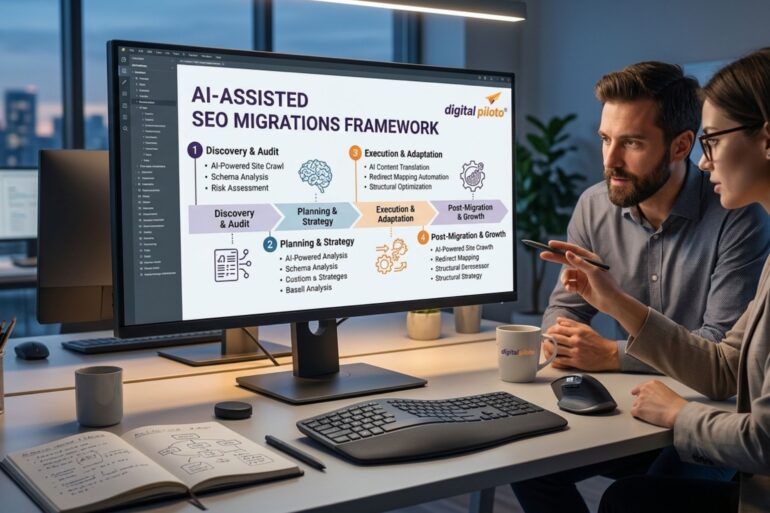
AI-Assisted SEO Migrations Framework is a structured approach that uses artificial intelligence to plan, monitor, and optimize website migrations while protecting search visibility. It helps businesses reduce ranking losses, identify technical risks early, preserve valuable SEO assets, and ensure a smoother transition when changing domains, platforms, site structures, or technologies.
For any digital marketing company, website migration is one of the highest-risk projects in digital growth. A single mistake in redirects, indexing, or URL mapping can erase years of SEO progress. AI is transforming this process by providing predictive insights, automation, and real-time analysis that significantly reduce migration risks.
What Is an AI-Assisted SEO Migrations Framework?
Definition
An AI-Assisted SEO Migrations Framework is a methodology that combines traditional SEO migration best practices with machine learning and automation tools to maintain search performance before, during, and after a website migration.
Instead of relying solely on manual audits and spreadsheets, AI helps teams detect patterns, prioritize issues, forecast risks, and validate migration success more efficiently.
Why Traditional SEO Migrations Often Fail
Many migrations fail not because of poor development but because SEO considerations are introduced too late in the process.
Common migration mistakes include:
- Broken or missing redirects
- Lost metadata and structured data
- Incorrect canonical tags
- Indexing and crawlability issues
- Poor URL mapping strategies
- Internal linking disruptions
AI can identify these vulnerabilities before launch, reducing the likelihood of organic traffic declines.
The Core Components of an AI-Assisted Migration Framework
1. Intelligent Website Inventory
AI-powered crawlers can analyze thousands of URLs and classify pages based on traffic, authority, conversions, and content value.
This allows teams to prioritize critical pages rather than treating every URL equally.
2. Predictive Risk Analysis
Modern AI systems can evaluate historical migration data and estimate which sections of a website are most vulnerable to ranking fluctuations.
These predictions help businesses allocate resources where they matter most.
3. Automated URL Mapping
One of the most time-consuming migration tasks is matching old URLs to new destinations.
AI can analyze content similarity, page intent, and keyword relevance to recommend accurate redirect mappings at scale.
4. Technical Validation
AI tools continuously monitor:
- Redirect chains
- Canonical conflicts
- Duplicate content
- Broken links
- Indexation anomalies
- Structured data errors
This creates a safer deployment process with fewer unexpected issues.
Step-by-Step AI-Assisted SEO Migration Process
Step 1: Audit Existing SEO Assets
Gather information about rankings, backlinks, top-performing pages, metadata, and internal linking structures.
AI tools can quickly identify the pages generating the highest organic value.
Step 2: Create Migration Priorities
Use AI classification models to segment pages into high, medium, and low-priority groups.
This ensures business-critical pages receive additional protection.
Step 3: Generate URL Mapping Recommendations
AI compares old and new site architectures and suggests optimal redirect destinations.
This reduces manual errors during implementation.
Step 4: Validate Technical SEO Signals
Before launch, run AI-assisted quality checks across:
- Sitemaps
- Robots directives
- Schema markup
- Internal linking
- Meta information
Step 5: Monitor Post-Launch Performance
After deployment, AI continuously tracks rankings, crawl patterns, user behavior, and indexing status to identify anomalies before they become major problems.
How AI Improves Search Visibility During Migration
Search engines today evaluate websites using hundreds of signals. During migration, even small disruptions can affect visibility.
AI helps maintain search equity by identifying hidden technical issues that humans often overlook.
For example, a business working with a PPC agency Kolkata may rely heavily on landing pages that drive both paid and organic traffic. AI can ensure those pages remain accessible, properly redirected, and fully optimized throughout the migration process.
This cross-channel protection creates a stronger overall digital marketing strategy.
Practical Benefits for Modern Businesses
Faster Decision Making
AI reduces manual analysis time and highlights the most important issues first.
Reduced Traffic Loss
Predictive monitoring helps prevent ranking declines before they occur.
Better Resource Allocation
Teams spend less time on repetitive tasks and more time on strategic improvements.
Improved Technical Accuracy
Automated validation minimizes costly human errors.
These benefits are particularly valuable for organizations investing in enterprise SEO, website modernization, and AI-driven marketing initiatives.
The Future of SEO Migrations
Website migrations are becoming more complex as businesses adopt headless CMS platforms, React applications, AI-powered experiences, and multi-platform digital ecosystems.
Future migration frameworks will increasingly rely on AI to predict search behavior, automate technical audits, and provide real-time optimization recommendations.
Businesses partnering with a best SEO company Kolkata will likely expect AI-assisted migration planning to become a standard service rather than an optional enhancement.
Frequently Asked Questions
What is an AI-Assisted SEO Migration?
It is a migration strategy that uses artificial intelligence to automate audits, identify risks, manage redirects, and preserve search visibility during website changes.
Can AI prevent traffic loss during website migration?
AI cannot guarantee zero traffic loss, but it significantly reduces risks by detecting issues early and providing data-driven recommendations.
Which migrations benefit most from AI assistance?
Domain migrations, CMS migrations, site redesigns, platform changes, and large-scale URL restructures benefit the most.
How does AI help with redirect mapping?
AI analyzes content relevance and page intent to recommend the most appropriate destination URLs for redirects.
Is AI replacing SEO specialists during migrations?
No. AI enhances efficiency and accuracy, but experienced SEO professionals remain essential for strategy, decision-making, and quality control.
Conclusion
Successful website migrations require more than technical execution—they demand strategic SEO protection. An AI-Assisted SEO Migrations Framework brings intelligence, automation, and predictive analysis into the migration process, helping businesses preserve rankings, protect traffic, and maintain digital momentum. As websites become increasingly complex, combining human expertise with AI-powered insights will be the most reliable path to migration success.
Blog Development Credits:
This article was developed under the strategic guidance of Amlan Maiti, enriched through advanced AI research platforms, and refined with comprehensive SEO optimization support from Digital Piloto Private Limited.