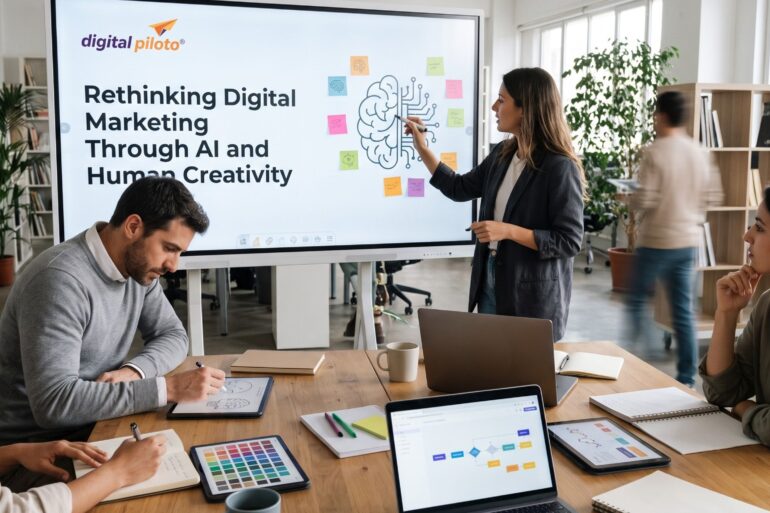
Digital marketing is changing quickly, but the biggest opportunity may not come from choosing between artificial intelligence and human creativity. It comes from combining them. AI can process information, identify patterns, and speed up routine work. People bring imagination, empathy, cultural understanding, and judgement. Together, they can make marketing more relevant and memorable.
Why Digital Marketing Needs a New Perspective
Not long ago, a marketing team could spend days researching keywords, preparing campaign reports, segmenting audiences, and testing different messages. Today, AI tools can assist with many of these activities in a fraction of the time. That is useful, certainly, but speed alone does not make a campaign successful.
Think about two brands selling similar products. Both use AI to analyse customer behaviour and generate advertising ideas. One publishes dozens of automated messages with little personality. The other uses the same insights to understand customer concerns, develop a distinctive campaign concept, and communicate in a voice that feels genuine. The technology may be similar, but the customer experience is very different.
This is where an experienced India SEO company can help businesses connect data-driven optimisation with a clear brand identity. Modern marketing needs both technical understanding and creative direction. Without the first, campaigns may struggle to reach the right audience. Without the second, they may reach people without giving them a reason to care.
What AI Brings to Modern Digital Marketing
Artificial intelligence is particularly useful when marketing teams need to work with large amounts of information or repeat tasks consistently. It can help turn scattered data into insights that support better decisions.
1. Faster research and audience understanding
AI-powered analytics tools can help marketers examine search behaviour, campaign performance, customer feedback, and engagement patterns. Instead of manually reviewing every interaction, teams can use AI to identify recurring questions, interests, and potential customer segments.
For example, an online furniture retailer might discover that many visitors explore compact storage solutions and space-saving designs. That observation could inspire a campaign focused on practical living for smaller homes. AI helps surface the pattern; a human marketer decides how to turn it into a meaningful story.
2. More relevant personalisation
Customers rarely respond to every message in the same way. A first-time visitor may need educational information, while an existing customer may be interested in upgrades or complementary products.
AI can support audience segmentation and help businesses deliver more relevant content based on permitted customer data and behaviour. However, personalisation should feel helpful rather than intrusive. A recommendation that genuinely solves a problem is valuable. One that makes a customer wonder how a brand knows so much about them can damage trust.
3. Smarter campaign optimisation
AI can assist with analysing advertising performance, identifying underperforming segments, comparing creative variations, and suggesting budget adjustments. These capabilities help marketing teams respond to changing campaign conditions more quickly.
Yet automated recommendations still need context. A campaign may appear inefficient during its early stages because it is testing a new audience or product category. A marketer must understand the business objective before deciding whether to change it.
Why Human Creativity Remains Essential
AI can generate a headline, suggest a social media caption, or produce several campaign concepts. But generating options is not the same as understanding which idea deserves attention.
Human creativity is shaped by experience, culture, emotion, observation, and sometimes an unexpected connection between seemingly unrelated things. A marketer may notice a customer frustration during a conversation and turn it into a campaign that feels unusually relevant. That kind of insight is difficult to reduce to a prompt.
Creativity gives a brand its personality
Imagine a local bakery launching a new range of traditional sweets. An AI tool could generate promotional messages about freshness, ingredients, and discounts. A creative team might instead build a campaign around the memories associated with family celebrations, familiar flavours, and the small rituals of sharing food.
The second approach gives the product an emotional context. It offers customers more than a list of features. This is particularly important in crowded markets, where several businesses may offer similar products at comparable prices.
Empathy makes communication more meaningful
Marketing is ultimately about people making decisions. Those decisions can involve practical needs, personal preferences, financial concerns, and emotional considerations. Human marketers are better positioned to interpret subtle context, question assumptions, and recognise when a message might sound insensitive or out of place.
AI can help analyse customer feedback, but people should decide how to respond with care. A complaint about delayed delivery, for instance, needs more than a perfectly formatted automated apology. It needs an appropriate response that acknowledges the customer’s frustration and explains what happens next.
Combining AI Efficiency with Creative Strategy
The strongest marketing workflows give AI and people clearly defined responsibilities. Rather than asking technology to make every decision, businesses can use it to prepare information, explore possibilities, and handle repetitive tasks while humans guide the larger strategy.
A practical collaboration model might include:
- AI for research: Identify search trends, summarise customer feedback, organise competitor observations, and discover content opportunities.
- Humans for positioning: Decide what the brand stands for, which audiences matter, and how the business should differentiate itself.
- AI for production support: Prepare first drafts, content outlines, campaign variations, and reporting summaries.
- Humans for creative refinement: Improve storytelling, verify claims, adjust tone, and ensure the content reflects real brand values.
- AI for measurement: Help identify performance patterns and highlight changes that deserve investigation.
- Humans for decisions: Interpret results in context and decide what should change in the next campaign.
This division is not fixed. A small team may use AI differently from a large enterprise marketing department. What matters is having a review process and making sure that important decisions remain accountable.
AI, SEO, and the Changing Discovery Journey
Search optimisation is one area where AI and human creativity can work particularly well together. AI tools can help marketers identify related search queries, understand content gaps, group keywords by intent, and monitor website performance. Human specialists can then turn those findings into useful resources that answer genuine customer questions.
Search behaviour is also expanding beyond traditional results pages. People increasingly encounter information through AI-generated summaries and conversational search experiences. This makes clear explanations, reliable information, useful page structures, and consistent brand details important parts of a modern search strategy.
However, publishing more AI-generated pages is not a shortcut to visibility. Content still needs to satisfy the reader. Google’s guidance on helpful, reliable, people-first content provides a useful reference for creating material that serves visitors rather than simply targeting search engines.
For businesses, the opportunity lies in combining AI-assisted keyword research with human expertise. A detailed article should not merely repeat popular search phrases. It should explain the subject, offer useful examples, address likely objections, and help readers make informed decisions.
Building a Consistent Brand Experience Across Channels
Customers rarely interact with a business through just one channel. They might discover a product through a search engine, watch a short video, read customer reviews, visit the website, and eventually contact the sales team. If every interaction communicates a different personality or promise, the brand experience becomes confusing.
AI can help marketing teams maintain consistency by organising brand information, adapting approved messages for different formats, and identifying inconsistencies across campaign materials. Human editors should still check whether the final communication sounds natural and suits the platform.
This is where a digital solutions provider India can support a broader approach to marketing transformation. Connecting customer data, website systems, analytics, and campaign workflows can help businesses build a more coordinated digital experience.
For example, a customer who has already submitted an enquiry should not keep receiving advertisements that suggest they have never heard of the product. Better coordination between marketing platforms can reduce this kind of friction and make communication more relevant.
How Businesses Can Put This Approach into Practice
There is no need to introduce every available AI tool at once. A gradual approach is usually easier to manage and allows teams to understand where technology genuinely improves their work.
- Identify repetitive activities: Start with tasks such as reporting, keyword grouping, campaign summaries, or organising customer feedback.
- Choose tools around clear objectives: Select technology based on the problem it solves, not simply because it is popular.
- Define the brand voice: Document the brand’s tone, audience, values, terminology, and communication boundaries before using AI for content production.
- Build human review into workflows: Assign responsibility for checking accuracy, originality, legal claims, and brand suitability.
- Test with real audience feedback: Compare campaign performance and customer responses rather than assuming automation has improved the experience.
- Improve continuously: Keep what works, revise what does not, and review the process as customer expectations change.
A digital marketing agency India can help coordinate SEO, paid advertising, content marketing, social media, and conversion optimisation within this framework. The objective is to make each channel contribute to a consistent business strategy rather than operate as an isolated activity.
Challenges: Using AI Without Losing Trust
AI-powered marketing also brings risks. Generated content can contain inaccurate claims, generic language, or misleading details. Automated personalisation may cross privacy boundaries if businesses collect or use customer information carelessly. Over-reliance on AI can also make several brands sound remarkably alike.
To avoid these problems, businesses should follow a few basic principles:
- Verify factual claims, statistics, product information, and external references before publication.
- Use customer data responsibly, with appropriate permissions and privacy safeguards.
- Keep a recognisable brand voice instead of publishing unedited generic AI output.
- Review automated campaign decisions, especially when budgets or customer experiences are affected.
- Use original insights and real expertise to give marketing content a meaningful point of difference.
Trust is difficult to build and surprisingly easy to lose. A fast campaign is not a successful campaign if its message misleads customers or damages the brand’s reputation.
Frequently Asked Questions
1. How does AI improve digital marketing?
AI can support audience research, data analysis, content planning, personalisation, campaign optimisation, and reporting. It helps teams process information faster, but strategic decisions and quality control still require human judgement.
2. Can AI replace human creativity in marketing?
No. AI can generate ideas and creative variations, but human insight remains essential for emotional storytelling, cultural understanding, brand positioning, and interpreting customer needs.
3. How can small businesses combine AI and creativity?
Small businesses can begin by using AI for practical tasks such as keyword research, content outlines, customer feedback analysis, and reporting. They can then apply their own product knowledge and customer understanding to refine the output.
4. Does AI-generated content help SEO?
AI-assisted content can support SEO when it is accurate, original, relevant, and genuinely useful. Using AI to produce large volumes of repetitive or low-value pages does not guarantee better search visibility.
Final Thoughts
The future of digital marketing does not belong to AI alone or to creativity without technology. It belongs to businesses that know how to bring the two together. Let AI handle the heavy lifting where it makes sense, and let people provide the judgement, imagination, and empathy that give marketing its human character. That balance can make digital growth both more efficient and more meaningful.
Blog Development Credits
Conceptualised by Amlan Maiti, this article was shaped through AI-assisted research and editorial refinement, with final SEO enhancements by Digital Piloto Private Limited.