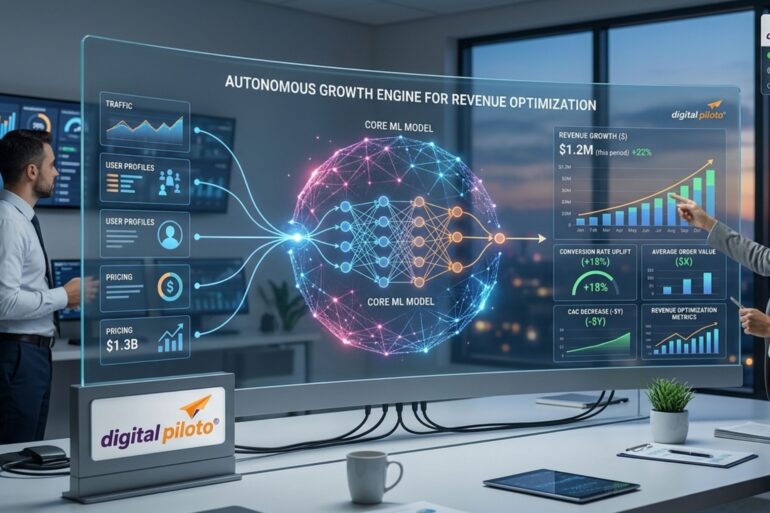
Businesses can achieve faster and more predictable revenue growth by implementing an autonomous growth engine—a system that continuously collects data, identifies opportunities, automates decisions, and optimizes customer acquisition and retention with minimal manual intervention. Instead of relying on isolated campaigns, organizations create a self-improving ecosystem that drives sustainable revenue performance.
Today, every digital marketing agency in Kolkata and growth-focused organization faces increasing competition, rising acquisition costs, and evolving customer expectations. Autonomous growth engines provide a practical framework to unify marketing automation, predictive analytics, and customer intelligence into one scalable system.
What Is an Autonomous Growth Engine?
Definition
An autonomous growth engine is an AI-powered business framework that automatically analyzes customer behavior, predicts growth opportunities, executes optimization actions, and continuously improves revenue outcomes without constant human intervention.
Unlike traditional marketing systems that depend heavily on manual decisions, autonomous engines leverage machine learning, automation workflows, and real-time analytics to make data-driven adjustments continuously.
Why Revenue Optimization Needs Automation in 2026
Modern buyers interact with brands across multiple touchpoints—search engines, AI assistants, social platforms, marketplaces, and email channels. Managing these interactions manually often creates delays and inefficiencies.
Autonomous systems solve this challenge by:
- Detecting buying signals instantly.
- Prioritizing high-value prospects automatically.
- Personalizing experiences at scale.
- Reducing customer acquisition costs.
- Improving conversion rates continuously.
In practice, businesses adopting intelligent growth systems frequently discover that optimization becomes a daily process rather than a quarterly exercise.
Core Components of an Autonomous Growth Engine
1. Unified Customer Data Layer
Every autonomous system begins with centralized data. Customer interactions from websites, CRM platforms, search analytics, social channels, and sales systems must flow into a single intelligence hub.
Key data sources include:
- Website engagement metrics
- Organic search performance
- Customer purchase history
- Email interactions
- Behavioral analytics
- CRM records
2. Predictive Analytics Engine
Predictive models identify future outcomes based on historical behavior. These systems forecast:
- Purchase probability
- Customer lifetime value
- Churn likelihood
- Upselling opportunities
- Revenue forecasting
Businesses using predictive analytics often make more confident budget allocation decisions.
3. Automated Execution Layer
Once opportunities are identified, automated workflows activate responses immediately.
Examples include:
- Sending personalized nurture emails.
- Launching remarketing campaigns.
- Adjusting content recommendations.
- Triggering sales alerts.
- Modifying bid strategies automatically.
How to Build an Autonomous Growth Engine: Step-by-Step Framework
Step 1: Define Revenue Objectives
Start with measurable goals such as increasing monthly recurring revenue, improving conversion rates, or reducing acquisition costs.
Step 2: Map the Entire Customer Journey
Document every customer touchpoint from awareness to retention. Understanding journey friction points helps prioritize automation opportunities.
Step 3: Consolidate Data Infrastructure
Integrate analytics platforms, CRM systems, advertising accounts, and customer databases into one reporting environment.
Step 4: Implement Predictive Models
Use AI tools to score leads, forecast revenue, and identify customer segments with the highest growth potential.
Step 5: Automate Decision-Making Workflows
Establish rules and AI-driven triggers that automatically execute marketing and sales actions.
Step 6: Continuously Measure and Refine
An autonomous growth engine should learn continuously. Monitor performance, retrain models, and optimize workflows regularly.
The Role of SEO in Revenue Optimization
Organic search remains one of the highest ROI acquisition channels. Strong search visibility feeds qualified traffic into autonomous growth systems.
Partnering with an experienced SEO agency Kolkata can significantly improve organic acquisition pipelines by aligning content, user intent, and conversion pathways.
Modern SEO strategies also support:
- Customer intent prediction
- Lead scoring enhancement
- Content personalization
- AI search visibility
Integrating Paid Media into Autonomous Growth
Paid advertising still plays a crucial role within autonomous ecosystems. However, AI now enables campaigns to optimize themselves based on performance signals.
Many organizations collaborate with the best PPC agency in Kolkata to deploy automated bidding strategies, predictive audience targeting, and dynamic creative optimization.
When integrated with CRM and analytics systems, paid campaigns become significantly more efficient.
Practical Example: Autonomous Revenue Growth in Action
Imagine a SaaS company receiving 10,000 monthly website visitors.
The autonomous growth engine could:
- Analyze visitor behavior in real time.
- Identify high-intent users.
- Assign predictive lead scores.
- Trigger personalized email sequences automatically.
- Launch remarketing ads for abandoned trials.
- Alert sales representatives for enterprise prospects.
- Recommend upsell opportunities for existing customers.
The result is a continuously optimized customer acquisition system requiring fewer manual interventions.
Common Mistakes to Avoid
- Automating without clean data.
- Ignoring customer experience in favor of efficiency.
- Relying exclusively on AI without human oversight.
- Tracking vanity metrics instead of revenue metrics.
- Failing to retrain predictive models regularly.
Automation should amplify strategic decision-making, not replace business judgment entirely.
Frequently Asked Questions
What is an autonomous growth engine?
An autonomous growth engine is an AI-driven system that automatically analyzes data, executes marketing actions, and continuously optimizes revenue performance.
How does AI improve revenue optimization?
AI improves revenue optimization by identifying patterns, predicting customer behavior, automating decisions, and personalizing customer experiences at scale.
Can small businesses implement autonomous growth systems?
Yes. Small businesses can begin with CRM automation, predictive analytics tools, and marketing automation platforms before expanding capabilities.
Is SEO important for autonomous growth engines?
Absolutely. SEO provides high-intent traffic and valuable behavioral data that strengthens predictive models and customer acquisition efforts.
What metrics should businesses monitor?
Key metrics include conversion rate, customer lifetime value, acquisition cost, churn rate, revenue growth, and lead quality scores.
Conclusion
Autonomous growth engines represent a significant shift from campaign-based marketing to continuously learning revenue ecosystems. Organizations that combine AI, automation, predictive analytics, and human expertise will be better positioned to scale efficiently, improve profitability, and maintain long-term competitive advantage.
Blog Development Credits:
This article was ideated by Amlan Maiti, developed with insights gathered through advanced AI platforms, and refined with strategic SEO enhancements by Digital Piloto Private Limited.