AI search is changing a basic question for brands: being visible is no longer enough if the system cannot confidently understand or trust what it finds. As users move from keyword searches to conversational answers, brand reputation, evidence, consistency, expertise, and third-party signals increasingly shape whether a company gets discovered, mentioned, or cited.
For any best digital marketing agency in Kolkata, this changes the optimization conversation. The objective is not simply to push a page higher. It is to build a digital footprint that gives search engines and AI systems enough reliable context to understand what a brand does, why it matters, and whether its information deserves attention.
Why Trust Has Become a Search Visibility Issue
Traditional SEO often gives marketers a comforting scoreboard: rankings, impressions, clicks, and traffic. AI search introduces a slightly different dynamic.
When someone asks an AI system, “Which software is suitable for a growing logistics company?” the system does not have to return ten blue links and leave the customer to figure everything out. It can interpret the question, explore related information, compare sources, summarize options, and provide a conversational answer.
That changes the role of trust.
A brand may rank for “logistics software,” yet still be poorly represented in an AI-generated answer if its website is vague, its third-party descriptions conflict, its product information is thin, or there is little independent evidence supporting its expertise.
Google’s current AI Search guidance emphasizes useful, unique, non-commodity content and says foundational SEO practices remain relevant for AI features. Google has also been adding mechanisms designed to surface original content, preferred sources, and highly cited material in AI Search.
So, in practical terms, AI visibility is becoming less about producing more pages and more about building a coherent body of evidence.
What Does “Trust” Mean in AI Search?
Trust is easy to discuss and surprisingly difficult to measure.
It is not one magic score hidden inside an AI model. There is no universal “brand trust” number that marketers can optimize for across every AI search platform.
Instead, trust is better understood as a collection of signals that help systems evaluate a brand’s identity, relevance, expertise, reliability, and context.
Think of it like introducing someone at a business meeting. Saying, “I am an expert,” is not particularly persuasive. A stronger introduction might include what the person does, where they have worked, what they have published, who has referenced their work, what customers say, and what evidence supports their claims.
Digital brands work much the same way.
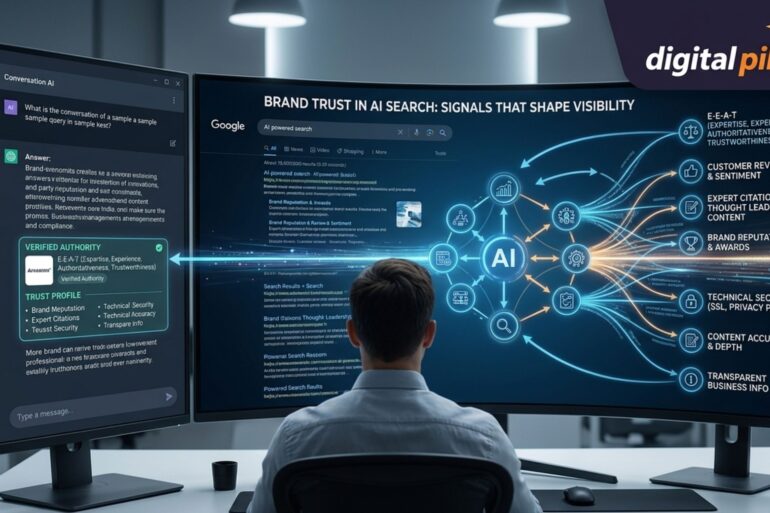
Some of the most useful AI search trust signals include:
- Clear identity: The company, products, services, people, and relationships are consistently represented.
- Firsthand expertise: Content demonstrates actual experience rather than recycled generalities.
- Independent references: Credible third-party sources mention or validate the brand.
- Evidence: Claims are supported by data, documentation, examples, research, or observable proof.
- Consistency: Important facts remain reasonably aligned across the web.
- Freshness: Time-sensitive information is maintained instead of quietly becoming outdated.
No individual signal guarantees visibility. Together, however, they create a stronger information environment around a brand.
The First Signal: A Clearly Defined Brand Entity
Before an AI system can recommend a company, it needs to understand what that company actually is.
This sounds obvious. It is not.
A startup may describe itself as an “AI transformation partner” on its homepage, a “software development company” on LinkedIn, an “automation consultancy” on a directory, and an “SaaS platform” on another website.
Each description might be technically defensible. Collectively, they create ambiguity.
Entity clarity means making the relationships between the brand, its services, products, people, locations, industries, and official properties understandable.
Google’s documentation for Organization structured data recommends information such as an organization’s name, URL, logo, contact details, and sameAs references. This helps search systems better understand organizational information and distinguish entities.
Structured data is not a shortcut to AI recommendations. It is simply part of making important information machine-readable and less ambiguous.
Original Expertise Is Becoming More Valuable
There is a strange irony in the age of generative AI.
Producing content has become easier, yet genuinely useful content has become more valuable.
Why? Because generic information is abundant.
If a company publishes another article explaining “What is digital marketing?” it may add very little to the information ecosystem. But if the company documents what it learned from managing a particular campaign, explains why a specific strategy failed, compares implementation choices, or shares original observations from customer work, the content carries a different kind of signal.
Google’s 2026 Search updates explicitly highlight original content and firsthand perspectives. Google has also introduced “Highly Cited” labels designed to help users identify articles that are frequently referenced by other stories.
That direction matters for brands.
The question is shifting from “Can we publish an article about this topic?” to “What can our organization genuinely add to this topic?”
What firsthand expertise can look like
- A detailed explanation based on real implementation experience.
- Original observations from customer or market research.
- Transparent case studies with clearly defined limitations.
- Expert commentary explaining why a common approach may fail in specific situations.
- Original frameworks, calculations, examples, or process documentation.
This is especially important for B2B brands, where expertise often influences a buying decision long before a sales conversation begins.
Third-Party Signals Matter Because Brands Are Not Their Own References
A company website naturally has an agenda: it exists to represent the company.
That does not make the information unreliable. It simply means independent references can provide additional context.
Imagine two businesses making the same claim about their industry expertise. One has only its own service pages. The other is also referenced by industry publications, professional associations, customers, partners, conference pages, research sources, and credible directories.
The second brand has a wider evidence footprint.
This is why brand authority in AI search should not be reduced to backlinks alone. A link can be useful, but the surrounding context matters too. What does the source say? Is the source relevant? Is the company correctly described? Does the reference provide meaningful evidence?
Google’s AI Search updates increasingly emphasize helping users discover original content, trusted sources, and firsthand perspectives rather than simply generating an answer without a connection to the wider web.
Consistency Is an Underrated Trust Signal
Trust can be weakened by small contradictions.
Suppose a company website says it has operated since 2018, while a business directory says 2020. Its LinkedIn page lists one headquarters, while another profile lists a different city. One page describes the company as an agency, another calls it a technology product, and a third says it is a consultancy.
None of these inconsistencies alone may destroy visibility.
But collectively, they make the digital identity harder to interpret.
For this reason, brands should periodically audit their most important external references.
- Check the official company name, website, location, and contact information.
- Review descriptions across major business directories and industry profiles.
- Check founder and leadership information for accuracy.
- Compare product and service descriptions across marketplaces and partner websites.
- Look for outdated claims, duplicate profiles, incorrect categories, and abandoned listings.
This is not glamorous SEO work. It is closer to digital housekeeping. Yet housekeeping becomes rather important when machines are reading the house.
Reviews Are Evidence, Not Just Reputation Scores
Reviews have always mattered in digital commerce. AI search makes their underlying language potentially even more useful.
Consider a customer asking an AI assistant, “What do users like about this software?”
A useful answer may depend not only on the average star rating but on recurring themes within customer experiences: ease of onboarding, support quality, reliability, pricing, learning curve, integrations, or limitations.
McKinsey’s 2026 consumer research shows an interesting trust gap. Across product-research channels, consumers reported lower trust in generative AI and social media than in several more established sources. In its survey, friends and family, professional recommendations, and sales assistance were among the more trusted sources, while generative AI responses ranked lower.
That is a useful warning for marketers: simply appearing in an AI answer does not automatically create trust.
The AI recommendation still needs credible supporting signals behind it.
AI Search Visibility Is Becoming More Conversational
Search behavior itself is changing.
Google reported in May 2026 that AI Mode had surpassed one billion monthly active users globally and that queries had more than doubled every quarter since launch. Google also described users as asking questions that are more conversational and closer to what they genuinely have on their minds.
This means brands need to think beyond short keywords.
A customer may not ask:
“Best CRM software.”
They may ask:
“What CRM should a 20-person B2B sales team use if the sales cycle is long and the team needs simple reporting?”
That query contains context that a conventional keyword list might completely miss.
Content should therefore address real decision-making questions: comparisons, use cases, limitations, implementation concerns, alternatives, pricing considerations, compatibility, and “Is this right for me?” moments.
Where GEO Fits Into Brand Trust
Generative Engine Optimization is often discussed as a visibility discipline, but the deeper opportunity is information quality.
Effective generative engine optimization services should not revolve around trying to manipulate an AI into mentioning a brand. The more durable approach is to make the brand easier to understand, verify, contextualize, and reference.
Google’s current guidance is particularly clear on this point: there are no special “GEO hacks” required for AI Search. The fundamentals remain valuable—crawlable pages, useful content, strong internal linking, appropriate structured data, and unique information that provides genuine value.
That makes GEO less mysterious.
It becomes an extension of good digital communication.
The Evidence Layer Behind a Trusted Brand
A trustworthy brand needs more than a polished homepage.
It needs an evidence layer that answers the silent questions behind almost every recommendation:
- Who is this company?
- What does it actually specialize in?
- How do we know?
- Who has experience with it?
- What evidence supports its claims?
- How current is the information?
- Where can I verify the details?
This evidence can live in many places: original research, customer stories, expert articles, product documentation, interviews, credible publications, case studies, reviews, professional profiles, and authoritative third-party references.
The key is not to manufacture evidence. It is to make genuine evidence discoverable.
Trust and Visibility Need to Be Measured Together
Traditional SEO dashboards tend to emphasize impressions, clicks, rankings, and conversions. Those metrics still matter. But AI search adds another layer of questions.
Brands can periodically test relevant conversational prompts and record whether the AI system:
- Recognizes the brand correctly.
- Associates it with the right products, services, or category.
- Describes important claims accurately.
- References credible supporting sources.
- Includes the brand when it is genuinely relevant to comparison or discovery questions.
- Changes its description when better evidence or fresher information becomes available.
These tests should be treated as directional research, not as a universal ranking score. AI responses can vary by model, query wording, location, freshness, user context, and available sources.
Google has also begun providing Search Console insights into appearances within generative AI Search features, including information about pages appearing in AI responses and related impressions. As of August 31, 2026, Google said these controls and insights had rolled out globally.
SEO Still Matters—But the Job Is Broader
It would be a mistake to interpret AI Search as the end of SEO.
In fact, the opposite is closer to reality. Technical accessibility, useful content, internal linking, structured information, page experience, and crawlability still form the foundation.
The difference is that the destination has expanded.
A page may need to satisfy a traditional searcher, a conversational AI interface, a comparison journey, and a customer who wants to verify the answer independently.
That is why a best SEO services Kolkata strategy increasingly needs to connect technical SEO with entity clarity, content expertise, reputation signals, and measurable brand visibility.
Five Practical Ways to Strengthen AI Search Trust
Brands do not need to rebuild their entire digital presence overnight. A focused program can begin with a few fundamentals:
- Clarify the entity: Make the company’s identity, services, products, people, and relationships consistent.
- Publish what you know: Turn genuine expertise and first-hand experience into useful content.
- Build evidence naturally: Earn credible mentions, references, reviews, partnerships, and independent coverage.
- Clean the information footprint: Fix outdated profiles, contradictory descriptions, broken links, and inconsistent business facts.
- Test conversational discovery: Ask realistic customer questions and monitor how accurately the brand is represented.
None of these is a magic trick. That is precisely the point.
FAQs
What are trust signals in AI search?
Trust signals are pieces of evidence that help AI and search systems understand a brand’s identity, relevance, expertise, reliability, and credibility. They can include original content, consistent business information, reviews, third-party references, structured data, and documented expertise.
Does brand authority affect AI search visibility?
Brand authority can contribute to a stronger information environment around a company, but there is no single universal authority score that guarantees AI visibility. AI systems evaluate information using their own systems and available sources.
Is GEO different from SEO?
GEO focuses on visibility within generative and AI-driven search experiences, while SEO covers broader search optimization. Google’s current guidance indicates that foundational SEO practices remain important for AI Search, so the two disciplines are better treated as connected rather than completely separate.
How can a brand improve trust for AI search?
Start by making the brand entity clear, publishing original and useful expertise, keeping important information consistent, earning credible third-party references, maintaining accurate reviews and profiles, and testing how AI systems describe the brand for relevant queries.
Final Thoughts
AI search is making one thing increasingly obvious: visibility without credibility is fragile.
A brand may be technically discoverable, but lasting visibility depends on whether the wider web gives AI systems—and ultimately people—enough reason to understand and trust it. Original expertise, consistent information, credible references, customer evidence, and useful content all contribute to that picture.
The smartest AI-search strategy, then, is not to chase every new feature. It is to build a brand that remains understandable when the search interface changes.
When the technology evolves again—and it almost certainly will—the brands with a strong evidence trail will have something far more durable than a temporary ranking tactic: a recognizable digital reputation.
Blog Development Credit
This article was conceived by Amlan Maiti, shaped through AI-assisted research, and given final SEO refinement by Digital Piloto Private Limited.