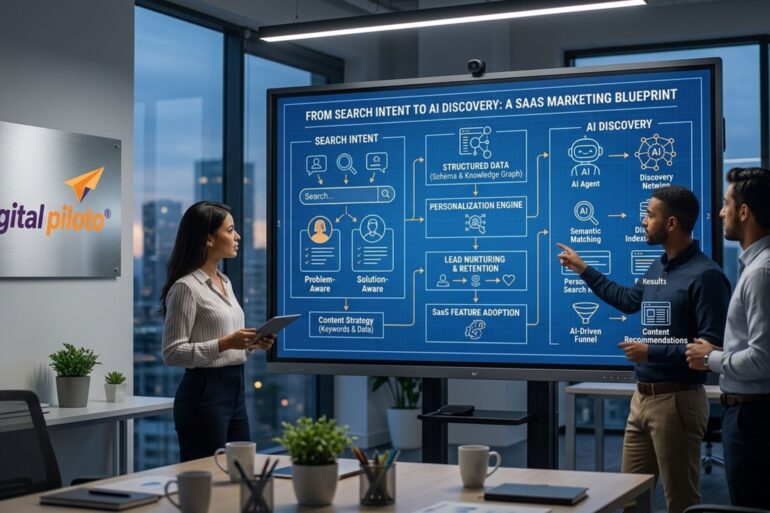
SaaS marketing is entering a new phase where understanding search intent alone is no longer enough. To achieve sustainable organic growth, companies must optimize for AI discovery by creating authoritative, context-rich content that both search engines and AI assistants can confidently understand, summarize, and recommend. This shift transforms visibility from ranking for keywords to becoming the trusted answer.
Forward-thinking SaaS brands are redesigning their growth strategies around semantic search, topical authority, and user experience. Partnering with a professional digital marketing agency in Kolkata can help businesses build scalable content ecosystems that perform across Google Search, AI-powered search engines, and conversational assistants.
What Is AI Discovery in SaaS Marketing?
Definition
AI Discovery is the process of making your SaaS brand easily understood, trusted, and recommended by AI-powered search platforms through high-quality content, semantic optimization, technical excellence, and demonstrated expertise.
Instead of relying solely on keyword rankings, AI discovery focuses on building a knowledge-rich website that answers user questions comprehensively while connecting related concepts in meaningful ways.
Why Search Intent Still Matters
Every successful SaaS marketing strategy starts with understanding user intent. Whether someone wants to learn, compare software, or purchase a solution, your content should align with that specific goal.
AI systems have raised the standard even further. They evaluate not only whether a page contains relevant information but also whether it fully satisfies the user’s objective. A detailed implementation guide often outperforms a short promotional article because it provides genuine value.
The Four Primary Search Intents
- Informational: Users want to understand a problem or concept.
- Commercial: Users compare software before making a decision.
- Transactional: Users are ready to sign up or purchase.
- Navigational: Users are looking for a specific brand or platform.
Mapping every piece of content to one clear intent improves relevance while making it easier for AI systems to classify and recommend your pages.
From Intent to Discovery: A Practical Framework
Step 1: Build Content Around Customer Questions
Forget isolated keywords for a moment. Begin with the real questions your audience asks throughout the buying journey.
For example, instead of targeting only “CRM software,” develop resources answering questions such as:
- How do I choose CRM software for a growing startup?
- Which CRM integrates best with marketing automation?
- What features should small businesses prioritize?
This approach naturally aligns with conversational AI search while improving topical relevance.
Step 2: Create Topic Clusters
Individual blog posts rarely establish authority on their own. Build a pillar page supported by implementation guides, comparison articles, case studies, FAQs, feature explainers, and industry insights.
For example, a SaaS security platform could organize content around:
- Cloud security best practices
- Zero Trust architecture
- Compliance frameworks
- Identity management
- Threat detection strategies
These connected resources demonstrate subject expertise while strengthening internal relevance.
Step 3: Optimize Content for AI Understanding
AI systems perform better when information is logically organized. Every article should include descriptive headings, concise explanations, supporting examples, and clear relationships between related concepts.
Rather than repeating keywords, explain how ideas connect. This creates semantic depth that benefits both human readers and AI-generated search experiences.
The Building Blocks of AI-Discoverable SaaS Content
Successful AI discovery depends on more than publishing frequent blog posts. Every page should contribute to a larger knowledge ecosystem.
Essential Components
- Clear answers to high-intent customer questions.
- Original research, frameworks, or practical insights.
- Logical internal linking across related topics.
- Consistent product and brand terminology.
- Structured data where appropriate.
- Fast, mobile-friendly user experience.
- Regular content reviews and updates.
When combined, these elements help AI systems recognize your website as a trustworthy source of information rather than simply another software vendor.
Why Context Creates Competitive Advantage
Many SaaS companies still produce isolated articles targeting individual keywords. Unfortunately, this often leads to fragmented authority. AI search favors websites that explain topics from multiple perspectives and connect those insights into a coherent learning journey.
For example, instead of publishing separate articles on API integration, workflow automation, onboarding, and customer retention without context, connect them under a broader SaaS growth framework. This demonstrates expertise while making it easier for both users and AI platforms to understand your content ecosystem.
Supporting AI Discovery with Integrated Marketing
Organic visibility works best when it is supported by insights from other marketing channels. Search behavior, advertising data, customer feedback, and product usage all reveal valuable information about what potential buyers actually want to know.
Many SaaS businesses use campaigns managed by a professional PPC agency Kolkata to identify high-converting search queries. Those insights can then be transformed into comprehensive guides, comparison pages, and solution-focused articles that strengthen long-term organic performance.
Common Mistakes That Limit AI Discovery
Even well-funded SaaS companies sometimes struggle with AI visibility because they prioritize publishing volume over information quality.
- Creating multiple pages targeting the same search intent.
- Publishing shallow feature-focused content without solving user problems.
- Ignoring semantic relationships between related topics.
- Using inconsistent product terminology across the website.
- Neglecting structured data and technical SEO fundamentals.
- Failing to update outdated tutorials and documentation.
- Writing primarily for search engines instead of real decision-makers.
A knowledgeable SEO service helps organize content into interconnected topic clusters, ensuring every page contributes to authority instead of competing with another page on the same website.
How to Measure AI Discovery Success
Traditional keyword rankings remain useful, but they no longer provide the complete picture. SaaS marketers should evaluate whether their content is building authority and attracting qualified prospects.
Track These Key Metrics
- Growth in organic traffic from conversational search queries.
- Higher visibility across topic clusters rather than single keywords.
- Longer average engagement time on educational resources.
- Increased product demo requests from organic visitors.
- Improved internal navigation between learning resources.
- Greater inclusion in AI-generated search summaries and recommendations.
Monitoring these indicators helps determine whether your content is becoming a trusted resource instead of simply another indexed webpage.
Frequently Asked Questions
What is AI Discovery in SaaS marketing?
AI Discovery is the practice of optimizing SaaS content so AI-powered search engines and assistants can understand, trust, and recommend it for relevant user queries.
How is AI Discovery different from traditional SEO?
Traditional SEO emphasizes rankings and keywords, while AI Discovery focuses on semantic relevance, topical authority, contextual depth, and information quality.
Why are topic clusters important for SaaS websites?
Topic clusters demonstrate expertise by connecting related content around a central theme, making it easier for AI systems to understand the full scope of your knowledge.
Should SaaS companies still target search intent?
Absolutely. Search intent remains the starting point, but it should be supported by comprehensive, interconnected content that answers follow-up questions and builds authority.
Can small SaaS startups benefit from AI Discovery?
Yes. Even smaller companies can compete effectively by publishing expert-driven, well-structured content that solves customer problems better than larger competitors.
Conclusion
The journey from search intent to AI discovery is not about replacing SEO—it is about expanding it. SaaS brands that organize knowledge around customer needs, strengthen semantic relationships, and consistently publish authoritative content will be better positioned to earn trust from both users and AI-powered search systems. In the years ahead, discoverability will belong to businesses that educate first and promote second.
Blog Development Credits:
This article was planned by Amlan Maiti, researched with the support of ChatGPT, Google Gemini, and Copilot, and professionally refined with advanced SEO enhancements by Digital Piloto Private Limited.