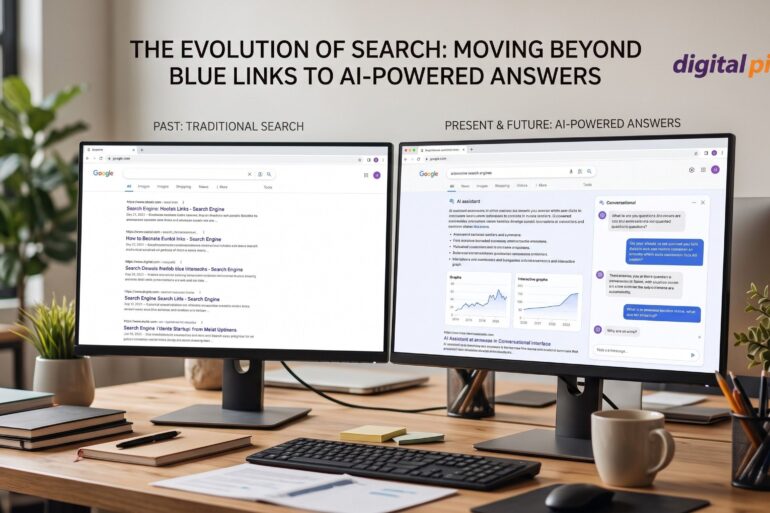
Not long ago, finding something online meant typing a few words into a search engine and opening a list of blue links. Today, people increasingly expect a direct explanation, a useful comparison, or a recommendation tailored to their needs. This change is reshaping how information is discovered—and forcing businesses to rethink what visibility really means in search.
For companies investing in digital marketing services in India, the shift is more than a change in search interface. It affects how potential customers discover brands, evaluate solutions, and decide whom to trust. Traditional SEO still matters, but sustainable visibility increasingly depends on answering real questions with useful, accurate, and accessible information.
How Search Evolved from Links to Answers
Early web search solved a straightforward problem: the internet was growing quickly, and people needed a way to find relevant pages. Search engines organized information using signals such as page content, links, and other measures of relevance. Users entered a query, scanned the results, and chose which website deserved their attention.
That model created the foundation of modern SEO. Businesses researched keywords, improved website structure, earned links, and published content designed to match what people were searching for. Ranking prominently could send valuable visitors to a website because users usually had to click through to learn more.
Search, however, has never stood still. Results pages have gradually incorporated maps, images, shopping listings, featured snippets, knowledge panels, and other features. These developments reduced the distance between a question and a useful response, even before generative AI became widely available.
AI-powered search takes this progression further. Instead of simply pointing toward potentially relevant pages, some search experiences can synthesize information, explain concepts, compare options, and provide follow-up suggestions. The result is a more answer-oriented experience, although traditional links remain important across many search journeys.
Why AI-Powered Search Is Gaining Attention
People often search because they want to accomplish something, not because they want to browse websites. Someone looking for a project management tool may need to compare pricing, understand integrations, and identify the best fit for a small team. Opening ten separate pages can make that process unnecessarily time-consuming.
AI-assisted search can help by bringing relevant information together into a single response. Depending on the platform and query, it may summarize information from several sources and provide links for users who want to investigate further.
Google explains how its AI features work within its broader search ecosystem in its official documentation on AI features and your website. The guidance reinforces an important point for publishers: established SEO practices remain relevant, and there is no guaranteed shortcut to inclusion in AI-generated responses.
What is changing for users?
- Less fragmented research: Users may get an initial overview without visiting several pages immediately.
- More contextual questions: People can describe complicated needs rather than reducing every search to two or three words.
- More iterative discovery: Follow-up questions can refine a search as the user learns what matters.
- Greater emphasis on trust: When an answer summarizes information, users still need reliable sources to verify important claims.
These changes do not mean everyone has abandoned conventional search results. Many users still click links, especially when researching purchases, checking original sources, or looking for detailed professional guidance. The evolution is happening alongside traditional search, not in a clean, overnight replacement.
What Happens to Traditional SEO?
SEO is not disappearing. Its role is expanding.
Search engines still need to discover pages, understand their content, and assess their relevance. Websites still benefit from crawlable architecture, helpful writing, clear navigation, and meaningful links. What is changing is the range of experiences in which a business may need to be visible.
A company might attract attention through a standard organic listing, appear as a source in an AI-generated response, receive visits from a product comparison, or be discovered through a local result. These pathways can overlap, but they do not necessarily produce the same traffic patterns.
Rankings are important, but they are not the whole picture
Consider a specialist accounting firm. It may rank well for a broad term such as “accounting services,” yet receive few qualified enquiries because its page says little about the industries it serves. A competing firm may explain tax planning for small manufacturers, outline common compliance challenges, and answer practical questions about its process.
The second firm gives prospective clients a clearer reason to trust its expertise. Its content can support discovery for specific queries while helping people assess whether the business suits their needs.
This is the practical connection between traditional SEO and AI search optimization: a website should be easy to discover, but it should also provide enough substance to be useful once discovered. Rankings can bring attention; relevant information helps turn that attention into confidence.
Why Content Quality Matters More Than Ever
When search results provide direct answers, publishing generic content becomes a weaker strategy. If a page merely repeats familiar advice without adding clarity, experience, evidence, or a useful perspective, it gives readers little reason to seek it out.
Content that supports AI-powered discovery should begin with the user’s problem and explain the answer in a way that is both direct and sufficiently detailed. A strong article does not hide its main point beneath a long introduction. It answers the central question, then adds context, examples, limitations, and related guidance.
Build pages that deserve attention
- Answer the central question early: Make the main takeaway easy to find before expanding into supporting details.
- Use specific examples: Explain how a recommendation works in realistic situations rather than relying on abstract statements.
- Support important claims: Link to trustworthy primary sources, official documentation, or credible research where appropriate.
- Show relevant expertise: Include genuine experience, transparent authorship, and useful details that distinguish the page from generic summaries.
- Keep information current: Review time-sensitive claims, product details, regulations, and examples so readers are not relying on outdated guidance.
Google’s guidance on creating helpful, reliable, people-first content offers a useful standard. Content should serve its intended audience rather than exist mainly to capture search traffic.
There is an important distinction here: good content practices can improve usefulness and support discoverability, but they do not guarantee that an AI system will quote a page. Each platform uses its own systems, and the visibility of a particular source can vary by query and context.
The Rise of Intent, Entities, and Context
In a blue-link environment, marketers sometimes focused heavily on matching a target phrase. In an answer-oriented environment, understanding the topic behind that phrase becomes increasingly valuable.
Suppose a person asks, “Which heat pump is suitable for a cold climate and a two-bedroom house?” A useful response may depend on several connected ideas: insulation, home size, seasonal efficiency, installation conditions, local weather, and operating costs. A page that explains these relationships offers more value than one that simply repeats the phrase “best heat pump.”
This is where search intent and entity-based SEO can help shape a content strategy. Search intent concerns what the user is trying to achieve. Entity-based SEO helps make important subjects and their relationships clearer—for example, the relationship between a product, its manufacturer, its features, and the problems it solves.
Businesses can respond by creating connected resources rather than isolated posts. An introductory guide might explain the basics, a comparison page could assess options, and a detailed service page could cover implementation, pricing factors, and next steps. Descriptive internal links help readers move between these resources without having to start their search again.
How Businesses Can Prepare for AI-Powered Answers
Adapting to the new search environment does not require throwing away a working SEO strategy. It requires examining whether that strategy still reflects how customers research and make decisions.
For businesses coordinating marketing, content, and website improvements, a digital transformation agency India can help connect these activities to broader digital goals. The important thing is to treat search visibility, website usability, analytics, and conversion planning as parts of the same customer journey.
A practical starting plan includes the following steps:
- Review your existing search performance. Identify pages that attract relevant visitors, generate enquiries, or support important business goals.
- Research real customer questions. Use search-query reports, sales conversations, support requests, reviews, and customer interviews to discover recurring concerns.
- Improve your most valuable pages. Add missing explanations, clearer examples, reliable sources, and direct answers where they genuinely help.
- Strengthen technical foundations. Check indexing, internal links, mobile usability, page accessibility, and structured data where appropriate.
- Build topical depth. Connect related articles and service pages so users can explore a subject from initial research to a more informed decision.
- Measure business outcomes. Monitor qualified traffic, leads, sales, and assisted conversions alongside rankings and impressions.
An experienced SEO optimization company india should be able to explain how its work supports these outcomes, rather than promising guaranteed AI citations or treating one visibility metric as proof of success.
Measuring Visibility When Clicks Tell Less of the Story
One of the biggest challenges in AI-powered search is measurement. A user may see a brand mentioned in an answer, remember the name, and visit the website later through another channel. In some cases, a useful answer may satisfy the immediate question without producing a click at all.
That does not make website traffic irrelevant. It means traffic should be interpreted alongside other evidence about how people discover and choose a business.
Track several indicators together:
- Organic performance: Review relevant clicks, impressions, search queries, and landing pages in available search reporting tools.
- Business conversions: Measure qualified enquiries, bookings, purchases, and other meaningful actions.
- Content contribution: Identify pages that assist conversions or help visitors move toward a decision.
- Referral sources: Where analytics data is available, assess traffic from AI assistants and other emerging discovery channels.
- Brand demand: Watch for changes in branded searches and direct visits, while recognizing that these can be influenced by many factors.
Avoid assuming that a rise or fall in performance comes from AI search alone. Competition, seasonal demand, website changes, advertising, and changes in search presentation can all affect results. Compare data over time and use multiple signals before making strategic decisions.
Frequently Asked Questions
1. What does moving beyond blue links mean?
It describes the shift from search experiences focused mainly on lists of website links toward experiences that can also provide summaries, direct answers, comparisons, and conversational follow-ups. Traditional links remain an important part of search.
2. Will AI-powered search replace traditional SEO?
No. Technical SEO, useful content, keyword research, internal linking, and website accessibility remain valuable. Businesses need to apply these fundamentals while adapting content to a wider range of search and discovery experiences.
3. How can a website improve its chances of appearing in AI answers?
Publish accurate, useful content; answer relevant questions clearly; demonstrate expertise; support claims with credible evidence; and maintain a technically accessible website. These practices support discoverability but cannot guarantee an AI citation or recommendation.
4. What should businesses measure beyond rankings?
Alongside rankings and impressions, monitor qualified organic traffic, enquiries, sales, content-assisted conversions, and reliable referral data from emerging search channels. Choose metrics that reflect actual business goals rather than visibility alone.
Final Thoughts
The evolution from blue links to AI-powered answers is changing how people explore information, but the underlying goal of search remains familiar: connecting people with useful information. Businesses that combine sound SEO foundations with clear explanations, credible evidence, and a genuine understanding of customer needs will be better prepared for what comes next. The opportunity is not simply to be seen, but to be worth finding.
Blog Development Credits
The concept was developed with Amlan Maiti, shaped through editorial research, and refined for search relevance by Digital Piloto Private Limited.