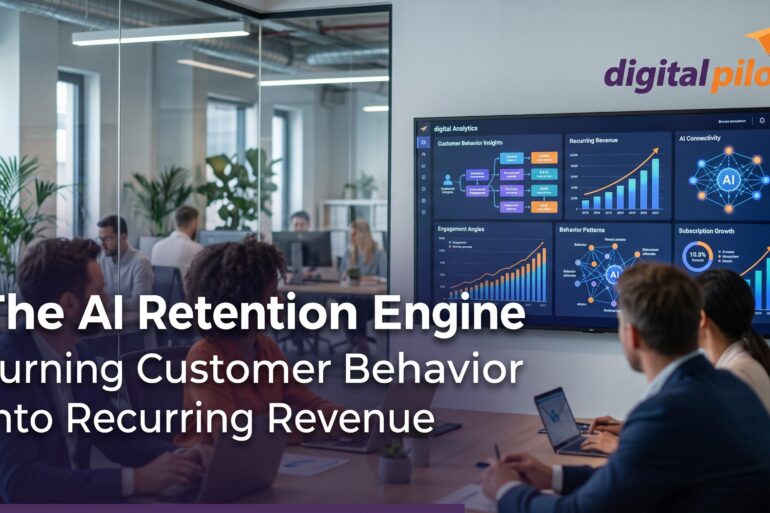
Winning a new customer feels like progress, but what happens after the first purchase? If customers disappear without returning, businesses can end up spending heavily to replace the revenue they have already earned. An AI retention engine changes the equation by interpreting customer behavior, identifying signs of disengagement, and helping businesses create timely, relevant experiences that encourage lasting relationships.
For brands working with a digital marketing agency, customer retention is no longer just an email campaign or a loyalty-points scheme. It involves understanding what customers need next, when they may lose interest, and which interactions genuinely improve their experience. By combining behavioral data, artificial intelligence, and marketing automation, businesses can build a smarter customer retention strategy that supports recurring revenue without overwhelming people with unwanted messages.
What Is an AI Retention Engine?
An AI retention engine is a connected system that uses customer data, predictive analytics, and automated workflows to improve the likelihood of repeat purchases, renewals, and long-term engagement.
Think of it as an attentive store manager who remembers a customer’s preferences, notices when their buying habits change, and offers relevant help at the right moment. Unlike a human manager, the system can analyze patterns across thousands of customer journeys simultaneously. It can identify behaviors associated with repeat purchases, estimate which customers may stop engaging, and recommend suitable actions for different segments.
That does not mean AI can read minds or predict every customer’s next move. Its recommendations depend on the quality of the available information, the relevance of the model, and how carefully the business tests its decisions.
A well-designed retention engine typically connects four capabilities: behavioral data collection, customer segmentation, predictive intelligence, and personalized engagement. Together, these capabilities help businesses move from generic follow-ups toward more useful, timely interactions.
Why Customer Retention Deserves More Attention
Acquisition and retention solve different problems. Acquisition introduces people to your business; retention gives them reasons to return. A company that focuses exclusively on attracting new buyers may overlook the customers who already know its products, have experienced its service, and may be willing to purchase again.
Research from Bain & Company on customer loyalty has famously highlighted how modest improvements in customer retention can have a substantial effect on profitability in some business contexts. The exact impact varies by industry, margins, acquisition costs, and operating model, so businesses should calculate their own economics rather than assume a universal return.
Consider an online skincare retailer. A first-time buyer purchases a moisturizer, but the business sends the same promotional messages to every customer for the next three months. Some customers receive irrelevant offers, while others who may be ready to reorder hear nothing useful.
An AI-assisted approach could estimate replenishment windows from suitable purchase data, recognize product preferences, and coordinate relevant reminders. The retailer still needs to respect customer consent and avoid assuming that everyone uses a product at the same rate. But the interaction becomes more thoughtful than sending the same discount to the entire mailing list.
How AI Turns Customer Behavior into Useful Signals
1. Understanding patterns across the customer journey
Customer behavior leaves clues. Purchase frequency, product browsing, subscription usage, support interactions, returns, and email engagement can reveal different aspects of the relationship.
Individually, these signals may tell only a small part of the story. Together, and when interpreted in context, they can help businesses distinguish a satisfied repeat buyer from someone who has stopped finding value in the product.
For a subscription software provider, declining product usage might suggest that a customer is struggling to adopt a feature. For an ecommerce company, repeated product views without a purchase might indicate uncertainty, price sensitivity, or simple browsing. The same signal can have different meanings depending on the customer and situation.
2. Predicting churn before it happens
Customer churn occurs when buyers stop purchasing, subscribers cancel, or clients leave a service. Predictive models can analyze historical patterns to identify customers whose behavior resembles that of previous customers who eventually churned.
A subscription business might examine falling login frequency, unused paid features, unresolved support tickets, and approaching renewal dates. The model can flag accounts that deserve attention, giving customer success teams time to investigate.
A churn score is a warning signal, not a verdict. A customer may be inactive because of a holiday, a seasonal buying cycle, or a completed project. Businesses should combine model predictions with context before deciding how to respond.
3. Finding the next useful action
Identifying a customer at risk is only half the job. The business must decide what to do next.
One customer may benefit from a product tutorial. Another might need help resolving a delivery issue. A long-standing customer could appreciate early access to a relevant product, while someone who has already received several promotional messages may need fewer communications, not more.
AI can help rank possible interventions according to predicted relevance or likely response. Testing those interventions is essential because a model’s recommendation does not prove that an action will cause a customer to stay.
Building a Practical AI Customer Retention Strategy
Businesses do not need an enormous data warehouse or a complex machine-learning platform to begin. A focused pilot can reveal where behavioral intelligence makes a meaningful difference.
- Unify customer information. Connect relevant CRM, ecommerce, billing, support, and engagement records. Establish reliable customer identifiers and remove duplicate or outdated entries where appropriate.
- Define meaningful customer segments. Group customers by lifecycle stage, purchase behavior, product adoption, or service needs rather than relying only on broad demographic categories.
- Choose a specific retention problem. Start with an issue such as missed subscription renewals, declining repeat purchases, or poor adoption after onboarding.
- Design a useful intervention. Decide whether the right response is education, customer support, a reminder, a product recommendation, or a human conversation.
- Measure incremental results. Compare outcomes with a suitable control group where possible. Track whether the intervention improves retention, repeat purchases, or renewal rates beyond what would have happened anyway.
This final step is especially important. A campaign may generate impressive revenue while simply rewarding customers who were already planning to buy. Controlled testing helps reveal whether AI-assisted targeting is creating additional value rather than merely taking credit for existing demand.
Personalization Without Making Customers Uncomfortable
Personalization works when it feels helpful. It becomes intrusive when a company appears to know too much, communicates too frequently, or uses information in ways customers did not reasonably expect.
An AI retention engine should therefore consider not only what a business can predict, but also what it should do with that prediction.
- Use relevant data: Collect and process information for clearly defined purposes, with appropriate permissions and safeguards.
- Respect communication preferences: Apply consent, opt-out choices, frequency limits, and channel preferences consistently.
- Avoid unsupported assumptions: Treat behavioral patterns as probabilities rather than certain statements about a customer’s intentions.
- Provide human assistance: Allow employees to review sensitive situations and resolve problems that automated workflows cannot handle well.
- Protect customer information: Restrict access, secure integrations, and define how long data should be retained.
These practices support customer trust as well as regulatory compliance. Businesses operating in India should assess applicable privacy obligations, including relevant requirements under the Digital Personal Data Protection Act and associated rules, based on their circumstances and the law in force.
Connecting Retention with Revenue Growth
A retention engine should ultimately improve business outcomes, not simply increase clicks or message opens. The most useful metrics connect customer behavior with commercial value.
Start by tracking repeat purchase rate, renewal rate, churn rate, customer lifetime value, and the cost of retention campaigns. Depending on the business model, monitor time to second purchase, product adoption, customer support resolution, and revenue retained from customers who might otherwise have left.
Customer lifetime value (CLV) estimates the value a customer generates over a defined relationship period. It can help teams compare retention investments with expected revenue, but the calculation should account for gross margin, servicing costs, discounting, and the assumptions used in the model.
For example, a subscription company might find that customers who complete onboarding within the first week renew more often. It could then test whether guided onboarding improves adoption and renewal outcomes. The insight becomes valuable when the business validates the pattern, improves the experience, and measures the financial result.
A digital technology company in India can help organizations connect customer data, marketing systems, analytics, and automation into a more coordinated operating model. For companies investing in acquisition as well, a reliable SEO company Kolkata can contribute to the discovery side of the customer journey, while retention systems help businesses nurture relationships after the first interaction.
Common Mistakes That Weaken AI Retention
Even sophisticated technology can produce disappointing results when the strategy is poorly defined. Watch for these recurring problems:
- Using fragmented data: Inconsistent customer records can lead to irrelevant recommendations and inaccurate churn predictions.
- Automating bad experiences: Sending faster reminders does not help if the underlying product or support issue remains unresolved.
- Offering discounts too quickly: Customers may learn to wait for promotions, weakening margins without building genuine loyalty.
- Trusting predictions without testing: A high churn score does not establish why a customer may leave or which intervention will work.
- Measuring engagement alone: More opens or clicks do not necessarily translate into repeat purchases, renewals, or profitable growth.
The strongest retention programs combine technology with an honest look at the customer experience. Sometimes the best intervention is not another campaign. It is fixing a confusing checkout, improving product quality, shortening response times, or making a subscription easier to use.
Frequently Asked Questions
1. What is an AI retention engine?
An AI retention engine uses customer data, predictive analytics, and automated workflows to identify retention opportunities and deliver relevant interventions. It helps businesses encourage repeat purchases, improve product adoption, and reduce avoidable customer churn.
2. How does AI predict customer churn?
AI models analyze historical and current behavior, such as purchase frequency, product usage, support activity, and renewal patterns. They estimate which customers may be at risk, but predictions should be reviewed in context and validated against actual outcomes.
3. Can small businesses use AI for customer retention?
Yes. Small businesses can begin with CRM automation, segmented email campaigns, replenishment reminders, or basic churn indicators. The best starting point is a specific customer problem that can be measured without requiring a complex technology investment.
4. How can businesses measure AI retention success?
Useful metrics include repeat purchase rate, customer churn, subscription renewal rate, customer lifetime value, and retention campaign costs. Comparing an intervention group with a suitable control group can help determine whether the strategy creates incremental business value.
Final Thoughts: Retention Begins with Understanding
Recurring revenue is rarely built through repeated promotions alone. It grows when customers continue to find value in a product, trust the business behind it, and receive useful support throughout their journey.
An AI retention engine helps businesses recognize patterns and respond with greater relevance, but technology is only part of the equation. Combine reliable data, thoughtful personalization, measurable experiments, and genuinely good customer experiences. That is how customer behavior becomes an opportunity for stronger relationships and more sustainable revenue.
Blog Development Credits
This article was conceived by Amlan Maiti, developed with AI-assisted research and writing, and refined by Digital Piloto Private Limited for editorial quality and search relevance.