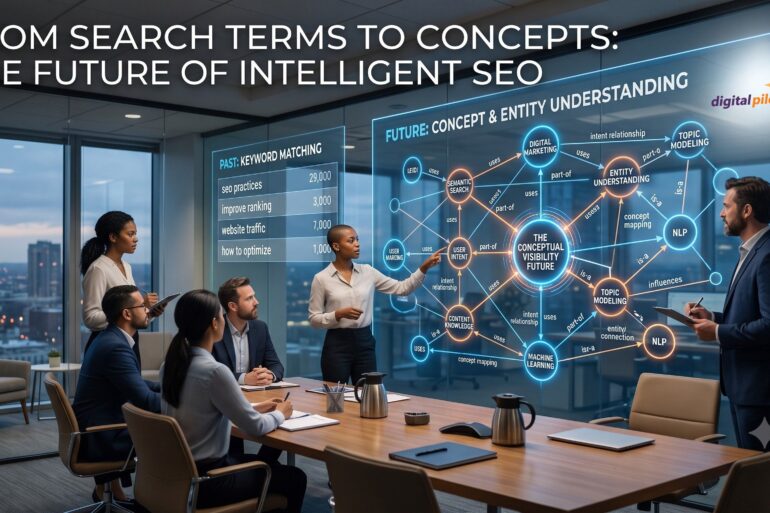
Search used to be a guessing game built around exact words. Today, people ask complete questions, describe situations, compare options, and expect intelligent answers. For SEO agencies in India, this shift changes the job completely. The future belongs to websites that can communicate meaning, expertise, context, and relationships—not simply repeat keywords.
SEO Is Moving Beyond the Keyword
For years, keywords were the basic currency of search engine optimization. A business would identify a phrase such as “best running shoes,” create a page around it, build links, and monitor its position in the search results.
That approach still has value, but it no longer explains how modern search works.
Imagine someone searching for “running shoes for flat feet under ₹10,000.” The search engine is not merely matching those words against web pages. It has to understand the person’s likely intent: they want footwear, they may need additional support, they have a specific budget, and they are probably comparing products before purchasing.
That is a concept, not merely a keyword.
Google’s current guidance makes this evolution particularly clear. Its documentation says that AI-powered search experiences continue to rely on foundational SEO, while AI systems can understand synonyms and broader meanings rather than requiring publishers to match every possible wording of a query. Google Search Central
In practical terms, SEO is becoming less about asking, “Which exact phrase should I rank for?” and more about asking, “Which problem, topic, entity, or decision should my website become known for?”
What Does Concept-Based SEO Actually Mean?
Concept-based SEO is an approach where content is organized around topics, entities, relationships, user intent, and contextual meaning instead of isolated search phrases.
Think about a large library. Traditional keyword SEO is like arranging books according to the words printed on their covers. Intelligent SEO is closer to creating a sophisticated catalog that understands which books discuss the same subject, which ones provide expert opinions, which ones answer related questions, and which ones are useful at different stages of a reader’s journey.
A page about “electric cars” might naturally connect with concepts such as batteries, charging infrastructure, range, regenerative braking, maintenance, tax incentives, charging time, and total ownership cost.
None of those terms needs to be forced into every paragraph. They become relevant because they belong to the same knowledge ecosystem.
The shift from strings to meaning
Search engines increasingly have to interpret what users mean rather than simply what they type. This becomes particularly important as conversational search and AI-generated answers become more common.
For example, these searches look different:
- “best CRM software”
- “CRM for a small sales team”
- “how can I track leads without hiring another salesperson?”
- “Salesforce vs HubSpot for a 10-person company”
They contain different wording, yet they belong to overlapping concepts. A genuinely authoritative website should be capable of addressing that broader information space rather than creating four thin pages simply because there are four keyword variations.
Why Search Queries Are Becoming More Conversational
People rarely think in SEO keywords when they are trying to solve a real problem.
A business owner may not search for “local SEO services.” They might type, “How do I get more customers from Google Maps?” A parent may not search for “children’s educational apps.” They may ask, “What are some safe learning apps for a seven-year-old?”
Those questions contain intent, circumstances, expectations, and sometimes emotion.
Modern search systems are increasingly designed to interpret these richer signals. Google’s AI Mode, for example, is built around more complex interactions and questions. Google reported in May 2026 that AI Mode had surpassed one billion monthly users globally, with queries more than doubling every quarter since launch.
This does not mean traditional searches are disappearing. It means the searcher’s journey is becoming more nuanced.
That creates an important opportunity for content creators: instead of optimizing only for the question typed into a search box, they can build resources that cover the surrounding decision-making process.
Entities Will Matter More Than Isolated Keywords
One of the most important ideas behind intelligent SEO is the concept of entities.
An entity can be a person, company, product, location, organization, service, event, or clearly identifiable concept. Search systems can connect entities with attributes and relationships.
Consider a company selling enterprise cybersecurity software. Its website should not merely repeat “enterprise cybersecurity software” dozens of times. It should establish clear relationships between the company, its products, security standards, industries served, integrations, use cases, experts, research, customer outcomes, and relevant technologies.
This creates what can be called entity clarity.
When a brand’s identity is consistent across its website and wider digital ecosystem, search systems have more contextual information with which to understand that brand.
Why entity clarity improves content strategy
A strong entity-focused content strategy typically answers questions such as:
- What does the brand actually specialize in?
- Which products, services, people, places, or concepts are associated with it?
- Which problems does it solve?
- Which audiences does it serve?
- What evidence supports its expertise?
- How does its information connect with related topics?
This is where topical authority becomes much more meaningful than simply publishing a large number of articles.
Topical Authority Is Becoming a Competitive Advantage
Publishing 100 articles about unrelated keywords does not necessarily make a website authoritative.
Publishing a connected body of genuinely useful information around one area of expertise can be far more valuable.
Suppose a company provides Shopify development services. Instead of publishing generic posts such as “What Is Shopify?” repeatedly, its content ecosystem could cover Shopify store architecture, checkout optimization, product-page UX, technical SEO, international stores, Shopify analytics, conversion optimization, app selection, migration risks, and real-world implementation challenges.
The result is not simply a collection of keyword-targeted pages. It is a recognizable knowledge graph around the company’s expertise.
That distinction matters because intelligent search experiences need information they can retrieve, connect, compare, summarize, and cite.
AI Search Is Changing What Visibility Means
Traditional SEO often treats visibility as a ranking position. If a page appears at position three, the job appears successful.
AI search complicates that measurement.
A brand might be mentioned in an AI-generated answer without appearing as a conventional blue-link result at the top of the page. Another website may receive a citation because it contains a particularly useful piece of evidence. A third brand may become part of an AI-generated comparison.
In other words, visibility is expanding beyond rankings.
Research from Pew Research Center illustrates why this matters. In its analysis of nearly 69,000 Google searches from March 2025, 18% produced an AI-generated summary. Traditional result links were clicked in 8% of visits when an AI summary appeared, compared with 15% when one did not. Only about 1% of visits involved clicking a link directly from the AI summary.
The lesson is not that clicks are becoming irrelevant. Rather, the path from discovery to conversion is becoming less linear.
Brand recognition, citations, mentions, reviews, expertise, and inclusion in AI-generated answers can all become part of the modern search journey.
Where Generative Engine Optimization Fits In
This is where generative engine optimization specialist strategies become increasingly relevant.
Generative Engine Optimization, commonly called GEO, focuses on improving the likelihood that a brand’s information is understood, retrieved, represented, and referenced within generative search experiences.
But GEO should not be treated as a collection of shortcuts.
Google’s own 2026 guidance says that SEO remains foundational for its generative AI features. It also emphasizes unique, valuable, non-commodity content rather than tactics designed solely to manipulate AI systems.
That makes sense. If an AI system has to construct a useful answer, shallow content gives it very little substance to work with.
Strong GEO therefore overlaps with strong SEO: clear information architecture, crawlable pages, credible evidence, original insights, useful formatting, expert knowledge, and consistent entity information.
What Intelligent SEO Will Prioritize
The future of SEO will probably look less like a checklist of isolated ranking factors and more like a connected discipline combining content strategy, technical SEO, brand building, data analysis, and user experience.
Businesses should pay particular attention to these areas:
- Search intent: Understand the problem behind the query rather than targeting the wording alone.
- Topic depth: Build useful clusters around areas where the business has genuine expertise.
- Entity consistency: Keep business names, services, products, people, locations, and facts consistent across important digital properties.
- Original information: Add research, examples, observations, opinions, data, or practical experience that competitors cannot easily reproduce.
- Technical accessibility: Make sure search systems can crawl, interpret, and index important content.
- Multiformat visibility: Use relevant text, images, video, product information, reviews, and other useful formats.
Google’s current documentation reinforces many of these principles, noting that technical SEO fundamentals, internal links, textual content, page experience, structured data where appropriate, and helpful people-first content remain important for AI search visibility.
From Keyword Research to Concept Mapping
This change also transforms keyword research itself.
Instead of beginning with a spreadsheet containing hundreds of phrases, an SEO strategist can begin with a core business concept and map the surrounding questions.
For example, a healthcare technology company might start with “remote patient monitoring.” The research process can then expand into patient eligibility, wearable devices, data security, clinical workflows, reimbursement, implementation, patient engagement, integration, and measurable outcomes.
Those concepts can become:
- Pillar pages explaining the core subject.
- Supporting articles answering specific questions.
- Comparison pages addressing alternatives.
- Case studies demonstrating practical outcomes.
- Glossaries explaining technical terminology.
- Expert commentary that adds first-hand perspective.
Now the website is not chasing keywords one by one. It is building a structured body of knowledge.
The Role of AI in the Future SEO Workflow
AI will also change how SEO professionals conduct research and analysis.
Instead of spending hours manually grouping thousands of queries, AI can help identify recurring themes, classify intent, discover semantic relationships, compare competitors, and highlight missing topics.
But there is an important line here.
AI can accelerate research. It cannot magically create expertise.
If every competitor uses the same model to generate ten articles about the same subject, the web simply becomes noisier. The brands that stand out will be the ones adding human judgment, original data, customer experience, specialist knowledge, and genuinely useful interpretation.
That is why the future may belong to teams that combine machine-scale analysis with human-scale understanding.
What Businesses Should Do Now
Companies do not need to abandon conventional SEO and rebuild everything from scratch. A more sensible approach is to evolve gradually.
Start by auditing your most important topics. Identify where the website is strong, where information is fragmented, and where competitors provide better answers.
Then build around the concepts that genuinely matter to customers.
A practical intelligent SEO roadmap looks like this:
- Identify core business entities. Clarify the brand, products, services, experts, locations, and industries you want associated with your business.
- Map customer intent. Group questions according to awareness, research, comparison, purchase, implementation, and post-purchase needs.
- Build topic clusters. Connect pillar pages with supporting content rather than publishing disconnected articles.
- Add first-hand value. Include original examples, data, case studies, expert commentary, and practical observations.
- Strengthen technical SEO. Improve crawlability, internal linking, page experience, indexing, and structured data where appropriate.
- Measure broader visibility. Track rankings and traffic, but also monitor brand mentions, citations, conversions, assisted journeys, and visibility within AI search experiences.
A strong digital marketing company India strategy will increasingly need to connect these activities rather than treating SEO as an isolated traffic-generation channel.
Frequently Asked Questions
What is concept-based SEO?
Concept-based SEO focuses on the meaning behind searches. Instead of optimizing only for exact keywords, it organizes content around topics, entities, relationships, user intent, and related questions.
Are keywords still important in intelligent SEO?
Yes. Keywords remain useful for understanding demand and search behavior. The difference is that they should be treated as signals of intent rather than rigid phrases that must be repeated throughout a page.
How does AI search change SEO strategy?
AI search can summarize information, connect multiple sources, and answer more conversational queries. As a result, businesses need content that is easy to understand, trustworthy, distinctive, well-structured, and relevant to broader concepts.
Is GEO replacing traditional SEO?
No. GEO and related AI-search practices build on many established SEO fundamentals. Google specifically states that its generative search features continue to rely on core Search systems and established SEO best practices.
Final Thoughts
The future of SEO is not keywordless. It is simply more intelligent about what keywords represent.
A search term is a clue. A concept is the bigger picture behind that clue.
As search engines become better at understanding language, context, entities, and relationships, businesses will have fewer reasons to create content just to capture individual phrases. The stronger opportunity is to become genuinely useful within a subject—and recognizable as an authority around it.
That is the real transition from search terms to concepts. And, ultimately, it is a transition from optimizing pages for machines to building knowledge that machines and people can understand.
Blog Development Credits
This article was conceptualized by Amlan Maiti, developed with advanced AI research tools, and refined through SEO optimization by Digital Piloto Private Limited.