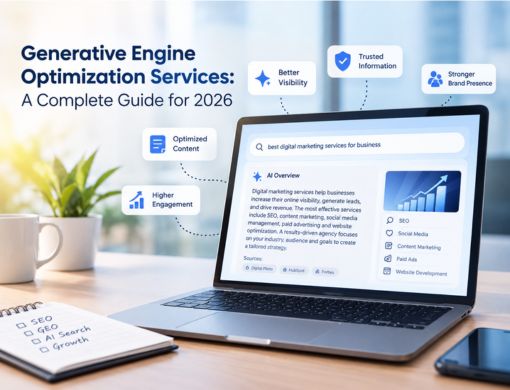
Generative engine optimization services help businesses improve how their content, expertise, products, and brand information can be discovered, understood, and potentially referenced across AI-powered search experiences. In 2026, effective GEO is not a replacement for SEO. It combines strong technical foundations, useful original content, clear entities, trustworthy information, and continuous measurement to support visibility across traditional and generative search.
If you are evaluating generative engine optimization services, the important question is not simply whether an agency promises to “rank you in ChatGPT.” AI systems do not provide one universal ranking system, and their responses can vary by query, source availability, location, language, freshness, and the underlying system.
What Are Generative Engine Optimization Services?
Generative engine optimization, or GEO, is the practice of improving a brand’s online information so that generative search systems can better discover, interpret, evaluate, and potentially use it when answering relevant user questions.
The concept emerged from research into generative engines that synthesize information from multiple sources rather than simply displaying a list of links. The original GEO research found that optimization strategies could influence visibility in generated responses under its experimental conditions, but subsequent research has highlighted the variability and limitations of the evidence.
In practical terms, GEO is therefore less about finding a secret AI ranking factor and more about improving the quality and accessibility of the information that represents a business online.
How Is GEO Different From Traditional SEO?
SEO primarily helps search engines discover, understand, and rank web pages for search queries. GEO extends the conversation to generative experiences where systems may retrieve information from multiple sources and synthesize an answer.
| Traditional SEO | Generative Search / GEO |
|---|---|
| Focuses strongly on organic search visibility | Focuses on visibility within AI-generated answers and discovery experiences |
| Optimizes pages for search intent and rankings | Improves information clarity, relevance, context, and source usefulness |
| Uses rankings, impressions, clicks and conversions as key measurements | Can also examine AI visibility, citations, mentions, impressions and resulting engagement |
| Relies heavily on search-engine crawling, indexing and ranking | May involve retrieval and synthesis across multiple sources and systems |
The distinction should not be exaggerated. Google explicitly states that existing SEO best practices remain relevant to AI Overviews and AI Mode because these experiences are grounded in Google’s broader Search systems.
What Should a GEO Service Actually Include?
A credible GEO programme should begin with the same fundamentals that support strong search visibility, then add specific analysis of how a brand is represented in generative search environments.
1. Technical and Crawlability Analysis
Before optimizing content for AI discovery, a website needs to be accessible to search systems. This includes crawlability, indexability, internal linking, rendering, page experience, canonicalization, and the availability of important information in text.
Google’s current guidance confirms that pages generally need to be indexed and eligible for normal Search visibility to be eligible as supporting links in AI Overviews or AI Mode.
2. Entity and Brand Understanding
AI systems need context. A company should be clearly associated with its products, services, locations, people, expertise, industries, and other relevant entities.
This means creating consistent information across important website pages and legitimate external sources rather than repeatedly inserting the brand name into unrelated content.
3. Content Optimization
Strong GEO content answers real questions directly and then provides sufficient evidence, explanation, examples, qualifications, and context. Headings, descriptive paragraphs, tables, lists, definitions, and concise answers can make information easier for both humans and search systems to understand.
However, formatting alone is not a GEO strategy. Google’s 2026 guidance specifically emphasizes unique, useful, non-commodity content rather than content created simply to target every possible search variation.
4. Authority and Supporting Sources
Generative systems can draw information from multiple sources. That makes the wider information environment around a business important. Relevant third-party coverage, industry publications, reputable directories, expert contributions, reviews, and other legitimate references can help establish context when they are genuinely earned and relevant.
This should not be confused with mass-produced mentions. Creating artificial references solely to influence AI responses can create low-quality signals and may conflict with search spam policies.
How Should Businesses Measure GEO Performance?
GEO should be measured as a visibility and business-outcome programme, not through a single “AI ranking” number. Generative systems can produce different answers for similar prompts, so repeated testing and broader performance analysis are more meaningful than one isolated result.
- Generative visibility: Does the brand appear for relevant questions?
- Citation presence: Is the business website or another authoritative source referenced?
- Accuracy: Is the information presented about the brand correct?
- Search performance: Are organic impressions, clicks and rankings improving?
- Business outcomes: Are qualified enquiries, leads, sales or other meaningful conversions increasing?
Google’s 2026 Search Console updates are particularly relevant here: Google introduced dedicated generative-AI performance reporting for visibility in features such as AI Overviews and AI Mode, while retaining this information within the broader Search performance picture.
What GEO Tactics Should Businesses Avoid?
One of the biggest mistakes is treating GEO as a shortcut around established SEO and content-quality principles. There is no reliable formula that guarantees an AI system will mention a company.
- Do not mass-produce near-identical pages simply to target every AI query variation.
- Do not publish generic AI-generated content without meaningful editorial value.
- Do not manufacture irrelevant brand mentions or citations.
- Do not assume that adding special AI files or markup automatically creates generative visibility.
- Do not measure success solely by whether a brand appears in one AI response.
Google’s current guidance explicitly warns against creating large volumes of content primarily to manipulate Search or generative responses. It also says there is no special schema or additional technical requirement specifically required for AI Overviews or AI Mode beyond the normal Search requirements.
Why Website Structure Still Matters in the AI Search Era
GEO is not only a content exercise. A business can publish excellent information and still create unnecessary barriers if important pages are difficult to crawl, poorly connected, slow, confusing, or dependent on inaccessible content.
This is where technical SEO and development work become important. For businesses rebuilding or expanding their digital presence, working with a Web Development Company in Kolkata can help ensure that website architecture, content presentation, performance, and technical accessibility support the broader search strategy.
What Does a Practical GEO Strategy Look Like?
A practical GEO programme can be organized into five stages:
- Audit: Review technical SEO, content, brand entities, existing visibility, and important information gaps.
- Map: Identify the questions, topics, entities, products, services, and audiences most relevant to the business.
- Improve: Strengthen important pages with original information, clear explanations, evidence, useful media, and better internal connections.
- Strengthen: Develop legitimate authority through relevant digital PR, expert contributions, partnerships, reviews, and other appropriate external signals.
- Measure: Monitor organic search performance, generative visibility, citations, brand accuracy, engagement, and conversions.
This approach also leaves room to adapt as AI search systems change. That matters because generative search is still developing, and different platforms can retrieve and present information differently.
Are Generative Engine Optimization Services Worth Investing In?
They can be useful when GEO is treated as an extension of a broader search and content strategy rather than as a standalone shortcut. Businesses that already have technical weaknesses, thin content, inconsistent brand information, or weak search foundations should generally address those issues rather than jumping straight to specialised GEO tactics.
The strongest business case comes from improving assets that have value regardless of which search interface a customer uses: accurate service information, authoritative content, strong technical foundations, useful resources, credible brand signals, and a website that makes it easy for visitors to take the next step.
Frequently Asked Questions
What is generative engine optimization?
Generative engine optimization is the practice of improving a brand’s online information so generative search systems can more effectively discover, understand, evaluate, and potentially reference it in relevant answers.
Does GEO replace SEO?
No. Google states that SEO best practices remain relevant to AI Overviews and AI Mode. GEO is better understood as an extension of search visibility work rather than a replacement for SEO.
Can an agency guarantee that my business will appear in ChatGPT or Google AI results?
A responsible provider should be cautious about guarantees. Generative responses can vary according to the system, query, available sources, freshness, location, and other factors. No universal GEO ranking position exists across all AI systems.
What should I look for when hiring a GEO agency?
Look for a provider that explains its methodology clearly, connects GEO with technical SEO and content quality, defines measurable outcomes, avoids artificial tactics, and reports what was actually changed and measured.
How can GEO performance be measured?
Measurement can include generative-search visibility, citations, brand accuracy, organic impressions and clicks, engagement, qualified leads, sales, and other business outcomes. Google now provides dedicated generative-AI visibility reporting through Search Console.
Conclusion
The future of search is becoming more conversational, multimodal, and answer-oriented, but the fundamentals have not disappeared. The businesses most prepared for generative search are not necessarily those chasing the newest GEO trick; they are the ones that make their expertise easy to discover, understand, verify, and use.
For 2026, that makes the practical role of generative engine optimization services clear: strengthen the technical foundation, improve the quality and usefulness of information, build legitimate authority, monitor how the brand is represented across AI search experiences, and connect visibility to real business outcomes.
Also Read: Generative AI SEO Agency: The Future of Search Optimization
Blog Development Credits:
This article idea was originally shaped by Amlan Maiti. It was researched and drafted using AI platforms such as ChatGPT, Gemini, and Copilot, and later refined with SEO insights from Digital Piloto Private Limited.