Generative AI is changing how people discover brands, compare solutions, and decide what deserves their attention. But does every industry need a completely different approach? Not necessarily. The smartest GEO strategies share a common foundation: useful information, clear expertise, strong context, and content that AI systems can understand and confidently reference.
That is where a generative engine optimization specialist can add real value. Rather than treating GEO as another isolated marketing trend, the goal is to build a repeatable framework that can adapt to healthcare, e-commerce, finance, technology, hospitality, professional services, and almost any other sector.
Start With the Questions Your Audience Asks
Traditional SEO often begins with keywords. GEO needs a slightly broader mindset. People using AI-powered search frequently ask complete questions, request comparisons, or describe a problem in ordinary language.
Imagine someone asking, “Which accounting software is best for a growing construction company?” A page targeting only “accounting software” misses much of the context. A useful resource could discuss industry-specific requirements, integrations, pricing considerations, implementation concerns, and common mistakes.
This approach works across industries because customer questions are usually more meaningful than isolated search terms.
- Collect questions from sales calls, customer support, reviews, and forums.
- Group questions by awareness, comparison, and purchase intent.
- Create answers that provide context instead of forcing keywords into every paragraph.
Create Industry-Specific Expertise
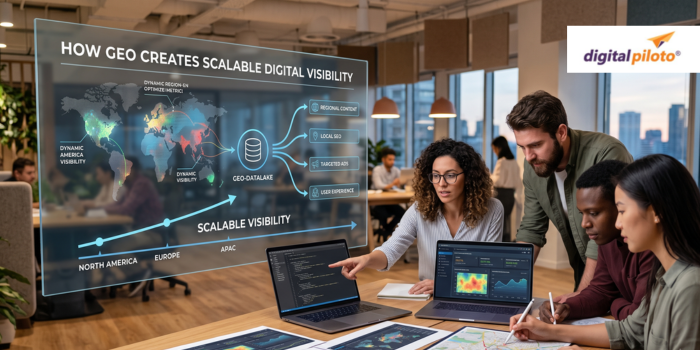
Scalable does not mean generic. That distinction matters. A successful GEO framework should have consistent principles while allowing the actual information to change dramatically by sector.
A healthcare brand may need medically responsible explanations and clearly attributed expertise. A B2B technology company might need technical comparisons, implementation examples, and integration details. A hotel could focus on location questions, amenities, travel planning, and guest experience.
Build content around genuine knowledge
Strong brand visibility in AI-driven search depends partly on whether the underlying information is credible and useful. Google’s guidance on helpful content encourages original information, first-hand expertise, and content created primarily to benefit people rather than manipulate search rankings. Google Search Central outlines these principles.
In practice, businesses should demonstrate expertise through examples, original research, expert commentary, transparent methodology, and practical explanations. Those details give content substance that generic articles often lack.
Use a Repeatable GEO Content Framework
Once the foundation is established, scaling becomes much easier. Instead of inventing a new content process for every campaign, develop a framework that teams can reuse across industries and locations.
- Discover: Identify real customer questions, industry terminology, pain points, and decision factors.
- Structure: Organise answers with descriptive headings, concise explanations, examples, and supporting evidence.
- Differentiate: Add original insights, expert opinions, data, case examples, or experiences competitors cannot easily duplicate.
- Review: Check accuracy, freshness, clarity, and whether the content genuinely answers the intended question.
This makes a geo strategy easier to scale without turning the website into a collection of repetitive AI-generated pages.
Make Information Easy to Understand
AI systems can process enormous quantities of information, but that does not mean businesses should make their content complicated. Quite the opposite. Clear writing, logical organisation, descriptive headings, supporting evidence, and direct answers make information easier for both humans and machines to interpret.
Google’s structured data documentation explains that structured data helps search engines understand page content and can make pages eligible for certain enhanced search features. Google’s structured data guidance is a useful technical reference when implementing this layer.
Connect GEO With Traditional SEO
One common mistake is treating GEO as a replacement for SEO. It is better understood as an extension of a strong digital foundation. Technical accessibility, useful content, internal linking, authoritative references, and a well-organised website still matter.
A capable SEO Service Provider in India can help businesses bring these disciplines together rather than running disconnected SEO and GEO campaigns.
- Keep important pages crawlable and logically connected.
- Build topical authority instead of publishing disconnected articles.
- Update factual information as products, regulations, markets, and customer expectations change.
Measure Visibility Beyond Rankings
GEO measurement requires a wider lens. Traditional rankings remain useful, but businesses should also watch branded searches, referral patterns, qualified traffic, assisted conversions, mentions, and how often their expertise appears in relevant AI-generated answers.
It is also worth remembering that generative search behaviour is evolving quickly. No single metric can tell the entire story. The better approach is to establish a baseline, monitor multiple signals, and improve the content that supports real commercial outcomes.
FAQs
1. What is GEO in digital marketing?
GEO, or Generative Engine Optimization, focuses on making a brand’s information useful, understandable, and credible enough to be surfaced or referenced by AI-powered search and answer systems.
2. Can one GEO strategy work across different industries?
Yes, the framework can be standardised, but the content should remain industry-specific. The same principles can guide healthcare, finance, retail, technology, hospitality, and professional services while the expertise and evidence differ.
3. Is GEO replacing traditional SEO?
No. GEO and SEO work best together. A technically healthy website, strong content, clear site architecture, and authoritative information provide a valuable foundation for visibility across both conventional and AI-assisted search.
4. How should businesses measure GEO success?
Look beyond rankings. Track qualified organic traffic, branded demand, conversions, relevant mentions, referral activity, and other signals showing whether AI-assisted discovery is contributing to genuine business visibility and growth.
Final Thoughts
The real power of GEO is not producing more content at greater speed. It is building a system that turns genuine business knowledge into clear, useful answers—again and again. When that system is flexible enough to respect each industry’s expertise while remaining operationally consistent, GEO becomes less of a trend and more of a scalable visibility strategy.
Blog development credits
This article was developed through expert research supported by AI-powered tools, then carefully refined and SEO-enhanced by Digital Piloto Private Limited, following the strategic guidance of Amlan Maiti.
Full Audio Version:- Click Here