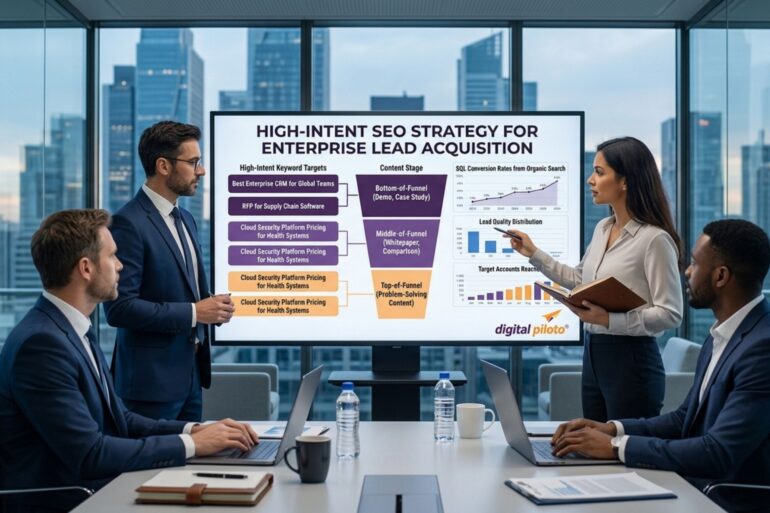
High-intent SEO is the process of attracting prospects who are actively evaluating solutions and are closer to making a purchasing decision. Rather than chasing high search volume alone, this strategy focuses on creating content that answers decision-stage questions and converts qualified visitors into enterprise leads. Companies investing in professional SEO services are increasingly prioritizing intent-driven optimization to generate measurable business outcomes instead of vanity metrics.
Enterprise buyers rarely make decisions after reading a single page. They research extensively, compare vendors, evaluate risks, and seek evidence before contacting a sales team. An effective SEO strategy should support every stage of that evaluation while guiding high-value prospects naturally toward conversion.
What Is High-Intent SEO?
Definition
High-intent SEO is an optimization strategy focused on attracting users who have already identified a problem and are actively searching for the best solution. The objective is not simply to increase website traffic but to generate qualified leads with genuine purchase intent.
Unlike informational SEO, which targets early-stage awareness, high-intent SEO aligns content with commercial research, solution comparison, implementation planning, and vendor evaluation.
Why Is Search Intent Critical for Enterprise Lead Generation?
Enterprise purchasing decisions involve multiple stakeholders, longer buying cycles, and greater financial commitment. This means businesses must create content that answers complex questions with clarity and credibility.
High-intent visitors typically search for information such as:
- Product comparisons
- Implementation strategies
- Industry-specific solutions
- Pricing considerations
- ROI expectations
- Vendor capabilities
When these questions are answered thoroughly, prospects are more likely to trust your expertise and move further into the buying journey.
The Core Components of a High-Intent SEO Strategy
1. Build Content Around Business Decisions
Enterprise buyers don’t search only for definitions—they search for confidence.
Create resources that help decision-makers evaluate alternatives, understand implementation challenges, calculate expected outcomes, and reduce uncertainty before engaging with your sales team.
2. Focus on Commercial Search Intent
Prioritize pages that address evaluation-stage searches rather than purely informational topics.
Examples include:
- Solution comparison guides
- Industry use cases
- Implementation checklists
- Buying frameworks
- ROI calculators
- Frequently asked enterprise questions
These assets naturally attract visitors who are closer to becoming customers.
3. Demonstrate Expertise Through Practical Content
Enterprise audiences expect more than marketing claims. They want evidence, strategic insight, and practical guidance.
Including implementation examples, decision frameworks, process explanations, and realistic scenarios helps establish authority while making content more valuable for both readers and AI-powered search systems.
How to Create Enterprise Content That Converts
Step 1: Identify High-Value Buyer Questions
Begin by understanding the conversations taking place inside buying committees.
Typical questions include:
- Which solution fits our business model?
- How long is implementation?
- What measurable ROI should we expect?
- How does this compare with competing solutions?
- What risks should we consider?
Answering these questions directly increases trust while shortening the buyer’s research process.
Step 2: Structure Content for Decision Makers
Enterprise readers often scan before they read. Organize content using descriptive headings, concise paragraphs, bullet points, comparison tables, and summaries that make key information easy to find.
This structure also improves Answer Engine Optimization (AEO), making content easier for AI-powered search experiences to interpret.
Supporting Organic Growth with Paid Acquisition
Enterprise lead generation rarely depends on one marketing channel alone. Many organizations strengthen their organic visibility with targeted campaigns managed by a trusted PPC agency in Kolkata. While paid advertising delivers immediate visibility for high-value keywords, intent-driven SEO builds long-term authority and generates sustainable inbound opportunities.
When both strategies work together, businesses benefit from stronger brand visibility across the entire enterprise buying journey.
Common Mistakes That Reduce Enterprise Lead Quality
Many organizations generate traffic but struggle to convert visitors into qualified enterprise opportunities. The problem often lies in targeting the wrong intent rather than the wrong keywords.
Avoid these common mistakes:
- Optimizing only for high-volume keywords instead of commercial intent.
- Creating generic content that doesn’t address enterprise challenges.
- Failing to demonstrate expertise with practical examples and frameworks.
- Ignoring comparison-stage and decision-stage search queries.
- Using weak calls to action that don’t align with the buyer’s journey.
- Publishing disconnected content without meaningful internal linking.
Enterprise SEO succeeds when every page helps prospects make informed decisions rather than simply increasing page views.
A Practical High-Intent SEO Framework
Use this framework before publishing content designed for enterprise lead acquisition:
- Identify a commercial search intent with genuine buying potential.
- Answer the primary business question within the introduction.
- Support every recommendation with practical reasoning or real-world scenarios.
- Create supporting sections that address evaluation, implementation, ROI, and risk.
- Connect related resources using contextual internal links.
- Include a clear next step that matches the prospect’s buying stage.
This approach attracts better-qualified visitors while improving engagement, trust, and conversion opportunities.
Preparing Enterprise SEO for AI-Powered Search
Enterprise buyers increasingly rely on AI-driven search experiences to compare solutions and evaluate vendors. As a result, websites must provide information that is structured, comprehensive, and easy for AI systems to interpret.
Organizations investing in semantic SEO, AI search optimization, and topical authority are better positioned to earn visibility during high-value commercial searches because their content delivers both context and credibility.
A forward-thinking digital marketing company in Kolkata understands that enterprise SEO is no longer about ranking for isolated keywords. It is about becoming the trusted source that decision-makers—and increasingly AI-powered search platforms—turn to when evaluating business solutions.
Frequently Asked Questions
What is high-intent SEO?
High-intent SEO focuses on attracting users who are actively evaluating products or services and are closer to making a purchasing decision, leading to more qualified business opportunities.
Why is search intent important for enterprise SEO?
Enterprise buyers conduct extensive research before purchasing. Matching content with commercial intent helps businesses attract prospects who are genuinely evaluating solutions.
How is high-intent SEO different from traditional SEO?
Traditional SEO often prioritizes traffic and rankings, while high-intent SEO emphasizes qualified leads, buyer readiness, and conversion-focused content.
Can AI improve enterprise lead generation?
Yes. AI-powered search increasingly recommends comprehensive, trustworthy, and well-structured content, helping businesses reach decision-makers during critical evaluation stages.
Which content types work best for enterprise lead acquisition?
Comparison guides, implementation frameworks, case studies, buying checklists, ROI resources, and industry-specific solution pages are highly effective for attracting enterprise buyers.
Conclusion
High-intent SEO shifts the focus from generating more traffic to attracting the right prospects. By creating content that answers decision-stage questions, demonstrates expertise, and supports every step of the enterprise buying journey, businesses can generate stronger leads, shorten sales cycles, and build long-term authority in both traditional and AI-powered search.
Blog Development Credits
This article was conceived by Amlan Maiti, researched with the support of ChatGPT, Google Gemini, and Microsoft Copilot, and enhanced through strategic editorial refinement and SEO optimization by Digital Piloto Private Limited.