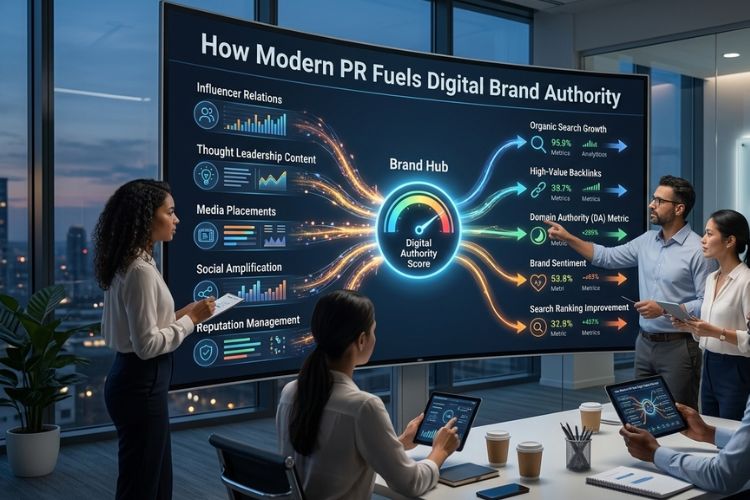
Modern PR fuels digital brand authority by earning credible media mentions, authoritative backlinks, expert citations, and consistent brand visibility across trusted online platforms. Today, successful public relations is no longer limited to newspaper coverage—it directly strengthens SEO, AI search visibility, and customer trust. Businesses that combine strategic storytelling with digital marketing services build authority that both people and search engines recognize.
Whether you’re an established enterprise or an emerging startup, modern PR has become one of the strongest signals of credibility. Every meaningful mention, interview, expert quote, or industry publication contributes to your digital reputation, making your website more trustworthy for users, search engines, and AI-powered search experiences alike.
What Is Modern Digital PR?
Definition
Modern Digital PR is the practice of building online authority through high-quality media coverage, expert positioning, digital publications, influencer collaborations, and valuable brand mentions that improve both public perception and organic search performance.
Unlike traditional PR, today’s approach focuses on creating measurable digital assets that influence search visibility, referral traffic, brand awareness, and long-term credibility.
Why Digital Brand Authority Matters More Than Ever
Search engines have evolved significantly over the past few years. Google’s algorithms—and increasingly AI-powered search assistants—look beyond keywords. They evaluate whether a brand demonstrates expertise, trustworthiness, and consistent recognition across reputable sources.
This means authority is no longer built solely through on-page optimization. It grows when trusted publications, respected professionals, and industry communities reference your business naturally.
For companies working with an experienced SEO company, integrating Digital PR into an SEO strategy creates stronger and more sustainable search performance.
How Modern PR Strengthens SEO and AI Visibility
Many marketers still separate PR and SEO into different departments. In reality, they work best together because both pursue the same outcome: trust.
- High-authority publications generate valuable backlinks.
- Brand mentions strengthen entity recognition.
- Expert interviews improve E-E-A-T signals.
- Industry citations increase topical authority.
- Positive media coverage improves brand reputation.
- Digital publications help AI systems identify trusted sources.
Rather than chasing hundreds of low-quality links, modern PR focuses on earning genuine recognition from authoritative websites that already have established credibility.
The Modern PR Authority Framework
Step 1: Build a Story Worth Sharing
Journalists rarely cover businesses simply because they exist. They cover ideas, innovations, customer success stories, industry research, and expert insights.
Create stories that educate or solve problems instead of promoting products.
Step 2: Publish Original Research
Original data naturally attracts citations. Surveys, market reports, customer insights, and industry benchmarks often become reference material for blogs, news sites, and AI-generated answers.
Step 3: Position Company Experts
Authority is easier to establish when real people represent the brand.
Executives, founders, consultants, and specialists should contribute guest articles, podcasts, webinars, and interviews that demonstrate practical expertise.
Step 4: Earn Quality Mentions Consistently
One media feature rarely changes everything.
Authority develops through continuous visibility across respected publications, niche blogs, podcasts, and professional communities.
Characteristics of High-Impact Digital PR
- Original and newsworthy content.
- Expert commentary backed by experience.
- Industry-specific publications.
- High-authority backlinks.
- Consistent brand messaging.
- Long-term relationship building with journalists.
- Value-driven communication instead of promotional messaging.
How PR and Content Marketing Work Together
Content gives PR something meaningful to promote, while PR gives content wider visibility.
For example, publishing an in-depth industry report can become the foundation for media outreach, LinkedIn discussions, podcasts, newsletters, webinars, and expert interviews.
This multiplies exposure while creating multiple trust signals for search engines.
Integrating PR Into Your Digital Marketing Strategy
Step-by-Step Process
- Identify topics your audience genuinely cares about.
- Create original research or expert-driven resources.
- Develop compelling media pitches.
- Reach out to journalists, publishers, and industry websites.
- Monitor earned mentions and backlinks.
- Refresh successful stories with updated insights.
- Measure authority growth alongside SEO performance.
This integrated approach often produces stronger long-term results than isolated SEO campaigns.
Where Paid Advertising Complements PR
While earned media builds credibility, strategic advertising amplifies visibility. Businesses frequently combine PR campaigns with PPC services in Kolkata to promote major announcements, industry reports, webinars, or product launches.
The paid campaign drives immediate exposure, while PR generates lasting authority through editorial mentions and trusted third-party coverage.
Common Digital PR Mistakes That Limit Brand Authority
Even well-intentioned PR campaigns can fall short when they focus on publicity instead of long-term credibility. Sustainable digital authority comes from consistency, relevance, and authenticity.
- Sending generic press releases with little news value.
- Targeting quantity of media mentions over publication quality.
- Ignoring niche industry websites that influence buying decisions.
- Publishing promotional content without expert insights or supporting data.
- Failing to measure referral traffic, backlinks, and brand mentions.
Brands that consistently share meaningful expertise are more likely to become trusted references for both users and AI-powered search experiences.
Conclusion
Modern PR is no longer just about gaining publicity—it is about earning trust that compounds over time. Every authoritative mention, expert contribution, and quality backlink strengthens your digital footprint. Businesses that align PR with SEO, content strategy, and customer value are far better positioned to build lasting digital brand authority, outperform competitors, and remain visible as search continues to evolve.
Frequently Asked Questions
1. How does modern PR improve SEO?
Modern PR earns authoritative backlinks, trusted brand mentions, expert citations, and referral traffic that strengthen domain authority and improve organic search visibility.
2. Is Digital PR different from traditional public relations?
Yes. Digital PR focuses on online publications, backlinks, digital media coverage, podcasts, influencer collaborations, and measurable SEO outcomes rather than only print or broadcast exposure.
3. Why is Digital PR important for AI-powered search?
AI search systems rely on trusted sources and recognized entities. Consistent mentions across authoritative websites help establish credibility and improve the likelihood of being referenced in AI-generated answers.
4. Can small businesses benefit from Digital PR?
Absolutely. Even local businesses can build authority by publishing original insights, earning coverage in niche publications, participating in industry discussions, and sharing expert knowledge.
5. Should Digital PR replace SEO?
No. Digital PR and SEO complement one another. SEO improves technical visibility, while PR builds the authority and trust signals that support long-term organic growth.
Blog Development Credits
This article was planned by Amlan Maiti, developed with insights from advanced AI platforms including ChatGPT, Google Gemini, and Copilot, and professionally refined with SEO enhancements by Digital Piloto Private Limited.