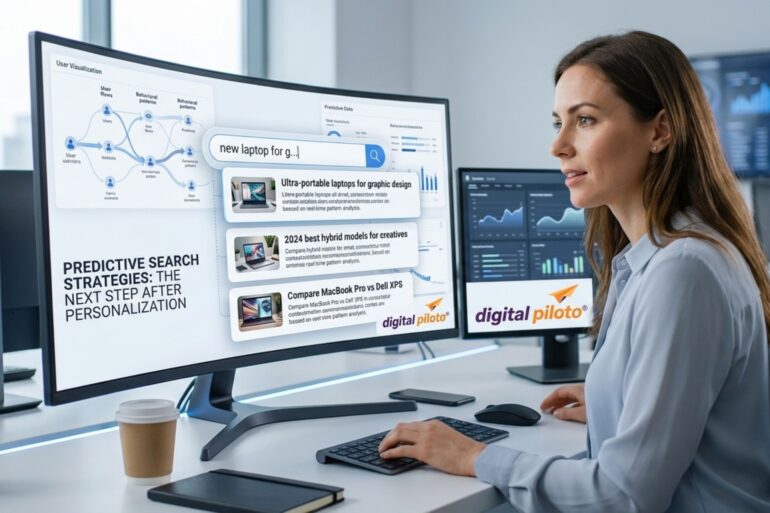
Personalized search changed the question from “What are you looking for?” to “What might suit you?” The next shift goes further: predictive search attempts to understand context, timing, intent, and likely next steps before a customer fully expresses them. For brands, that means visibility is no longer only about being relevant today. It is about becoming useful for what happens next.
For businesses investing in digital marketing services in Kolkata, this distinction is becoming important. Search is evolving from a retrieval system into something closer to an intelligent decision layer, where past behavior, current context, product information, and conversational signals can influence what people discover next.
Personalization Was Only the Beginning
Personalization usually answers a fairly straightforward question: “What is more relevant to this particular person?” Predictive search asks a harder one: “Given everything we know right now, what will this person probably need next?”
That sounds like a small change in wording. Strategically, it is not.
Imagine someone searching for “best running shoes for beginners.” A personalized search engine might use their location, previous searches, preferred brands, or browsing history to refine the results. A predictive system could go another step. It might recognize that the person recently searched for beginner training plans, compare shoe requirements with their likely running conditions, and surface content about sizing, injury prevention, or nearby retailers.
The search experience starts anticipating the journey rather than simply responding to an isolated query.
Google’s recent development of Personal Intelligence in AI Mode illustrates where search experiences are heading. Google says its system can connect information from services such as Gmail and Photos, when users choose to enable that context, to make responses more personally relevant. In India, Google has also introduced Personal Intelligence in Gemini, connecting information across selected Google services. Google’s explanation of Personal Intelligence and its India announcement provide useful examples.
What Predictive Search Actually Means
Predictive search should not be confused with a search box guessing the next word you will type. That is autocomplete. Predictive search, in the broader marketing sense, is about anticipating the information, product, service, or action a person may need based on multiple signals.
Those signals can include:
- Previous behavior: searches, clicks, purchases, saved items, and content interactions.
- Current intent: the language, urgency, complexity, and purpose behind a query.
- Context: location, device, time, season, journey stage, or other permitted contextual information.
- Relationships: connections between products, services, topics, brands, and entities.
- Patterns: recurring sequences that suggest what people commonly investigate or purchase next.
The important point is that prediction is probabilistic. A system is not reading someone’s mind. It is making an informed estimate from available signals.
That distinction matters for marketers. A prediction can be useful without being perfect. The objective is not to know exactly what every customer will do. It is to reduce the distance between a person’s current question and the next useful answer.
Why AI Is Accelerating the Shift
Traditional search was largely built around matching a query with documents. Modern AI search can interpret a much richer description of the user’s problem, break complex questions into related searches, and synthesize information from multiple sources.
Google reported in 2026 that AI Mode had surpassed one billion monthly users globally and that AI Mode queries had more than doubled each quarter since launch. Google has also described AI Mode as increasingly capable of handling longer, multimodal and conversational questions. Google’s 2026 AI Mode research documents this change.
That creates an interesting consequence for brands: the customer’s search journey may contain fewer obvious keyword moments.
A buyer may begin with a broad question, ask a follow-up, compare alternatives, request recommendations, investigate reviews, and finally ask an AI system what to buy. From the marketer’s perspective, these are separate queries. From the customer’s perspective, they are one continuous decision.
This is where predictive search strategy becomes valuable.
From Keyword Intent to Journey Intent
SEO has traditionally taught marketers to classify intent as informational, navigational, commercial, or transactional. That remains useful. But AI-mediated search makes the journey between those stages more fluid.
Consider a B2B buyer researching customer relationship management software.
- They first ask what a CRM does.
- They then investigate which CRM features matter for a growing company.
- Next, they compare platforms, implementation costs, integrations, and security.
- Finally, they ask for a shortlist suitable for their company size and industry.
A keyword-focused strategy might create separate pages for each query. A predictive strategy connects them into an information journey.
That means the real optimization question becomes: What question is likely to come next if this page successfully answers the current one?
This simple question can change content architecture dramatically. Instead of ending an article with a generic call to action, a brand can provide the next logical piece of information: a comparison, calculator, checklist, implementation guide, case evidence, product specification, or buying framework.
The New SEO Opportunity: Anticipating the Next Question
Predictive search does not make conventional SEO obsolete. Quite the opposite. Strong technical SEO, crawlability, useful content, clear entities, internal linking, structured information, and authoritative sources remain the foundation from which intelligent search systems can retrieve information.
But the content strategy needs another layer: next-question optimization.
Build content around sequences, not isolated keywords
Instead of creating a page for “SEO audit” and another unrelated page for “SEO strategy,” map the questions that naturally connect them. Someone evaluating an audit may next want to know what the findings mean, which problems should be fixed first, how much implementation costs, and how results will be measured.
Those relationships create a stronger content ecosystem.
Make important facts easy to retrieve
AI systems work with information, not marketing slogans. Product specifications, service boundaries, pricing conditions, locations, qualifications, processes, policies, comparisons, and evidence should be clearly stated.
A vague sentence such as “we deliver powerful digital solutions” tells a machine very little. A specific explanation of what a service includes, who it serves, what process it follows, and what evidence supports it is much more useful.
Think beyond the website visit
A customer may never land on your website before an AI system mentions your company. This makes off-site consistency increasingly important. Business profiles, third-party references, expert commentary, reviews, publications, social presence, and other credible sources can contribute to how a brand is understood.
Google’s recent guidance around original content and AI search also emphasizes helping people discover useful, original information rather than producing interchangeable content at scale. Google’s original-content guidance is particularly relevant to this shift.
Predictive Search and Generative Engine Optimization
This is where predictive search overlaps with GEO.
A generative AI SEO agency working on AI-search visibility should not only ask whether a brand appears for a target prompt. It should also investigate the wider question chain surrounding that prompt.
Suppose a company sells industrial packaging equipment. The obvious target might be “industrial packaging machine.” But a real buyer could ask an AI assistant:
- Which packaging machine is suitable for a high-volume food manufacturer?
- What maintenance issues should I expect?
- How much downtime does installation normally require?
- Which specifications should I compare between suppliers?
- What should I ask before requesting a quotation?
These questions expose the real competitive battlefield.
A brand that answers only the commercial keyword may be visible at one stage. A brand that consistently provides credible answers throughout the decision journey has more opportunities to become part of the AI-generated recommendation set.
That is a more mature interpretation of GEO: not chasing mentions, but building an information footprint that makes the brand useful across related decisions.
Data Quality Becomes a Marketing Issue
Predictive systems are only as useful as the information they can access and interpret. This makes fragmented customer data a surprisingly important marketing problem.
Salesforce reported in 2026 that 81% of marketers in India had adopted AI, while 86% said they would trust AI to respond to customers at scale. The same research identified disconnected or irrelevant data as a major constraint. Salesforce’s India State of Marketing findings illustrate why data infrastructure increasingly sits underneath personalization and AI-led engagement.
For businesses, this means predictive search strategy cannot live entirely inside the SEO department.
Marketing, CRM, sales, ecommerce, customer support, analytics, and content teams may all hold pieces of the customer journey. If those pieces contradict one another, prediction becomes weaker.
A practical predictive-search audit should therefore examine:
- Whether product and service information is accurate and consistent.
- Whether customer questions are captured across sales and support conversations.
- Whether content reflects different stages of the buying journey.
- Whether important business entities and relationships are clearly defined.
- Whether analytics can connect discovery, engagement, conversion, and retention signals.
Prediction Changes What “Relevant Content” Means
For years, relevance often meant matching a page to a search term. Predictive search expands that definition.
A relevant page may answer the current question and prepare the visitor for the next one.
Think about a travel website. A person searching for “three-day Kolkata itinerary” may also need transport guidance, weather considerations, neighborhood comparisons, restaurant suggestions, ticket information, and a realistic daily schedule. A useful system can connect those needs instead of forcing the traveler to start six new searches.
The same principle applies to B2B services, healthcare information, education, ecommerce, finance, hospitality, and local businesses.
Content should increasingly be designed as a connected decision environment rather than a collection of isolated landing pages.
How Businesses Can Prepare Now
You do not need a futuristic AI platform to begin. Start with the information already being generated by customers.
1. Mine real customer questions
Review sales calls, support tickets, chatbot conversations, search-console queries, reviews, FAQs, and lost-deal feedback. The questions customers ask repeatedly often reveal the next stage of their decision process.
2. Map the likely next action
For every important page, ask what a visitor would logically need next. Build internal links and supporting content around that progression.
3. Strengthen your evidence layer
Publish original research, first-hand observations, product specifications, expert explanations, documented processes, customer experiences, and other information that demonstrates genuine knowledge.
4. Measure discovery differently
Traffic still matters, but it should sit beside branded searches, qualified leads, assisted conversions, AI-referred visits, recommendation appearances, customer questions, and conversion quality.
McKinsey’s 2026 research describes the future of marketing as a continuous system combining insights, creativity, personalization, agentic commerce, and orchestration. The broader lesson is useful here: prediction works best when information, content, data, and execution operate as one connected loop. McKinsey’s 2026 marketing research explores this transition in detail.
Where Traditional SEO Still Fits
There is a temptation to treat predictive search as the replacement for SEO. That would be premature.
Search engines and AI systems still need accessible, understandable, trustworthy information. Technical foundations still matter. So do relevance, authority, original content, internal architecture, local signals, and user experience.
The difference is that SEO is increasingly becoming one component of a broader discovery strategy.
An experienced SEO agency Kolkata should therefore look beyond ranking individual pages. The larger question is whether the brand has enough useful information, clear relationships, trustworthy evidence, and contextual depth to remain discoverable as search becomes more conversational and predictive.
FAQs About Predictive Search
What is predictive search?
Predictive search uses signals such as intent, context, previous interactions, relationships, and behavioral patterns to anticipate information or recommendations a user may need next.
Is predictive search the same as personalized search?
No. Personalization makes results more relevant to an individual based on known preferences or context. Predictive search goes further by attempting to anticipate the user’s next need or action.
How does predictive search affect SEO?
SEO remains foundational, but content strategy must become more journey-oriented. Brands should answer related questions, strengthen entity clarity, provide evidence, and connect pages around real decision paths.
Can small businesses use predictive search strategies?
Yes. Small businesses can begin by analyzing customer questions, creating useful follow-up content, maintaining accurate business information, improving internal linking, and identifying recurring customer journeys.
Final Thoughts
Personalization taught search systems to understand that different people may want different answers. Predictive search takes the idea one step further: the most valuable answer may be the one that helps someone before they know exactly what to ask next.
For brands, this is less about guessing the future and more about understanding customers deeply enough to anticipate their information needs. The businesses that build that kind of connected knowledge now will be better prepared for a search environment where discovery, recommendation, and decision-making increasingly happen together.
Blog Development Credit
Conceptualized by Amlan Maiti, researched and drafted with advanced AI assistance, then refined and SEO-optimized by Digital Piloto Private Limited.