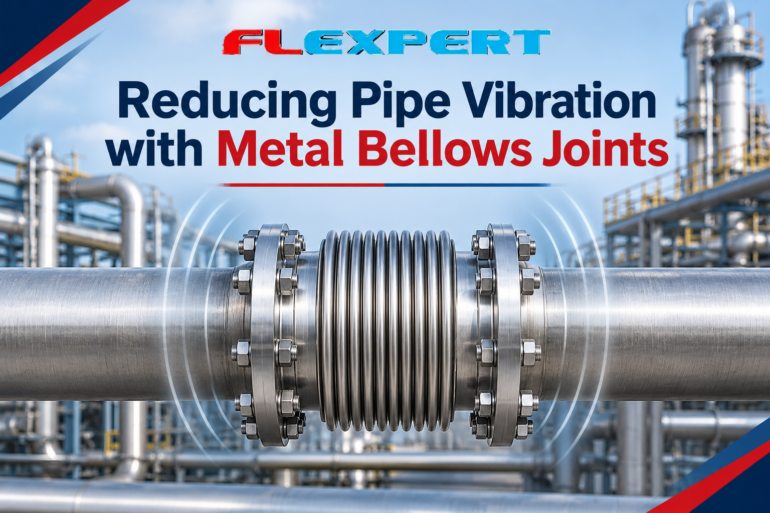
Have you ever wondered why industrial pipelines develop excessive vibration even when their equipment appears to be working normally? Continuous movement, pressure fluctuations, and mechanical forces can gradually affect piping performance. Managing these issues requires more than strong pipe materials. Properly selected metal bellows expansion joints can help accommodate movement and reduce the transmission of certain vibrations through connected piping systems.
Understanding Why Pipe Vibration Happens
Pipe vibration is a common challenge in industrial environments. Pumps, compressors, turbines, motors, and other rotating machinery can generate mechanical movement that travels through connected pipework. Fluid turbulence, pressure variations, and poorly supported pipelines can add to the problem.
At first, the movement might seem harmless. However, continuous vibration can loosen connections, increase stress around welded areas, damage nearby equipment, and contribute to premature fatigue. Think of it like repeatedly bending a paper clip. A single movement changes very little, but repeated bending eventually weakens the material.
This is why vibration management should be considered during the initial piping design rather than treated as a repair task after problems appear.
How Metal Bellows Joints Help Manage Vibration?
Metal bellows joints feature a flexible, corrugated metal section that allows controlled movement. Their convoluted construction enables the component to accommodate axial compression, extension, lateral movement, and angular rotation, depending on its design.
When appropriately engineered, these joints can help manage small-amplitude, high-frequency vibration and reduce the mechanical forces transferred between connected equipment and piping. They also accommodate thermal expansion, which is particularly useful in systems exposed to changing operating temperatures.
However, there is an important distinction: metal bellows joints are not universal vibration isolators. The Expansion Joint Manufacturers Association (EJMA) explains that metallic bellows are suitable for certain high-frequency, low-amplitude vibration applications, but are not generally suitable for low-frequency, high-amplitude vibration from reciprocating machinery. Pressure pulsations also require separate consideration.
For additional technical guidance, refer to the EJMA information on bellows design and movement capabilities.
Key Benefits of Using Metal Bellows in Industrial Piping
Beyond accommodating movement, properly designed bellows assemblies offer several practical advantages for industrial operations.
1. Reduced Mechanical Stress
Vibration and thermal movement can create unwanted loads on connected pipes and equipment. A suitably selected bellows joint accommodates specified movements, helping limit excessive mechanical stress when the complete piping system is properly supported.
2. Better Equipment Protection
Pumps and compressors are sensitive to excessive nozzle loads and piping misalignment. A correctly engineered flexible connection can help accommodate movement and reduce the transfer of mechanical forces to connected equipment.
3. Improved Operational Reliability
By managing expected movement and avoiding unnecessary loading, metal bellows joints can contribute to more dependable piping performance. Their suitability, however, depends on correct design, installation, and operating conditions.
4. Thermal Expansion Management
Industrial pipelines experience expansion and contraction as temperatures change. Bellows joints provide controlled flexibility, helping accommodate these movements without requiring excessive deformation of rigid pipe sections.
Important Factors When Selecting Metal Bellows Joints
Not every expansion joint is suitable for every vibration-related application. Choosing the correct configuration requires an understanding of actual site conditions and equipment behaviour.
Experienced engineers generally evaluate the following factors before finalising a design:
- Operating pressure and temperature: The joint must withstand the system’s design conditions and operating variations.
- Vibration frequency and amplitude: Identify the vibration source and determine whether the bellows design is suitable for the expected movement.
- Material compatibility: Stainless steel grades and other suitable alloys should be selected according to temperature, corrosion exposure, and process fluid.
- Movement requirements: Calculate axial, lateral, and angular movements rather than relying on assumptions.
- Fatigue life: Consider the expected number of operating cycles and repeated vibration loads.
- Pipe supports and restraints: Ensure anchors, guides, and supports control unwanted movement and pressure thrust.
The Importance of Proper Design and Installation
Even a high-quality expansion joint may perform poorly when installed incorrectly. Incorrect alignment, excessive movement, unsupported pipe sections, and unwanted torsional loading can reduce service life.
This is where working with an experienced expansion bellows manufacturer becomes valuable. A technically capable manufacturer can assess operating conditions, recommend appropriate bellows configurations, and help establish suitable design requirements.
Installation teams should also pay close attention to the manufacturer’s instructions. For a closer look at common problems, read Common Bellows Installation Mistakes That Can Reduce Performance.
For best results, consider these practical installation and maintenance recommendations:
- Check the alignment of adjoining pipe sections before connecting the expansion joint.
- Verify that anchors, guides, and supports are correctly positioned.
- Avoid twisting or forcing the bellows during installation.
- Inspect the convolutions periodically for corrosion, deformation, and visible damage.
- Investigate unusual vibration rather than assuming the expansion joint will compensate for every mechanical problem.
Remember, a bellows joint should never be used to correct an improperly designed piping layout.
Frequently Asked Questions
1. Can metal bellows expansion joints reduce pipe vibration?
Yes, suitably designed metal bellows can help accommodate certain high-frequency, low-amplitude vibrations and reduce mechanical vibration transmission. Their effectiveness depends on the vibration characteristics and overall piping arrangement.
2. Are metal bellows joints suitable for pump connections?
They can be used in selected pump piping applications when properly engineered for operating pressure, temperature, movement, and vibration. The pump manufacturer’s requirements and piping support arrangement should also be considered.
3. What causes metal bellows expansion joints to fail?
Common contributing factors include excessive movement, fatigue, corrosion, incorrect installation, pressure-related instability, and unwanted torsional loading. Proper design and regular inspection help reduce these risks.
4. How often should metal bellows joints be inspected?
Inspection frequency depends on operating conditions, service severity, and manufacturer recommendations. Systems experiencing frequent vibration, pressure fluctuations, or temperature cycling may require more frequent monitoring.
Final Thoughts
Controlling pipe vibration is about protecting the entire piping system, not simply reducing visible movement. Metal bellows expansion joints offer a practical solution for accommodating specified movements and managing certain vibration-related stresses when correctly selected and installed. With proper engineering, suitable materials, and regular maintenance, industrial facilities can improve piping reliability and support safer, more efficient operations.
Listen Here: Click Now