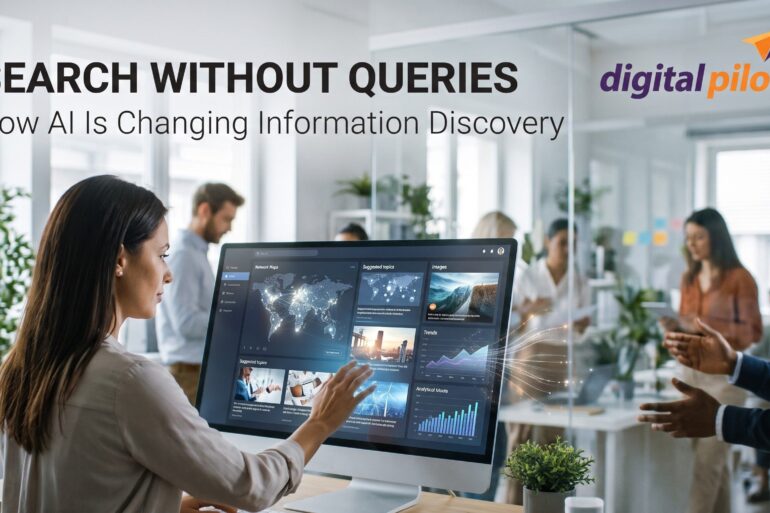
Imagine finding the perfect product, learning about an unfamiliar subject or discovering a solution to a problem without typing a single word. It may sound unusual, but information discovery is moving in that direction. AI is changing how people encounter useful information, making search less dependent on deliberate queries and more connected to interests, context and everyday experiences.
For brands working with the best digital marketing agency in India, this shift raises an important question: how can a business become visible when a potential customer has not even started searching? The answer involves understanding a wider discovery journey, where content, recommendations, visual experiences and AI-generated suggestions can influence decisions before a traditional search begins.
What Does Search Without Queries Actually Mean?
Traditional search usually begins with an action. A person opens a search engine, enters a phrase and looks through the results. The user knows, at least roughly, what they want to find.
Queryless discovery works differently. Information reaches people through recommendations, personalised feeds, visual recognition, predictive suggestions and AI assistants. Instead of asking a search engine to find something, users may encounter relevant information while browsing, watching a video, taking a photograph or using an application.
Think about someone scrolling through home décor inspiration. They notice a particular lighting design, tap an image and discover similar products. They did not begin with a keyword such as “modern pendant lights”. Their interest developed after seeing something relevant.
That is the essential difference: discovery can begin with exposure rather than an explicit question.
How AI Is Making Information Discovery More Proactive
AI-powered platforms can analyse patterns, recognise relationships and organise information in ways that make recommendations more relevant. They do not need to wait for every user to formulate a perfect query. Depending on the platform and available permissions, they can use signals such as content interactions, expressed interests, visual inputs and previous activity.
1. Personalised feeds anticipate interests
Recommendation feeds are among the clearest examples of discovery without traditional search. A person reading about electric vehicles may start seeing related content about battery technology, charging infrastructure and vehicle comparisons.
Google Discover, for example, presents content based on people’s interests and activity rather than requiring them to submit a fresh search for every article. Google’s Discover documentation explains that content can be selected according to individual interests and that older articles may also appear when they remain relevant.
For publishers, this creates an interesting opportunity. A well-researched article may reach someone because it matches an established interest, even if that person has not searched for the article’s main keyword.
2. Visual search turns objects into entry points
Sometimes people cannot describe what they are looking for. They simply recognise it when they see it.
Visual search makes that behaviour useful. A user can photograph a plant, scan a product, select an object on a screen or capture a piece of furniture to discover related information. AI helps interpret the image and connect it with relevant products, pages or explanations.
Google reported in October 2024 that Google Lens was being used for nearly 20 billion visual searches every month. The company also stated that one in five Lens searches was shopping-related. These figures illustrate how visual discovery had already become a significant way for people to explore products and information. The figures are from Google’s own announcement, not an independent measurement.
3. AI assistants connect information across topics
AI assistants can help people explore a subject through conversation. A user might ask for a weekend travel idea and then receive suggestions about destinations, transport, weather considerations and activities. The experience can move naturally from one subject to another.
More importantly, the user does not always need to know the right technical terms. They can describe a situation in ordinary language, share an image or provide additional details as the conversation develops.
This makes information discovery feel less like searching a catalogue and more like speaking with a knowledgeable guide. It is not perfect, of course, but it changes what users expect from digital experiences.
Why People May Discover a Brand Before Searching for It
Consider a small business owner who wants to improve online sales. A few months ago, the journey might have started with a Google search for a marketing agency. Today, the owner might first encounter a short educational video, read a recommended article about conversion problems and later see a case study shared by a professional community.
By the time the person searches for an agency, several brands may already feel familiar.
This is an important change in the customer journey. Brand awareness is no longer created only through keyword rankings, advertisements or direct website visits. It can develop through repeated exposure across different discovery environments.
Businesses should pay attention to several emerging touchpoints:
- Recommended content: Articles and videos appearing in personalised feeds can introduce a brand to people with relevant interests.
- Visual discovery: Product images, demonstrations and descriptive visual assets can help users find items without knowing their names.
- AI-generated recommendations: Assistants may introduce brands or solutions while helping users explore a broader problem.
- Social and community conversations: Reviews, expert discussions and shared experiences can influence what people investigate next.
These touchpoints do not replace traditional search. They expand the number of places where a business can become relevant.
What the Latest Research Suggests About Changing Search Habits
Evidence suggests that AI is influencing how people research, even when they continue using conventional search engines.
A January 2026 Gartner survey of 377 U.S. consumers, conducted in June and July 2025, found that only around one-third considered generative AI chatbots as effective as search engines for learning new information. The research also found that 31% said AI summaries made them spend more time searching, while 16% said they spent less.
This is a useful reminder that AI discovery is not simply a story of traditional search disappearing. People may use AI to explore possibilities, return to search engines to verify information and visit other platforms before making a decision.
The opportunity for businesses is therefore broader than appearing in one search result. They need to remain useful and recognisable across the different moments when people encounter information.
How Businesses Can Prepare for Queryless Discovery
When discovery happens without an explicit query, businesses cannot rely entirely on pages designed around exact-match keywords. They need a content and visibility strategy that gives people multiple reasons to notice, understand and trust a brand.
Create content people want to discover
Not every piece of content should feel like a direct sales pitch. Educational explainers, practical demonstrations, original research, expert opinions and useful visual guides can attract attention before a person enters the buying stage.
For example, a skincare company could publish a visual guide explaining common ingredient combinations rather than producing only product pages. A software provider might demonstrate how a team can solve a recurring workflow problem through a short video.
Such content gives recommendation systems and audiences something meaningful to engage with. It also introduces the brand through expertise rather than constant promotion.
Build a consistent brand identity
AI systems and users encounter businesses across many sources. If a company’s name, services, expertise and descriptions are inconsistent, understanding its identity becomes harder.
Businesses should maintain accurate company information, clear service descriptions, useful author profiles and consistent references across their website and relevant external platforms. A connected digital presence makes it easier for audiences to recognise what the organisation actually offers.
This is where a digital transformation agency India can support a more integrated approach, connecting content, website experience, technology and brand communication instead of treating each channel as a separate activity.
Make visual assets informative
Images and videos are no longer just decorative additions to a website. They can help people understand products, recognise services and explore unfamiliar subjects.
Use descriptive image filenames, meaningful alternative text, clear captions and high-quality original visuals. Product photographs should show useful details, while demonstration videos should explain what is happening rather than relying entirely on attractive editing.
Keep the technical foundations strong
Queryless discovery may reduce dependence on typed searches, but it does not make website quality irrelevant. Search engines and other discovery platforms still need to access, interpret and evaluate online content.
Businesses should prioritise:
- Crawlable pages: Important content should be accessible to search engine crawlers.
- Clear information architecture: Logical navigation and internal links help people and systems understand relationships between pages.
- Accurate structured data: Use relevant schema markup that reflects the information visible on the page.
- Mobile-friendly experiences: Pages should load and function properly across common devices.
- Reliable information: Support factual claims with credible sources and keep important pages updated.
These practices also support SEO marketing in India, where businesses need to maintain organic search visibility while adapting to newer discovery experiences.
Measuring Visibility Beyond Search Rankings
One challenge with queryless discovery is measurement. A person may see a brand in a recommendation feed, recognise it later in an AI-generated answer and eventually visit its website directly. Traditional last-click reporting may not reveal the entire journey.
Businesses should therefore examine a wider group of indicators:
- Referral traffic from recommendation platforms and content feeds.
- Engagement with videos, images and educational resources.
- Branded search trends and direct website visits.
- Qualified leads and assisted conversions across channels.
- Brand mentions and citations in AI discovery experiences, where measurement tools provide reliable data.
These indicators should be interpreted together. A rise in impressions does not automatically mean stronger demand, and a mention in an AI answer does not guarantee a customer. The real question is whether discovery is contributing to awareness, trust and meaningful business outcomes.
The Challenges: Privacy, Trust and Relevance
More proactive discovery also raises important concerns. Personalisation can be helpful, but people should have meaningful control over how their information and activity influence recommendations. Businesses must respect privacy requirements and avoid assuming that every available user signal can be used for marketing.
There is also the risk of creating an information bubble. If platforms repeatedly recommend similar material, users may miss alternative viewpoints or useful new subjects. AI-generated recommendations can also be inaccurate, outdated or poorly matched to someone’s actual needs.
For brands, this means relevance should never become an excuse for manipulation. Misleading headlines, artificial engagement and exaggerated claims may attract short-term attention, but they do little to build lasting confidence.
Frequently Asked Questions
1. What is search without queries?
Search without queries refers to discovering information without deliberately typing a search phrase. It can happen through personalised feeds, visual search, recommendations, AI assistants and other experiences that introduce relevant information based on context or interests.
2. How does AI help people discover information without searching?
AI can identify patterns, interpret images, connect related subjects and personalise recommendations. Depending on the platform, these capabilities can help surface useful content or products before a person enters a conventional search query.
3. Does queryless discovery mean traditional SEO is becoming irrelevant?
No. Traditional SEO remains important for helping search engines access and understand website content. However, businesses should expand their strategies to include visual discovery, helpful content, brand authority, recommendations and AI-driven search experiences.
4. How can businesses optimise for AI-driven information discovery?
Businesses can create useful and original content, maintain consistent brand information, publish descriptive visual assets, improve website accessibility and build credibility through reliable information. They should also monitor discovery and conversion signals across multiple platforms.
Final Thoughts: Visibility Starts Before the Search
The next stage of digital discovery will not always begin with a question typed into a search box. Sometimes it will begin with an image, a recommendation or an interest someone has not yet put into words. Businesses that create genuinely useful experiences and maintain a credible presence across platforms will be better prepared for this shift. In the emerging discovery landscape, being found matters, but being worth discovering matters even more.
Blog Development Credits
This article was conceptualised by Amlan Maiti, developed through research and AI-assisted writing, then refined with editorial and SEO improvements by Digital Piloto Private Limited.