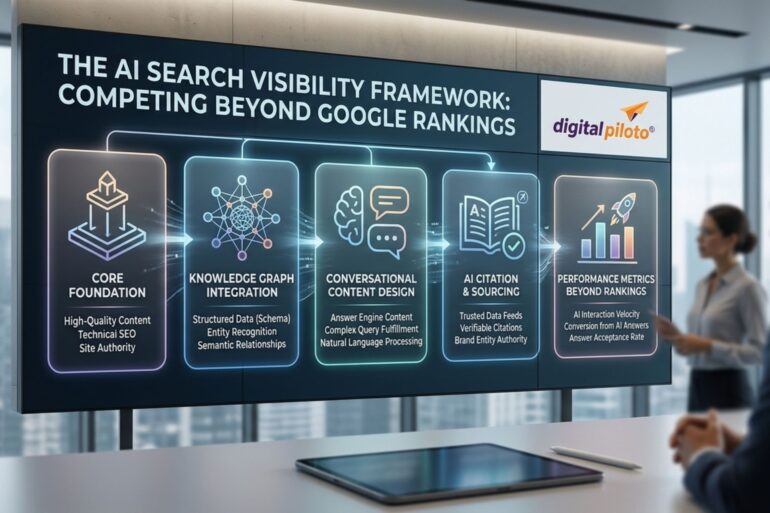
Ranking on Google is no longer the only measure of online success. Today’s brands also need visibility across AI-powered search engines, conversational assistants, recommendation systems, and answer engines. The AI Search Visibility Framework focuses on making your business discoverable, understandable, and trustworthy wherever AI generates answers, helping brands earn attention long before users ever visit a traditional search results page.
Businesses investing in a strong digital marketing company strategy are beginning to realize that visibility now extends far beyond search rankings. Instead of optimizing only for search engines, organizations must build digital assets that AI systems can confidently interpret, verify, and recommend across multiple platforms.
What Is the AI Search Visibility Framework?
Definition
The AI Search Visibility Framework is a strategic approach that combines technical SEO, structured content, entity optimization, authority building, and user experience to improve how artificial intelligence platforms understand and recommend a brand.
Unlike traditional SEO, which primarily focuses on ranking web pages, this framework aims to make an entire brand recognizable across AI-driven discovery channels.
Why Google Rankings Alone Are No Longer Enough
Consumers now discover products through ChatGPT, Google AI Overviews, Microsoft Copilot, Perplexity, voice assistants, social search, YouTube recommendations, and even marketplace search engines.
Many buying journeys begin with AI-generated recommendations instead of clicking ten blue links. That means businesses must optimize for visibility wherever decisions are being influenced.
A website ranking first for one keyword may still lose valuable leads if AI assistants consistently recommend better-structured competitors.
The Four Visibility Layers Modern Brands Need
1. Crawl Visibility
Search engines and AI crawlers still need fast-loading websites, logical architecture, XML sitemaps, structured data, and accessible content.
2. Entity Visibility
AI understands businesses through entities rather than isolated keywords. Brands should consistently present information about products, services, expertise, locations, and authors across every digital touchpoint.
3. Authority Visibility
Recommendation systems evaluate credibility using citations, reviews, mentions, expert content, trusted backlinks, and consistent brand signals.
4. Experience Visibility
User satisfaction has become an indirect ranking signal for both search engines and AI systems. Helpful content, intuitive navigation, and positive engagement strengthen long-term visibility.
Step-by-Step Framework for AI Search Visibility
Step 1: Build Strong Entity Foundations
Define every important business entity clearly.
- Organization
- Products
- Services
- Authors
- Locations
- Industries served
Consistency across websites, directories, knowledge panels, and social profiles improves AI confidence.
Step 2: Structure Information for Machines
Organize every page with clear headings, concise definitions, FAQs, schema markup, and logical internal linking.
AI systems extract structured answers far more efficiently from well-organized content than from long, unstructured paragraphs.
Step 3: Publish Comprehensive Topic Clusters
Instead of producing dozens of isolated keyword articles, build interconnected knowledge hubs.
For example, a cybersecurity SaaS company should connect content around:
- Threat detection
- Cloud security
- Compliance
- Incident response
- Zero Trust architecture
This creates stronger topical authority that AI systems recognize.
Optimize Content for AI Answers, Not Just Rankings
AI models prefer content that answers questions directly.
Instead of writing long introductions filled with keywords, begin each section with a concise answer followed by supporting details and practical examples.
This improves extraction accuracy while making content more useful for readers.
Characteristics of AI-Friendly Content
- Direct answers appear first.
- Definitions are concise and factual.
- Lists simplify complex concepts.
- Examples provide practical context.
- Clear headings improve machine understanding.
- Facts remain consistent across the website.
Integrate Paid and Organic Visibility
AI-driven marketing isn’t limited to organic discovery. Paid campaigns also generate behavioral data that strengthens audience insights, content planning, and conversion optimization.
Working alongside a beat PPC company in Kolkata allows businesses to identify high-converting search behavior, refine messaging, and discover new audience segments that can later be supported through organic AI-focused content.
Technical Signals Still Matter
Although AI search introduces new ranking considerations, technical SEO remains the foundation. Fast performance, mobile responsiveness, structured data, canonical URLs, crawl efficiency, and secure architecture all contribute to better machine understanding.
Many organizations working with professional SEO services are now expanding technical audits to include AI-readiness, entity validation, semantic content architecture, and knowledge graph optimization.
How to Measure AI Search Visibility
Traditional SEO metrics such as keyword rankings and organic traffic remain valuable, but they no longer tell the complete story. AI search introduces new visibility signals that reflect how often your brand is referenced, summarized, or recommended across intelligent search experiences.
Key Metrics to Monitor
- Brand mentions within AI-generated answers
- Citation frequency across trusted websites
- Entity recognition consistency
- Topical authority across related content clusters
- Engagement metrics such as dwell time and return visits
- Knowledge panel accuracy and completeness
- Organic conversions influenced by AI-assisted discovery
Looking at these indicators together provides a much clearer picture of your digital authority than rankings alone.
Common Mistakes That Limit AI Visibility
Many businesses unknowingly reduce their chances of appearing in AI-generated recommendations by relying on outdated SEO habits.
- Publishing repetitive, keyword-heavy content
- Ignoring structured data implementation
- Creating disconnected blog posts without topical depth
- Maintaining inconsistent business information across platforms
- Neglecting author credibility and trust signals
- Optimizing only for Google while overlooking emerging AI platforms
Modern optimization requires treating your website as a trusted knowledge source rather than simply a collection of ranking pages.
The Future Belongs to Trusted Digital Authorities
As AI assistants become the first stop for research, product comparisons, and purchasing decisions, businesses that invest in clarity, expertise, and structured knowledge will enjoy a significant competitive advantage.
The winning strategy is no longer to chase individual keywords. Instead, organizations should focus on building an authoritative digital ecosystem where every page reinforces the brand’s expertise and every digital signal supports machine understanding.
Frequently Asked Questions
1. What is AI search visibility?
AI search visibility is the ability of a brand to appear in AI-generated answers, recommendations, summaries, and conversational search experiences beyond traditional search engine rankings.
2. Is traditional SEO still important?
Yes. Technical SEO remains the foundation, but it should now be combined with entity optimization, structured content, and authority building for AI-driven search.
3. Why do entities matter in AI search?
AI systems understand relationships between entities such as organizations, products, authors, and services, making consistent entity signals essential for accurate recommendations.
4. Can small businesses compete in AI search?
Absolutely. High-quality content, clear expertise, structured information, and trusted brand signals often outperform larger competitors with weaker content strategies.
5. How often should an AI visibility strategy be reviewed?
A quarterly review is recommended to evaluate technical performance, content quality, structured data, entity consistency, and changes in AI search behavior.
Conclusion
AI-powered search is changing how people discover brands, evaluate products, and make purchasing decisions. Businesses that move beyond traditional ranking strategies and build authoritative, structured, and trustworthy digital ecosystems will be better positioned for sustainable growth. The future belongs to brands that are not only easy to find but also easy for AI systems to understand and confidently recommend.
Blog Development Credits
This article was planned by Amlan Maiti, developed with insights from advanced AI platforms including ChatGPT, Google Gemini, and Copilot, and professionally refined with SEO expertise by Digital Piloto Private Limited.