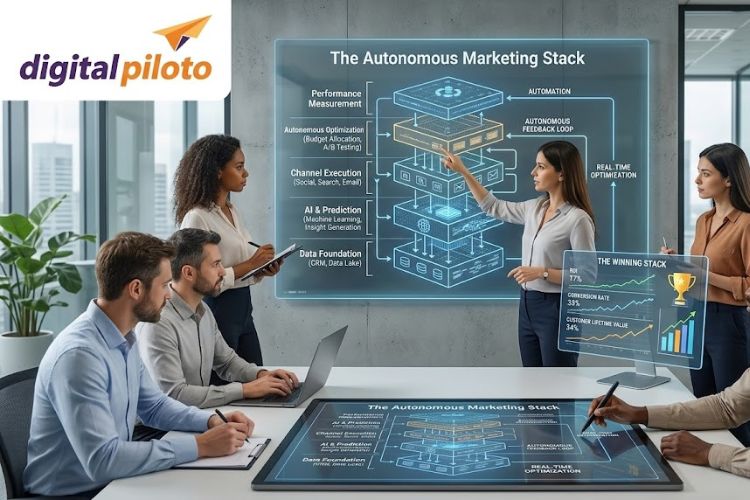
An autonomous marketing stack is a connected ecosystem of AI-powered tools that collect data, analyze customer behavior, make marketing decisions, and automate execution with minimal human intervention. Rather than replacing marketers, it empowers them to make faster, smarter decisions while focusing on strategy and creativity. Businesses that work with the best seo company in kolkata often combine automation with expert oversight to achieve sustainable digital growth.
Today’s customers expect personalized experiences across every channel. Managing campaigns manually is becoming increasingly difficult as customer journeys become more complex. An autonomous marketing stack helps businesses respond in real time, optimize performance continuously, and create marketing systems that improve themselves through data-driven learning.
What Is an Autonomous Marketing Stack?
Definition: An autonomous marketing stack is an integrated collection of AI-driven marketing technologies that automatically collect customer data, generate insights, personalize content, optimize campaigns, and measure performance with limited manual effort.
Unlike traditional marketing software, autonomous systems don’t simply automate repetitive tasks. They analyze patterns, predict outcomes, and recommend—or even execute—the next best marketing action based on live customer behavior.
Why Every Modern Business Needs One
Marketing has shifted from campaign-based execution to continuous customer engagement. Customers interact with brands through search engines, social media, websites, email, messaging apps, and AI-powered search experiences. Managing all these touchpoints manually often leads to inconsistent experiences.
An autonomous stack creates one connected ecosystem where every customer interaction contributes to better marketing decisions.
- Eliminates repetitive manual marketing tasks.
- Creates personalized customer experiences at scale.
- Improves campaign performance through predictive analytics.
- Responds instantly to changing customer behavior.
- Supports faster business growth with smarter automation.
The Core Components of an Autonomous Marketing Stack
1. Customer Data Platform (CDP)
A CDP unifies customer information from websites, CRM platforms, mobile apps, emails, and offline interactions into one comprehensive customer profile.
2. AI Analytics Engine
This layer identifies customer intent, predicts buying behavior, measures engagement patterns, and discovers opportunities that traditional analytics often miss.
3. Marketing Automation Platform
Automation platforms schedule emails, trigger workflows, manage lead nurturing, and personalize customer communication based on behavioral signals.
4. Content Intelligence System
AI helps marketers create, optimize, and personalize blogs, landing pages, advertisements, and email content based on audience preferences.
5. Performance Optimization Layer
This component continuously tests headlines, creatives, landing pages, and audience segments to maximize conversion rates.
How an Autonomous Marketing Stack Works
Step 1: Collect Data
Customer interactions from multiple channels are gathered automatically into one centralized system.
Step 2: Analyze Behavior
AI identifies buying intent, engagement trends, customer preferences, and potential drop-off points.
Step 3: Predict Outcomes
Machine learning forecasts which customers are most likely to convert, churn, or require additional engagement.
Step 4: Execute Personalized Campaigns
The system automatically delivers relevant emails, recommendations, advertisements, and website experiences.
Step 5: Learn and Improve
Every interaction becomes new training data, enabling future campaigns to perform even better.
Where Generative AI Fits Into the Stack
Generative AI has expanded the role of autonomous marketing beyond automation. It now assists with content creation, conversational search optimization, customer support, dynamic personalization, and campaign ideation.
Businesses working with a trusted generative AI seo agency are increasingly optimizing content not only for traditional search engines but also for AI-powered answer engines that summarize information directly for users.
This shift makes AI content optimization, predictive marketing, and intelligent automation essential parts of every future-ready marketing ecosystem.
Practical Benefits for Businesses
- Higher conversion rates: Personalized experiences improve customer engagement.
- Smarter budget allocation: AI shifts investment toward high-performing channels.
- Faster decision-making: Real-time insights replace delayed reporting.
- Consistent customer journeys: Every touchpoint works together seamlessly.
- Scalable growth: Marketing operations expand without proportional increases in workload.
Many organizations strengthen these capabilities further by integrating autonomous technologies with professional digital marketing services, allowing AI-driven execution to align with broader business objectives.
Common Mistakes to Avoid
- Implementing disconnected marketing tools.
- Ignoring data quality and governance.
- Automating poor customer experiences.
- Removing human oversight completely.
- Measuring only short-term campaign metrics.
The best autonomous marketing stacks combine AI efficiency with human creativity. Technology makes recommendations, while experienced marketers provide strategic judgment and brand direction.
Frequently Asked Questions
What is an autonomous marketing stack?
An autonomous marketing stack is a connected set of AI-powered marketing tools that automate customer analysis, personalization, campaign execution, and performance optimization.
How does an autonomous marketing stack improve marketing?
It uses artificial intelligence to analyze customer behavior, automate decisions, personalize campaigns, and continuously optimize marketing performance.
Is an autonomous marketing stack suitable for small businesses?
Yes. Many modern marketing platforms offer scalable AI features that help small businesses automate campaigns and improve efficiency without large teams.
Does AI replace marketing professionals?
No. AI enhances productivity by automating analysis and execution, while marketers remain responsible for strategy, creativity, branding, and customer relationships.
What technologies are included in an autonomous marketing stack?
Typical components include CRM platforms, customer data platforms, AI analytics, marketing automation software, predictive analytics, content intelligence, and conversion optimization tools.
Conclusion
The future of marketing isn’t about replacing people with technology—it’s about creating intelligent systems that allow people to make better decisions. An autonomous marketing stack helps businesses deliver more relevant customer experiences, respond faster to market changes, and scale growth with confidence. Organizations that thoughtfully combine AI automation with human expertise will be far better positioned for the next generation of digital marketing.
Blog development credits
This article was developed through strategic research, advanced AI-assisted analysis, and expert editorial review. Final SEO refinement and optimization were completed by Digital Piloto Private Limited, building on the strategic vision of Amlan Maiti.