The future of SEO is not a world without keywords. It is a shift from treating keywords as the entire optimization target toward understanding the intent, concepts, entities, relationships and evidence behind those searches. AI-powered search is accelerating this change, but Google’s own guidance makes an important point: SEO fundamentals still matter for AI Overviews and AI Mode. The future is therefore not “SEO versus AI.” It is SEO becoming more contextual, semantic and outcome-focused.
For businesses investing in digital marketing services in India, this distinction is strategically important. Keyword research still reveals demand, but winning visibility increasingly requires turning that demand into useful information architectures that people and modern search systems can understand.
Is Keyword-Based SEO Dead?
No. Keywords are not dead. What is changing is their role. Keywords remain valuable for understanding demand, language, search behavior and content opportunities, while modern search increasingly interprets those words in relation to intent, context, entities and the broader subject being discussed.
Google’s current SEO guidance continues to emphasize helping search engines understand content and helping users discover and evaluate pages. Its guidance for AI Overviews and AI Mode also states that existing SEO best practices remain relevant and that there are no additional technical requirements for appearing in those experiences.
So the better question is not:
“Should we stop optimizing for keywords?”
It is:
“What should we understand beyond the keyword?”
What Is Changing in SEO?
Traditional SEO often began with a relatively simple chain:
Keyword → Page → Ranking → Click
Modern search requires a broader model:
Query → Intent → Concepts → Entities → Relationships → Evidence → Answer → Action
This does not mean search engines ignore words. Words remain the visible expression of a user’s information need. But the system has to interpret those words to determine what the user means and which information is useful.
Google Cloud’s explanation of semantic search describes this distinction directly: semantic search focuses on contextual meaning and intent rather than relying only on literal keyword matches.
Why Search Is Moving From Keywords Toward Concepts
A keyword is a string of words. A concept is the underlying idea that those words represent.
Consider the search:
“best running shoes for flat feet”
A keyword-focused strategy might create a page around that exact phrase.
A concept-focused strategy asks additional questions:
- What does flat-foot support mean?
- What shoe characteristics matter?
- How does pronation affect the recommendation?
- What type of runner is being discussed?
- What are the trade-offs between stability and cushioning?
- Which products actually have those attributes?
- What evidence supports the recommendations?
- What questions would someone ask next?
The second approach produces a richer representation of the user’s problem.
That is the important shift: SEO increasingly has to understand the subject behind the query, not merely reproduce the query.
Keywords, Topics, Entities and Concepts Are Different
These terms are related, but they should not be treated as synonyms.
Keyword
A keyword is a word or phrase associated with a search or a piece of content.
Example: “digital marketing agency”.
Topic
A topic is the broader subject being discussed.
Example: digital marketing for business growth.
Entity
An entity is an identifiable thing, person, organization, place, product or concept.
Example: Google, Shopify, Digital Piloto, India, SEO.
Concept
A concept is an underlying idea or relationship that helps explain meaning.
Example: customer acquisition cost, search intent, topical authority or conversion optimization.
Search Engine Land notes that entities, topics and keywords are interconnected elements rather than completely separate SEO systems.
This is why replacing keyword research with “entity research” alone is not the answer. Strong SEO connects all of these layers.
How AI Search Changes the Search Journey
AI search changes not only what users see but also how complex questions can be resolved.
Google says AI Overviews and AI Mode may use query fan-out, issuing multiple related searches across subtopics and data sources before producing a response.
Imagine someone asks:
“What is the best CRM for a 50-person B2B SaaS company that needs Salesforce integration but has a smaller budget?”
The underlying information need may involve:
- CRM functionality
- B2B SaaS requirements
- company size
- Salesforce compatibility
- pricing
- implementation complexity
- automation
- reporting
- security
- alternatives
The SEO opportunity is therefore broader than creating one page that repeats “best CRM for SaaS.”
The opportunity is to build authoritative content around the decision itself.
The New SEO Unit: From Phrase to Meaning
The keyword remains an important starting point. But the unit of strategic optimization is becoming broader.
A useful way to think about the evolution is:
- Phrase: What words does the user type?
- Intent: What is the user trying to accomplish?
- Concept: What underlying idea are they exploring?
- Entities: Which people, organizations, products, places or subjects matter?
- Relationships: How do those entities and concepts connect?
- Evidence: What information proves or supports the claims?
- Experience: Can the user actually solve the problem on the site?
- Outcome: Does the visit create business or user value?
This framework is not a published Google ranking formula. It is a practical strategy model for thinking about how SEO can evolve alongside increasingly semantic and AI-mediated search.
Why Search Intent Is Becoming More Important
Search intent describes the user’s underlying purpose.
Two users can use similar words while wanting completely different things.
For example, “SEO software” could indicate someone looking for:
- a definition
- software recommendations
- a comparison
- pricing
- a free tool
- a specific platform
- implementation advice.
A page that matches the phrase but fails the intent can be highly relevant linguistically while remaining practically unhelpful.
AI-powered search increases the importance of this distinction because conversational queries often contain more context than traditional short searches.
Semantic SEO Is Not Just Adding More Keywords
Semantic SEO is sometimes reduced to inserting related terms throughout a page. That is too narrow.
A genuinely semantic content strategy asks whether the page explains the important concepts and relationships required to understand the subject.
For a page about ecommerce SEO, semantic coverage might naturally include:
- product pages
- category architecture
- faceted navigation
- structured data
- internal linking
- product feeds
- merchant information
- search intent
- technical crawlability
- conversion optimization.
The goal is not to force these terms into a page. The goal is to make the content genuinely complete enough to solve the user’s problem.
Entities Are Becoming More Important Too
Entities give search systems a way to distinguish real-world things from arbitrary strings of text.
For a business, relevant entities may include:
- the organization itself
- founders and executives
- products
- services
- locations
- industries
- technologies
- certifications
- partners
- customers or use cases.
The objective is not to create an artificial “entity score.” It is to make the identity and relationships represented by a website clear and consistent.
Google’s Organization structured-data documentation says that appropriate Organization markup can help Google better understand an organization’s administrative details and disambiguate it in Search.
That makes structured data useful—but it should not be confused with a magic AI-ranking mechanism.
Does Schema Markup Become More Important in AI Search?
Structured data is useful, but it is not a shortcut to AI visibility.
Google explicitly states that there is no special schema.org structured data required for AI Overviews or AI Mode. It also says that structured data should match the visible content on the page.
For organizations, structured data can provide explicit clues about details such as:
- name
- alternate name
- logo
- URL
- address
- telephone
- identifiers
- legitimate social or profile relationships.
Google recommends using relevant Organization properties and notes that structured data can help it understand and disambiguate organizations.
The correct strategy is therefore:
Use structured data to clarify information—not to manufacture authority.
AI Search Does Not Eliminate Traditional SEO
This is one of the most important points for businesses planning their 2026 strategy.
Google’s official AI-search documentation says that AI Overviews and AI Mode are rooted in Google’s core Search ranking and quality systems. Google also explains that generative AI features use retrieval and grounding to surface relevant information from the Search index.
Google further states that pages need to be indexed and eligible to appear in normal Search in order to be eligible as supporting links in AI features.
That means technical SEO still matters.
So do:
- crawlability
- indexability
- internal linking
- content quality
- page experience
- useful textual content
- relevant images and media
- accurate structured data.
What Changes When AI Becomes the Interface?
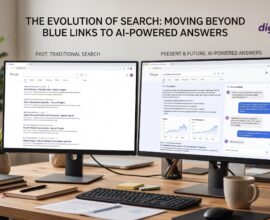
The traditional search experience asks the user to evaluate a list of pages.
Generative search can instead provide a synthesized response with supporting sources.
That changes the visibility problem.
Previously, a marketer could primarily ask:
“Where do we rank?”
Now additional questions matter:
- Is our brand mentioned?
- Is our content cited?
- Are our products represented accurately?
- Are we associated with the right concepts?
- Which sources are being used to describe us?
- Does the AI answer contain the correct information?
- Does AI-driven discovery generate visits?
- Do those visits convert?
This does not make rankings irrelevant. It expands the measurement layer.
AI Visibility Is Becoming Measurable
One of the most important developments of 2026 is the growing ability to observe AI-search visibility directly.
Google launched dedicated Search Console reporting for visibility in generative AI features such as AI Overviews and AI Mode in June 2026, with the company stating that the insights were rolled out worldwide by August 31.
Microsoft has also introduced AI Performance reporting in Bing Webmaster Tools, showing how publisher content appears as citations across Microsoft Copilot, Bing AI-generated summaries and selected partner experiences.
This suggests a broader evolution:
SEO measurement is expanding from rankings toward visibility, citations, engagement and business outcomes across multiple search interfaces.
From Ranking Keywords to Ranking Concepts
The phrase “ranking concepts” is useful as a strategic metaphor, but it should not be interpreted literally as a published Google metric.
A more practical objective is to build pages that can satisfy multiple related information needs.
Suppose a business sells enterprise cybersecurity software.
Instead of producing dozens of thin pages around:
- enterprise cybersecurity software
- enterprise cybersecurity platform
- enterprise cyber security solution
- best enterprise cybersecurity software
a stronger strategy might build authoritative resources covering:
- enterprise security architecture
- threat detection
- identity management
- compliance requirements
- implementation considerations
- integration requirements
- industry-specific risks
- vendor evaluation
- total cost of ownership.
The keywords still matter. But the content is organized around the user’s actual decision.
How Query Fan-Out Changes Content Strategy
Google says AI Overviews and AI Mode can break complex queries into related searches across subtopics and data sources.
That makes content breadth and clarity strategically important.
Instead of asking only:
“What keyword should this page rank for?”
ask:
“What subquestions must a trustworthy source answer to satisfy this information need?”
This creates a much stronger content research process.
The Future of Keyword Research
Keyword research is likely to remain useful, but its job is expanding.
In the future, a keyword database should be treated less like a list of targets and more like a map of demand.
For each important query, SEO teams should identify:
- primary intent
- secondary intents
- related concepts
- important entities
- common comparisons
- follow-up questions
- commercial implications
- supporting evidence
- content gaps
- conversion opportunities.
This makes keyword research a strategic research discipline rather than a simple volume-and-difficulty exercise.
What Is the Role of Topical Authority?
Topical authority is the depth and usefulness of a site’s coverage around a subject.
But topical authority should not mean publishing hundreds of superficially related articles.
A better approach is to build a coherent information architecture where important concepts connect naturally.
For example:
SEO
- technical SEO
- content strategy
- keyword research
- semantic search
- entity optimization
- local SEO
- ecommerce SEO
- AI search
- measurement.
Each topic can connect to the others through meaningful internal links and a clear site architecture.
How AI Changes Content Quality
Generative AI has made producing text cheaper. That makes generic text less valuable as a competitive advantage.
Google’s AI-search guidance emphasizes useful, people-first content and warns against creating large amounts of content primarily to manipulate Search or AI systems.
The implication is important:
As content production becomes easier, original information becomes more valuable.
Useful differentiation can come from:
- original research
- expert analysis
- first-party data
- real examples
- transparent methodology
- unique comparisons
- original visuals
- practical frameworks
- clear limitations.
The Future of SEO Is Also About Evidence
AI-generated answers create a new problem: where did the answer come from?
That makes source quality increasingly important.
A strong page should make it easy to identify:
- who created the content
- when it was updated
- what evidence supports important claims
- which sources were consulted
- what is fact versus interpretation
- what remains uncertain.
This is especially important for industries where inaccurate information can cause financial, legal, medical or safety consequences.
SEO vs GEO: Are They Becoming the Same Thing?
No. They overlap, but they are not identical.
SEO focuses on making websites discoverable, crawlable, understandable and competitive in search.
GEO focuses more specifically on visibility and representation within generative and AI-mediated search experiences.
Google’s guidance is important here: it does not require a special “AI SEO” technical layer to qualify for AI Overviews or AI Mode. The foundation remains Search eligibility and strong SEO practices.
A practical geo strategy should therefore complement—not replace—SEO.
The relationship can be viewed as:
SEO foundation → content and evidence → semantic clarity → AI-search visibility → measurement → optimization.
How Businesses Should Adapt Their SEO Strategy
1. Keep keyword research
Continue identifying search demand, but don’t stop at volume and difficulty.
2. Map search intent
Determine what users actually want to accomplish.
3. Build concept maps
Identify the concepts that naturally belong to the subject.
4. Identify entities
Map organizations, people, products, services, technologies, locations and other important entities.
5. Connect relationships
Explain how those entities and concepts relate rather than mentioning them randomly.
6. Strengthen evidence
Support important claims with authoritative sources, original research or transparent first-party information.
7. Improve technical accessibility
Make sure important content can be crawled, indexed and understood.
8. Measure AI visibility
Use available Search Console, analytics and other appropriate visibility tools to understand how your content appears beyond conventional rankings.
Google’s current documentation reinforces the importance of crawlability, internal links, page experience, textual content and accurate structured data for AI-search eligibility.
What Should SEO Teams Stop Doing?
The future of SEO is not only about adding new tactics. It also requires removing outdated habits.
- Stop treating keyword density as a meaningful quality target.
- Stop creating separate pages for every trivial keyword variation.
- Stop publishing generic AI-generated articles without original value.
- Stop assuming schema alone creates visibility.
- Stop measuring success exclusively through rankings.
- Stop confusing traffic with business impact.
- Stop treating every AI-search claim as established fact.
Google’s current AI-search documentation specifically advises against creating separate pages for every possible variation of a query solely to influence generative results.
What Should SEO Teams Start Doing?
- Build topic and entity maps.
- Research questions rather than phrases alone.
- Design content around complete user problems.
- Strengthen internal relationships between related pages.
- Publish evidence and original insights.
- Make important information explicit and easy to understand.
- Track AI visibility as well as conventional search performance.
- Connect SEO data with conversions and revenue.
What Will SEO Look Like in 2027 and Beyond?
Confirmed current development
Search is already incorporating generative AI experiences, and Google says AI Overviews and AI Mode remain grounded in core Search systems. Dedicated generative-AI visibility reporting is also now available in Search Console.
Emerging trend
SEO teams are increasingly measuring semantic coverage, entities, AI mentions, citations, source visibility and brand representation alongside rankings. Industry research from Ahrefs identifies semantic/entity optimization, query fan-out and AI-search measurement among notable 2026 developments.
Professional prediction
The strongest SEO teams will increasingly operate as information architects rather than keyword-placement teams. Their work will involve understanding demand, designing knowledge structures, building evidence, improving discoverability and measuring how brands are represented across search interfaces.
Keywords will remain part of that system—but they will no longer tell the whole story.
A Practical 90-Day Future-Ready SEO Roadmap
Days 1–30: Rebuild the search map
- audit existing keyword targets
- group queries by intent
- identify overlapping pages
- map major entities
- identify important concepts
- find missing subtopics
Days 31–60: Strengthen content architecture
- consolidate thin or overlapping pages
- build stronger topic hubs
- improve internal linking
- add original evidence
- improve author and source transparency
- implement relevant structured data
Days 61–90: Measure the new search environment
- monitor organic rankings
- monitor Search Console performance
- review generative-AI visibility
- track AI citations where measurable
- monitor branded search demand
- connect search visibility to conversions
- review which concepts and entities are associated with the brand.
How to Measure SEO When Rankings Are No Longer Enough
Rankings remain useful, but a future-ready measurement framework should include several layers.
Visibility
- organic rankings
- impressions
- AI-search appearances
- brand mentions
- citations
Engagement
- organic clicks
- engaged sessions
- return visits
- content interaction.
Business outcomes
- leads
- sales
- qualified pipeline
- customer acquisition cost
- revenue
- customer lifetime value.
This prevents a common mistake: celebrating visibility without determining whether that visibility produces meaningful business value.
The Future of SEO Is Not “Keywordless SEO”
The phrase “keywordless SEO” can be useful as a provocative idea, but it should not be taken literally.
People still use language to search.
Businesses still need to understand the words customers use.
Search engines still need textual and structured information to retrieve and interpret content.
Keywords therefore remain useful inputs.
What changes is the level of interpretation around them.
The future is not keywordless SEO. It is context-rich SEO.
Final Takeaway
The future of SEO is moving from isolated keyword targeting toward a broader discipline built around intent, concepts, entities, relationships, evidence and outcomes.
That does not make traditional SEO obsolete. In fact, Google’s current guidance says the opposite: strong SEO fundamentals remain important for AI-powered Search experiences.
The real change is strategic.
Instead of asking only:
“What keyword should we rank for?”
SEO teams should increasingly ask:
“What does the user mean, what information do they need, which concepts and entities are involved, what evidence supports the answer, and how can our business become the most useful source?”
That is the shift from keywords to AI-driven concepts.
And for businesses preparing for the next generation of search, it is a far more sustainable strategy than chasing every new AI acronym.
Ready to make your SEO strategy more resilient for AI-powered search? Start by auditing your keyword architecture, search intent, content depth, technical SEO, entity clarity, internal linking, AI-search visibility and conversion paths. Digital Piloto can help connect those pieces into a measurable SEO and AI-search strategy designed around long-term business growth.