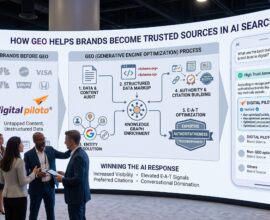
Trust used to be built through familiar signals: recommendations, reviews, recognizable logos and years in business. Now, people also encounter brands through AI-generated answers, summaries and recommendations. That changes the game. A company must not only look credible to customers; it needs a consistent, verifiable digital presence that AI systems can understand and confidently associate with the brand.
Brand Authority Has Entered a New Era
Brand authority has always been bigger than a search ranking. A company can rank well and still fail to inspire confidence. Conversely, a smaller business with strong expertise, authentic reviews and clear information can become a trusted choice within its niche.
AI is making that distinction more visible.
When someone asks an AI-powered search system to recommend a software provider, healthcare brand, hotel or professional service, the answer may be assembled from multiple pieces of information. The brand’s website is only one piece. Reviews, publications, business profiles, third-party references, structured information and other signals can all contribute to the digital picture.
That is why an SEO company near me should increasingly think beyond rankings. The larger objective is to build an online presence that consistently communicates expertise, relevance and trust.
What Does AI-Driven Brand Authority Mean?
AI-driven brand authority refers to a brand’s ability to be recognized, understood and represented accurately across AI-powered discovery environments.
It is not an official score handed out by an AI company. There is no universal “brand authority meter” hiding behind the screen.
Instead, it describes a broader digital reality: AI systems need enough reliable context to understand what a business is, what it does, who it serves and why it might be relevant to a particular question.
Imagine introducing yourself at a networking event. If you simply say, “I run a great company,” people have little to work with. But if several credible people independently describe your expertise, your work is discussed in relevant publications and your own website clearly explains what you do, the picture becomes much stronger.
Digital trust works in much the same way.
Why Digital Trust Matters More in AI Search
Generative search changes the customer’s relationship with information. Instead of receiving ten links and deciding where to begin, users may receive a synthesized response first and then decide which sources to explore.
Google’s documentation explains that its AI search features continue to use core Search systems and can perform multiple related searches to explore different aspects of a query. This means the visibility equation increasingly involves how well a brand and its supporting information fit into a broader topic. Google Search Central documents how AI features work with existing Search foundations.
For businesses, that creates an important shift.
The question is no longer only, “Can people find our website?”
It becomes, “When people—or machines helping people—research our category, does our brand appear credible and relevant?”
The Signals That Build Digital Trust
Trust is rarely created by one spectacular piece of content. It tends to accumulate through consistency.
- Clear expertise: Explain complicated subjects accurately and demonstrate practical knowledge.
- Consistent business information: Keep company details, services, locations and contact information aligned across important platforms.
- Independent validation: Relevant reviews, mentions, links and third-party references can reinforce credibility.
- First-hand experience: Original examples, observations and genuine expertise are harder to replace with generic content.
- Transparent communication: Make claims carefully and provide evidence where appropriate.
- Technical accessibility: Ensure important content can be discovered, crawled and understood by search systems.
None of these signals should be treated as a shortcut. Authority is cumulative. A polished homepage cannot compensate indefinitely for contradictory business information or shallow content elsewhere.
AI Is Becoming Part of the Brand Discovery Journey
Picture a customer researching a new accounting platform.
They might begin with a broad question about accounting software. Then they ask which platforms suit small businesses. After that, they compare pricing, investigate integrations and ask which providers have strong support.
At every stage, the brand may be mentioned—or completely absent.
This is why AI brand visibility deserves attention alongside traditional organic traffic. A customer may never type the company’s exact name into a search engine at the beginning. They might encounter it because an AI system considers it relevant to a broader question.
That makes category-level authority valuable.
If a business consistently publishes useful information around its subject, earns relevant third-party recognition and maintains accurate brand information, it gives discovery systems more context from which to understand the company.
Generative AI Raises the Standard for Content
The internet is now flooded with AI-assisted content. That creates an uncomfortable problem for marketers: producing more text has become easier, but producing genuinely useful information has not.
Search engines and users have little reason to value another generic article that repeats obvious information.
Google’s guidance for creating helpful content emphasizes making content for people rather than producing material primarily to manipulate search rankings. Its documentation also encourages original information, substantial value and clear expertise where appropriate. Google’s helpful content guidance provides more detail.
This is where a generative AI SEO agency can contribute to a broader brand strategy—not by trying to “hack” AI answers, but by improving the quality, structure and discoverability of the information surrounding a brand.
Good AI-search content should answer questions directly, demonstrate expertise and give users a reason to trust the source.
What authoritative content looks like in practice
Consider two articles about commercial refrigeration.
The first defines refrigeration, lists a few common benefits and ends with a sales pitch.
The second explains how businesses choose refrigeration systems, discusses common installation mistakes, shares practical maintenance considerations, distinguishes different equipment types and clearly identifies situations where professional advice is appropriate.
The second article has something the first lacks: useful context.
That context is what helps a brand become associated with a subject rather than merely a keyword.
Entity Recognition Is Becoming More Important
One reason digital trust is changing is the growing importance of entities.
An entity is essentially a distinct thing that search systems can understand as a real-world concept: a company, person, product, place, organization or topic.
For brands, entity clarity matters because ambiguity creates friction.
If a company’s name is written differently across websites, its address changes without explanation, its service descriptions contradict each other or third-party information is outdated, search systems may have a less coherent understanding of the organization.
Strong entity SEO therefore involves making the brand’s identity and relationships clearer across the web.
Structured data can support this process by helping search engines interpret information about a page and its entities. Google’s documentation notes that structured data provides explicit clues about the meaning of page content, although it does not guarantee enhanced search results. Google Search Central’s structured data documentation explains the role of structured markup.
Reviews and Reputation Are Not Just Local SEO Signals
Digital trust becomes especially tangible when customers start talking about a company.
A review can confirm a claim that appears on a website. A detailed customer experience can add context that a service page cannot. An independent article can reinforce expertise.
BrightLocal’s 2026 Local Consumer Review Survey reported that 85% of consumers were more likely to use a business after seeing positive reviews, while 77% said negative reviews would make them less likely to choose it. The survey also reported that 54% visited a business’s website after reading positive reviews. BrightLocal’s Local Consumer Review Survey provides the methodology and findings.
The lesson is broader than local search. Reputation creates a bridge between discovery and evaluation.
Businesses should therefore treat customer feedback as part of their content ecosystem rather than an isolated marketing metric.
How Businesses Can Build AI-Ready Authority
There is no single checklist that guarantees an AI system will mention a brand. However, several practices can make the digital footprint substantially stronger.
- Define the brand clearly: Explain who you are, what you offer, whom you serve and what differentiates your expertise.
- Own important topics: Build genuinely useful resources around the problems your customers care about.
- Strengthen first-party evidence: Publish original insights, expert commentary, examples and practical guidance.
- Earn third-party credibility: Seek legitimate industry mentions, relevant links, reviews and collaborations.
- Keep information consistent: Review business profiles, directories and other important references for accuracy.
- Connect related information: Use internal links and clear site architecture so users and search systems can understand relationships between topics.
The key word here is legitimate. Buying manufactured reviews, creating artificial mentions or publishing hundreds of low-value pages may create noise, but noise is not authority.
AI Trust Does Not Mean Losing the Human Touch
There is an irony in all of this. The more AI becomes involved in discovery, the more valuable authentic human experience may become.
Why?
Because generic information is increasingly abundant.
A company’s actual experiences—what it learned from solving a difficult problem, how it approaches a complicated project, what customers commonly misunderstand and what it would do differently—are much harder to reproduce convincingly.
That gives brands an opportunity.
Instead of trying to sound like an encyclopedia, businesses can sound like experienced professionals. Tell customers what matters. Explain trade-offs. Admit when a solution is not appropriate. Share lessons that came from doing the work.
That kind of content can strengthen both human trust and the broader information ecosystem around a brand.
The Role of AI in Reputation Management
AI can also help businesses monitor their own digital presence.
Teams can use AI-assisted analysis to identify recurring customer concerns, group reviews by themes, discover gaps in FAQ content and track how the brand is described across different sources.
But automation should not become an excuse for robotic communication.
If ten customers complain about confusing pricing, the answer should not simply be another automatically generated paragraph. The business should investigate the underlying problem.
Technology can identify the signal. People still need to decide what the signal means.
What the Future of Brand Authority Looks Like
Brand authority is likely to become increasingly distributed.
A company’s reputation will not live only on its homepage or in its Google rankings. It will exist across websites, reviews, professional profiles, publications, business listings, social conversations, structured information and AI-generated discovery experiences.
That makes consistency incredibly valuable.
If every meaningful source tells roughly the same story about the business—and that story is supported by evidence—the brand becomes easier to understand.
A digital marketing agency can help coordinate these touchpoints, but authority ultimately comes from the substance behind them.
The strongest brands will not merely optimize for being mentioned. They will build enough real expertise and digital evidence that being mentioned makes sense.
Frequently Asked Questions
What is AI-driven brand authority?
AI-driven brand authority describes how consistently and credibly a brand can be understood and represented across AI-powered search and digital discovery environments. It is built through useful content, trustworthy information, expertise and relevant third-party signals.
How does AI affect digital trust?
AI can change how customers discover and evaluate businesses by summarizing information and answering questions directly. This makes accurate, consistent and credible information about a brand increasingly important.
Can SEO improve a brand’s visibility in AI search?
Yes, foundational SEO remains relevant to AI search. Search engines still need to discover, crawl and understand useful content. However, businesses should think beyond rankings and build broader topical authority and digital trust.
What is the most important factor in building digital trust?
There is no single factor. Trust is cumulative. Clear information, demonstrated expertise, authentic customer experiences, consistent business details and credible third-party references can work together to strengthen a brand’s reputation.
Final Thoughts
AI is not replacing brand trust; it is changing how trust gets discovered. A recommendation, summary or answer may introduce a customer to a company before they ever visit its website. The brands that benefit most will be those with something substantial behind the signal: clear expertise, consistent information, genuine customer proof and a digital presence that tells the same credible story wherever people look.
Blog Development Credits
Conceptualized by Amlan Maiti, the article was created through AI-assisted research and writing, followed by final SEO refinement from Digital Piloto Private Limited.