What makes a school genuinely engaging in a world where children can find information with a few taps? The answer is not simply smarter classrooms or more screens. It is an environment where curiosity is encouraged, questions are welcomed, and lessons connect with everyday life. That is what families should look for when exploring Top ICSE Schools in Kolkata.
What Makes an ICSE School Truly Innovative?
Innovation in education is sometimes mistaken for technology. A smart board can certainly make a lesson more visual, but it cannot replace a teacher who knows how to spark curiosity. The most effective schools combine thoughtful teaching with practical experiences, discussion, creativity, and technology used with a clear purpose.
This approach is increasingly relevant as digital skills become part of everyday learning. UNESCO notes that digital technology can support interactive and flexible learning, while also emphasizing that technology should remain human-centred and strengthen inclusion, quality, and digital competence. UNESCO’s work on e-learning highlights this broader role of technology in education.
For parents comparing the best ICSE schools, the real question is therefore not “How much technology does the school have?” but “How effectively does the school use its resources to help children think, explore, and create?”
Learning That Feels Relevant to Real Life
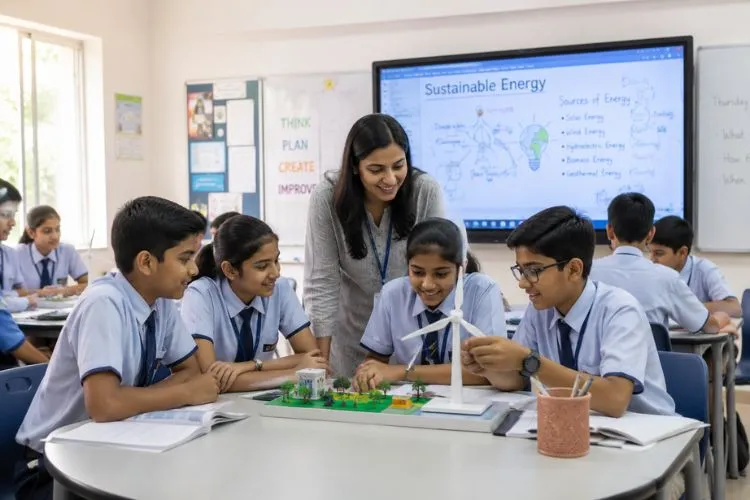
Imagine a science lesson where students do not simply memorise the water cycle. Instead, they observe rainfall, discuss water conservation, conduct a simple experiment, and then explain their findings. The subject suddenly feels less like a chapter and more like something happening around them.
That is the strength of experiential learning. Innovative ICSE schools can make lessons memorable by bringing academic concepts into practical situations. This can include:
- Project-based learning: Students investigate questions and create something meaningful from what they discover.
- Hands-on activities: Experiments, models, demonstrations, and practical assignments make abstract concepts easier to understand.
- Collaborative tasks: Group discussions and presentations help students learn communication, teamwork, and responsibility.
- Creative expression: Art, theatre, writing, music, and design allow children to approach ideas from different perspectives.
Technology Should Support Curiosity, Not Replace It
A modern classroom does not need to look like a technology showroom. In fact, more screens do not automatically mean better learning. The smarter approach is to use digital tools when they genuinely add value—perhaps to visualise a difficult scientific process, explore a historical location virtually, practise a language skill, or present a research project.
UNESCO’s current guidance similarly stresses human agency, critical thinking, ethics, and responsible use of AI and technology in education. Its research also shows that digital transformation works best when technology is paired with appropriate teaching practices and access. UNESCO’s digital education resources provide useful context on this evolving landscape.
What Parents Should Look For
- Teachers who encourage questions rather than only providing answers.
- Classrooms where students participate instead of passively listening.
- Opportunities for research, presentations, experiments, and creative work.
- Technology integrated thoughtfully into the curriculum.
- Strong academic foundations alongside communication and life skills.
Innovation Starts Early
Engaging education should not suddenly begin when a child reaches secondary school. The foundation is often built much earlier, when children are naturally curious and eager to understand how things work.
A good Nursery School can nurture this curiosity through stories, play, music, movement, sensory activities, and simple problem-solving exercises. At this stage, learning should feel joyful rather than pressured. Children learn by doing, copying, asking, trying again, and occasionally making a gloriously messy mistake.
As children progress, that same curiosity can evolve into structured inquiry, independent thinking, and more sophisticated project work. Parents planning Admission for KG in Kolkata should therefore consider whether a school’s educational philosophy supports this gradual development from early exploration to confident learning.
Why Holistic Development Matters
Academic results matter, of course. But education has a longer horizon than the next examination. Children also need to learn how to communicate an idea, work with someone different from them, handle setbacks, make decisions, and take responsibility.
The strongest ICSE schools in Kolkata understand that these qualities are not separate from academic achievement. They reinforce it. A student who learns to research carefully, speak confidently, collaborate respectfully, and question assumptions is better prepared for university, work, and life.
Look for opportunities such as:
- Clubs and competitions that encourage students to explore interests beyond textbooks.
- Sports and performing arts that develop discipline, confidence, teamwork, and resilience.
- Leadership opportunities that allow students to organise, communicate, and take ownership.
- Community-focused activities that connect classroom learning with social responsibility.
How Parents Can Choose the Right School
School visits can reveal things that brochures simply cannot. Watch how teachers speak to students. Notice whether children seem comfortable asking questions. Ask how projects are assessed and how technology is used. Most importantly, look beyond impressive facilities and find out what actually happens inside the classroom on an ordinary Tuesday.
A school may have excellent infrastructure, but the learning culture is what gives those facilities meaning. The best choice is usually a school where academic rigour and curiosity coexist rather than compete.
Frequently Asked Questions
What makes an ICSE school innovative?
An innovative ICSE school combines strong academics with project work, practical learning, creative activities, technology, collaboration, and opportunities for independent thinking.
Is technology essential for engaging learning?
Technology can make learning more interactive, but it is not the goal by itself. Effective teaching uses digital tools selectively while keeping teachers, students, discussion, and critical thinking at the centre.
Why is experiential learning important for students?
Experiential learning connects concepts with real situations. By experimenting, researching, building, discussing, and presenting, students can develop deeper understanding and practical skills.
What should parents consider when comparing ICSE schools?
Parents should consider teaching quality, curriculum, learning environment, student participation, co-curricular opportunities, facilities, communication, safety, and the school’s approach to holistic development.
Final Thoughts
The best schools do more than deliver lessons; they create reasons for children to want to learn. Innovative and engaging ICSE education is ultimately about building that spark—one thoughtful question, practical activity, experiment, discussion, and discovery at a time. For families choosing a school, that culture of curiosity may be one of the most valuable advantages a child can receive.