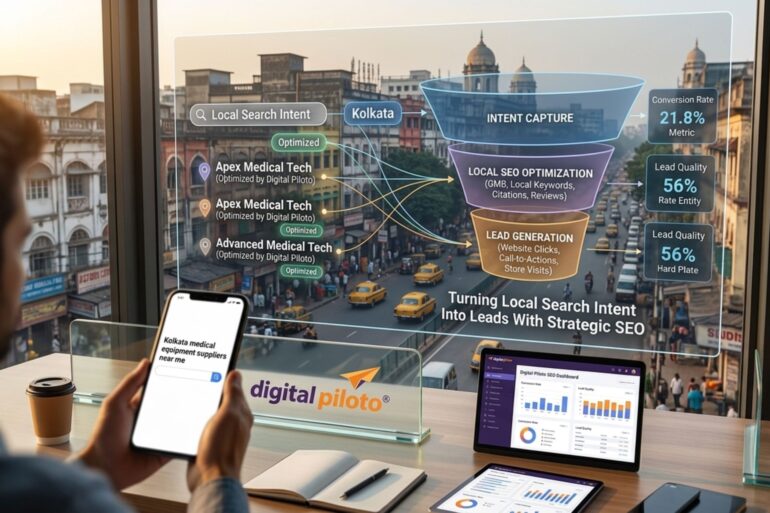
Local search is rarely just about finding information. When someone searches “dentist near me,” “best café in Kolkata,” or “SEO agency nearby,” they are often already weighing a decision. The real opportunity is not simply appearing in those searches. It is turning that moment of intent into a phone call, enquiry, booking, store visit, or sale.
That is where a digital marketing company in Kolkata can make a meaningful difference. Strategic local SEO connects what people search for with what a business can actually deliver, creating a path from discovery to action rather than chasing rankings for their own sake.
Local Search Intent Is More Than a Keyword
One of the easiest mistakes in local SEO is treating every location-based query as essentially the same. It isn’t.
Consider the difference between “physiotherapist in Kolkata,” “best physiotherapist for back pain,” and “physiotherapist open now near me.” All three have local intent, but the user’s position in the buying journey is different.
The first person may still be researching. The second is comparing expertise and suitability. The third may be ready to make contact within minutes.
That distinction matters because good local SEO should reflect why someone is searching, not merely where they are searching from.
In practical terms, local search intent usually falls into a few overlapping groups:
- Discovery intent: “restaurants in Salt Lake” or “digital marketing agency Kolkata.”
- Comparison intent: “best dental clinic near me” or “top interior designers in Kolkata.”
- Action intent: “AC repair near me open now” or “book a salon appointment.”
- Navigation intent: searches for a specific business, branch, address, phone number, or opening hours.
The clever part is building pages and local profiles that meet each intent without creating dozens of thin, almost-identical location pages.
Why Rankings Alone Don’t Create Local Leads
A high position can improve visibility. It does not automatically produce trust.
Recent research from BrightLocal illustrates this nicely. Its 2026 consumer research found that 72% of consumers typically look at three or fewer businesses before deciding, while only 6% simply choose the first result. Consumers consider factors such as proximity, star ratings, review volume, complete listing information, pricing and photos alongside ranking position. BrightLocal’s consumer research provides the underlying findings.
That changes the local SEO conversation.
Instead of asking, “How do I get into position one?” a business should also ask:
- Does the searcher immediately understand what we offer?
- Can they see where we are and whether we serve their area?
- Do our reviews provide credible evidence?
- Is there enough information to compare us with alternatives?
- Can someone contact or book us without hunting around?
Think of the search result as a shop window. Ranking gets someone onto the street in front of your store. The information, reputation and experience determine whether they walk inside.
Build Around the Local Customer Journey
Strategic local SEO starts by mapping the journey before mapping keywords.
1. Identify the problem behind the search
Customers don’t usually wake up wanting to search for a keyword. They have a problem, need or immediate objective.
A person searching “emergency plumber Kolkata” is not conducting academic research about plumbing. They probably want someone who can respond quickly. A person searching “best coaching centre near me” may care more about reputation, results, fees and accessibility.
Those differences should influence the content, calls to action, landing pages and even the information presented in the Google Business Profile.
2. Match content to decision stage
A useful local content strategy might include service pages for high-intent searches, location pages where genuinely relevant, comparison or educational content for researchers, and concise conversion-focused pages for users who already know what they need.
The goal is not to publish a page for every possible phrase. It is to answer the meaningful questions that sit between “I need this” and “I’ll contact this business.”
3. Remove friction from the final step
This sounds obvious, yet it is surprisingly common for a business to win the search impression and lose the customer on the website.
If the customer has to search for a phone number, guess whether the branch is open, fill out an unnecessarily long form or navigate five pages to understand pricing, intent can disappear quickly.
Local SEO therefore needs a conversion layer. Clear calls to action, accurate contact information, location details, appointment options and mobile-friendly design all matter.
Google Business Profile Is Part of the Conversion Experience
For many local businesses, the Google Business Profile is effectively a mini storefront inside search and Maps.
Google states that local results are primarily influenced by relevance, distance and prominence. Relevance concerns how well the business matches the search; distance considers proximity to the searcher; prominence reflects how well-known the business is and can incorporate signals such as reviews and links from other websites. Google’s official local ranking guidance explains these factors.
That means a profile should not be treated as something you create once and forget.
Businesses should pay attention to:
- Accurate primary and secondary categories.
- Complete business information and current opening hours.
- High-quality photographs that reflect the real business.
- Relevant products or services where available.
- Regularly monitored customer reviews and thoughtful responses.
- Accurate website, phone, address and booking information.
There is an important distinction here: optimization does not mean stuffing keywords into the business name or description. It means making the profile genuinely useful and consistent with the business customers encounter offline.
Reviews Turn Local Visibility Into Trust
Reviews occupy an unusual position in local search. They are both a visibility signal and a persuasion mechanism.
BrightLocal’s 2026 Local Consumer Review Survey found that 97% of consumers read reviews for local businesses, while 85% said positive reviews make them more likely to use a business. The research also found that 54% of consumers visit a business website after reading positive reviews. BrightLocal’s 2026 review research offers the detailed methodology and findings.
Notice what happens there: the review does not necessarily end the journey. It can push the consumer from one discovery surface to another.
That is why review management should focus on genuine customer experiences rather than simply chasing a larger number.
Detailed feedback about service quality, staff, location, responsiveness or a specific customer problem can provide useful context to future customers. Businesses should also respond professionally to criticism. A defensive response may win an argument and lose a customer; a calm, helpful response can demonstrate how the company behaves when things don’t go perfectly.
Local Content Should Answer the Questions Customers Actually Ask
Local content works best when it feels useful rather than manufactured.
Suppose you run a dental clinic. A generic article titled “Best Dental Clinic in Kolkata” may have limited practical value. A more useful content strategy could address questions such as what to expect during a root canal, how emergency appointments work, what factors affect treatment cost, or how to choose a clinic for a particular need.
Then the relevant service and location pages can connect those informational searches with a clear next step.
This creates a stronger topical structure:
- Answer the problem: provide genuinely useful information.
- Demonstrate expertise: explain the issue with evidence and practical experience.
- Connect the solution: show how the business addresses the need.
- Make the next action obvious: call, enquire, visit, book or request a quote.
This is also where generative engine optimization services increasingly intersect with local SEO. Search behaviour is spreading beyond traditional blue links, and AI-powered tools can become another layer through which people research businesses and local options.
Local SEO and AI Search Are Starting to Overlap
Local discovery is no longer confined to a conventional Google results page.
BrightLocal’s 2026 research found that 31% of consumers use AI tools for local business recommendations at least monthly, while 45% said they had used AI tools for local recommendations during the previous year. Yet only 18% of AI users surveyed felt ready to contact the recommended business immediately; many continued researching through Google or other channels. BrightLocal’s research on local search channels highlights this emerging behaviour.
The lesson isn’t that traditional local SEO has suddenly become irrelevant. Quite the opposite. Strong fundamentals become the evidence layer that can support discovery across multiple surfaces.
Consistent business information, authoritative mentions, useful website content, customer reviews, clear services and a recognizable business entity all help create a coherent digital footprint.
In other words, don’t optimize only for the local pack. Build a business presence that makes sense wherever a customer encounters it.
Technical SEO Still Matters—Especially Locally
Local strategy can become very sophisticated, but the technical foundation remains surprisingly ordinary.
Your location pages should be crawlable. Important information should be available in HTML rather than hidden behind complicated interfaces. Internal links should connect relevant services and locations. Pages should load well on mobile devices, and duplicate or near-duplicate location pages should be avoided.
Structured data can also help search engines interpret business information. Google’s documentation explains that LocalBusiness structured data can communicate information such as business hours and other details about a local entity. Google Search Central’s LocalBusiness documentation provides implementation guidance.
Structured data, however, is not a magic ranking button. It should reinforce information that is already accurate and visible on the website.
Measure Leads, Not Just Local Visibility
A local SEO campaign can look successful in a ranking report while producing very little business.
That is why measurement should move closer to commercial outcomes.
- Visibility: local rankings, impressions, Maps visibility and profile interactions.
- Engagement: website visits, direction requests, calls and page interactions.
- Lead quality: enquiries, bookings, qualified calls and quote requests.
- Business outcomes: converted leads, revenue and repeat customers.
For example, suppose one location page generates 2,000 visits and another generates only 600. The second page may still be more valuable if it produces twice as many qualified enquiries.
That is the difference between traffic reporting and business reporting.
Good SEO services should ultimately help answer a commercial question: “Are more of the right local customers finding and choosing us?”
A Practical Local Lead Strategy
For a business starting from scratch—or rebuilding an underperforming local presence—a sensible sequence is more useful than trying to optimize everything simultaneously.
- Research local intent: identify services, problems, locations and decision-stage searches.
- Fix business information: make website and profile details accurate and consistent.
- Strengthen service and location pages: give each important page a clear purpose.
- Build reputation: create a genuine process for requesting and responding to reviews.
- Publish useful local content: answer questions that help people make decisions.
- Improve conversion paths: make calls, bookings and enquiries effortless.
- Track commercial outcomes: connect search activity with leads and revenue wherever possible.
The order matters. There is little value in publishing twenty new local articles if your phone number is wrong on the profile or your enquiry form doesn’t work properly.
Frequently Asked Questions
What is local search intent?
Local search intent describes the reason behind a search involving a place, service area or nearby business. It can range from researching local options to finding a business immediately and taking action.
How does local SEO generate leads?
Local SEO generates leads by improving a business’s visibility for relevant searches and making the resulting profile or webpage useful enough to encourage actions such as calls, bookings, enquiries or visits.
Are Google Business Profile reviews important for local SEO?
Reviews are important because they can influence customer trust and contribute to the broader local search ecosystem. Businesses should focus on earning genuine, detailed feedback rather than manufacturing or manipulating reviews.
Does AI search change local SEO?
AI search adds another discovery layer. Consumers are increasingly experimenting with AI tools for local recommendations, so businesses benefit from maintaining consistent information, useful content, strong reputation signals and a clear online identity.
Final Thoughts
Local SEO works best when it stops being treated as a race for a map position and starts being treated as a customer-acquisition system.
The search query is only the opening moment. The real work happens afterward: proving relevance, reducing uncertainty, showing credibility and giving the customer an easy reason to take the next step.
Businesses that connect local search intent with strong pages, trustworthy profiles, genuine reviews and frictionless conversion paths are better positioned to turn digital visibility into something far more valuable than clicks—real conversations with potential customers.
Blog Development Credit
This article was conceptualized by Amlan Maiti, developed with AI-assisted research, and finally refined and optimized by Digital Piloto Private Limited.