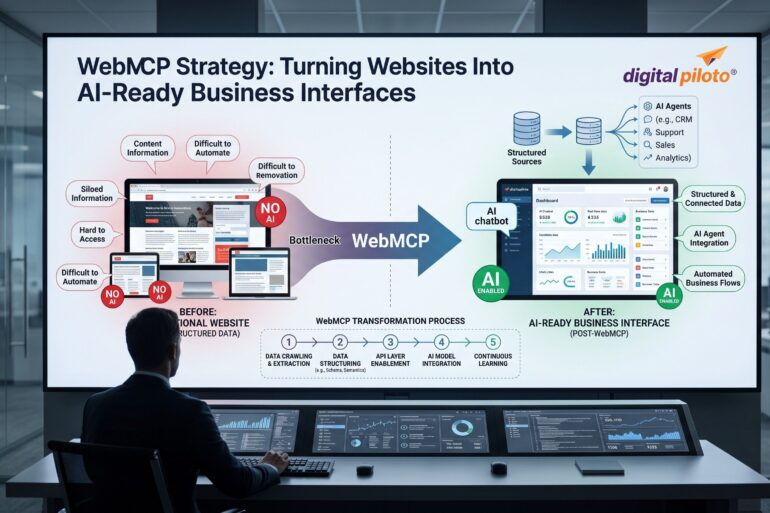
A website has traditionally been built for people: menus for browsing, forms for filling, buttons for clicking. But AI agents are changing that model. They can interpret intent, choose actions, and complete tasks. WebMCP offers a new way for websites to expose those actions clearly, turning ordinary pages into AI-ready business interfaces.
For brands planning ahead, this is more than a development experiment. It touches search, conversion, UX, content, and automation at once. A thoughtful digital marketing service India strategy can therefore begin connecting traditional discoverability with the emerging requirement for websites that AI agents can understand and operate.
What Makes a Website AI-Ready?
Consider how a human customer uses a typical website. They read a headline, open a menu, choose a service, compare options, complete a form, and perhaps make a purchase. Most of those steps are intuitive because people can visually interpret the interface.
An AI agent does not experience the website in quite the same way.
It needs explicit information about what an action does, what inputs are required, and what happens after the action is performed. This is where WebMCP becomes interesting.
Chrome describes WebMCP as a proposed web standard that lets websites expose functionality as structured tools for AI agents. Its current implementation supports both a Declarative API, which can turn standard HTML forms into tools through annotations, and an Imperative API for defining more dynamic tools with JavaScript. Chrome’s WebMCP documentation also makes clear that the technology remains under active development.
In practical terms, the website starts behaving less like a brochure and more like an interface an agent can interact with.
From Website Pages to Business Capabilities
This is probably the most important mental shift for marketers.
Instead of asking only, “What pages should our website have?” teams can begin asking, “What should a customer be able to accomplish here?”
For an ecommerce company, that could mean searching products, checking availability, comparing items, or adding something to a cart. For a clinic, it might mean finding an appropriate service and requesting an appointment. For a B2B company, the useful action could be generating a quote or arranging a consultation.
WebMCP can expose those kinds of capabilities to compatible agents in a structured form.
The difference between information and action
A normal FAQ might answer, “Do you offer weekend appointments?”
An agent-ready interface could potentially go one step further: “Show me available Saturday appointments and help me request one.”
That distinction sounds small. Commercially, it is not.
The first experience provides information. The second connects information to an action.
That is why AI-ready websites should be considered part of a broader customer-experience strategy rather than a purely technical upgrade.
WebMCP and the New SEO Layer
WebMCP is not established as a conventional Google ranking factor, and businesses should be careful about turning an emerging technology into an exaggerated SEO promise. The current Chrome documentation positions WebMCP around agent interaction rather than traditional search rankings.
Still, there is an obvious connection to modern SEO.
Search optimization has always involved making digital information easier for machines to interpret. Structured data helps describe entities. Semantic HTML clarifies page structure. Internal linking establishes relationships. Accessible forms give browsers meaningful controls.
WebMCP extends that philosophy from understanding information toward understanding available actions.
That opens the door to what could reasonably be called agentic SEO: preparing a brand’s digital ecosystem so AI systems can discover its information and, where appropriate, interact with its useful capabilities.
The important word is “preparing.” The technology is still evolving, so the sensible strategy is to build durable foundations rather than chase speculative ranking benefits.
Start With the Customer Journey, Not the Technology
One of the easiest mistakes would be to begin a WebMCP project by asking developers to expose every possible website function.
That is backwards.
Start with the customer journey. Find the points where customers repeatedly get stuck, spend unnecessary time, or perform several steps just to accomplish something simple.
Chrome’s current WebMCP guidance recommends planning a tool strategy around critical user journeys and building tools that correspond to genuine user needs. That is a useful principle even outside WebMCP itself.
A practical discovery exercise might identify:
- High-frequency tasks: actions customers perform repeatedly, such as searching products or checking order status.
- High-friction tasks: processes involving too many pages, fields, or confusing choices.
- High-value tasks: actions closely connected to revenue, qualified leads, bookings, or customer retention.
These are usually better candidates for agent-ready functionality than obscure features that hardly anyone uses.
Design Tools That Agents Can Actually Understand
Once useful actions have been identified, the next challenge is describing them properly.
Chrome’s documentation recommends clear, action-oriented tool names and descriptions that explain what the tool does and when an agent should use it. Its Lighthouse guidance also warns that exposing an excessive number of tools can consume model context, add latency, and make it harder for agents to choose correctly.
In other words, more tools do not automatically mean a better agent experience.
Imagine an online furniture store exposing separate tools for “find sofa,” “search sofa,” “locate sofa,” and “discover sofa.” If they perform essentially the same job, the agent now has unnecessary ambiguity.
A cleaner interface might expose one well-defined product-search capability with precise parameters.
Good tool design has an SEO-like quality
There is an interesting parallel here. Search engines prefer clear information architecture. Agents also benefit from clear capability architecture.
For each tool, teams should think about:
- Name: Does the name describe the action rather than merely the internal function?
- Description: Is it obvious when an agent should use it?
- Inputs: Are parameters specific, validated, and unambiguous?
- Output: Does the response contain the information an agent needs for its next decision?
- Side effects: Is the tool read-only, or can it create a real-world consequence?
This is where technical teams and SEO teams have an opportunity to work much more closely than they traditionally have.
Forms Could Become More Than Conversion Elements
Forms are usually discussed in marketing meetings as conversion assets. WebMCP gives them another possible role.
Chrome’s Declarative API allows standard HTML forms to be transformed into WebMCP tools through attributes that specify the tool’s name and purpose. Form fields can serve as tool parameters, allowing the browser to provide a structured representation for an agent.
That is a fascinating development because it means existing web conventions can become part of an agentic interface rather than being discarded.
Think about a “Request a Quote” form. Today, a customer fills it out manually. In an agent-enabled scenario, a compatible agent could potentially populate relevant fields based on the user’s instructions, while the website retains its visible form and business logic.
The interface does not necessarily disappear. It becomes more interoperable.
Security Must Sit Beside Convenience
Giving an AI system the ability to read a page is one thing. Giving it the ability to trigger actions is another.
That distinction deserves serious attention.
Chrome’s WebMCP documentation includes specific concepts for indicating whether a tool is read-only, returns potentially untrusted content, or performs consequential actions. The latter can help browsers and agents enforce confirmation requirements for activities such as bookings, payments, or other significant changes.
For businesses, this means an agent-ready website should not simply ask, “Can the AI do this?” It should also ask, “Under what conditions should the AI be allowed to do this?”
A sensible implementation should account for:
- Authentication and authorization before sensitive actions.
- Strict validation of agent-supplied inputs.
- Explicit confirmation for consequential transactions.
- Protection against malicious or untrusted content being passed through tools.
- Logging and monitoring so unusual agent activity can be investigated.
Convenience is valuable. Uncontrolled automation is not.
Content Still Powers the Interface
It would be a mistake to interpret WebMCP as the end of content SEO.
Agents still need context.
Suppose a travel website provides a tool for booking hotels. The tool may expose dates, room types, availability, and booking actions. But an agent may also need the site’s written information to understand cancellation rules, amenities, accessibility options, neighborhood details, and suitability for different travelers.
Tools tell an agent what it can do. Content helps it understand why a particular action or option may be appropriate.
That makes high-quality service pages, product information, FAQs, comparison content, and authoritative guides valuable components of an AI-ready website.
This is also where SEO company India strategies can evolve toward a broader combination of technical SEO, entity optimization, structured content, and AI-search readiness.
Where Generative Search Fits In
WebMCP should also be viewed alongside the wider transformation in search.
Generative search systems can summarize information, compare alternatives, and help users explore complex questions. Agentic systems take that concept further by potentially turning the next step into an action.
A customer might move through a journey that looks something like this:
- Ask an AI system for suitable providers.
- Review synthesized information and supporting sources.
- Visit a brand website for confirmation.
- Ask an agent to perform a useful task on the site.
- Confirm a consequential action when required.
That means brands need to think about discovery and execution as connected experiences.
generative engine optimization services can support the discovery side of this shift, while WebMCP-style capabilities address an emerging execution layer.
A Practical WebMCP Roadmap for Brands
Most businesses do not need to rebuild their website overnight. A phased approach is more sensible, especially while the standard and browser implementations continue to develop.
Phase 1: Audit. Document the website’s most important customer journeys and identify repetitive actions.
Phase 2: Simplify. Remove unnecessary friction from forms, navigation, and transaction flows before exposing anything to agents.
Phase 3: Structure. Improve semantic HTML, labels, schemas, content relationships, validation, and technical foundations.
Phase 4: Select tools. Choose a small number of meaningful actions that solve genuine customer problems.
Phase 5: Test. Use compatible agent tooling and development environments to verify that tools are discoverable, inputs are interpreted correctly, and outputs are useful.
Phase 6: Govern. Establish permission, security, confirmation, monitoring, and rollback procedures before exposing high-impact capabilities.
This approach keeps the business objective in charge of the technology, which is exactly where it should be.
Measuring an AI-Ready Website
Traditional SEO metrics remain relevant, but an agentic interface introduces additional questions.
Can an agent discover the correct tool? Can it understand when to use it? Does it provide valid parameters? Does the tool return a useful response? Does the user successfully complete the intended task?
Chrome’s WebMCP guidance now includes evaluation concepts aimed at testing whether agents understand when to call tools, how to execute them, and whether the resulting answers are acceptable.
For marketers, the ultimate measurement still comes back to business outcomes: qualified enquiries, completed bookings, purchases, reduced support friction, and better customer experiences.
Frequently Asked Questions
1. What does WebMCP do for a business website?
WebMCP allows a website to expose selected functionality as structured tools that compatible AI agents can discover and invoke. This can make tasks such as searching, submitting forms, or managing certain workflows more machine-interpretable.
2. Is WebMCP the same as traditional SEO?
No. WebMCP focuses on agent interaction with website functionality, while SEO focuses on helping search engines discover, understand, and surface web content. The two can complement each other through strong information architecture and technical foundations.
3. Should every website add WebMCP tools?
No. WebMCP is still an emerging technology. Businesses should first identify valuable customer journeys and then consider whether exposing particular actions to agents would genuinely improve the experience.
4. Can WebMCP improve Google rankings?
There is currently no established evidence that WebMCP itself directly improves Google rankings. Its immediate purpose is agent interaction. Any SEO benefit should therefore be treated as a strategic possibility rather than a guaranteed ranking effect.
Final Thoughts
The website of the future may not simply be a destination where people read, click, and complete forms manually. It may also be a capability layer that AI agents can understand and use on behalf of people, with appropriate permission and oversight.
WebMCP is still developing, but its underlying idea is remarkably practical: make digital capabilities explicit. Brands that begin with clear content, clean architecture, useful customer journeys, strong security, and carefully chosen actions will have a much better foundation for whatever the agentic web eventually becomes.
Blog Development Credits
Conceptualized by Amlan Maiti, researched and drafted with ChatGPT, Google Gemini and Copilot, then refined and SEO-enhanced by Digital Piloto Private Limited.