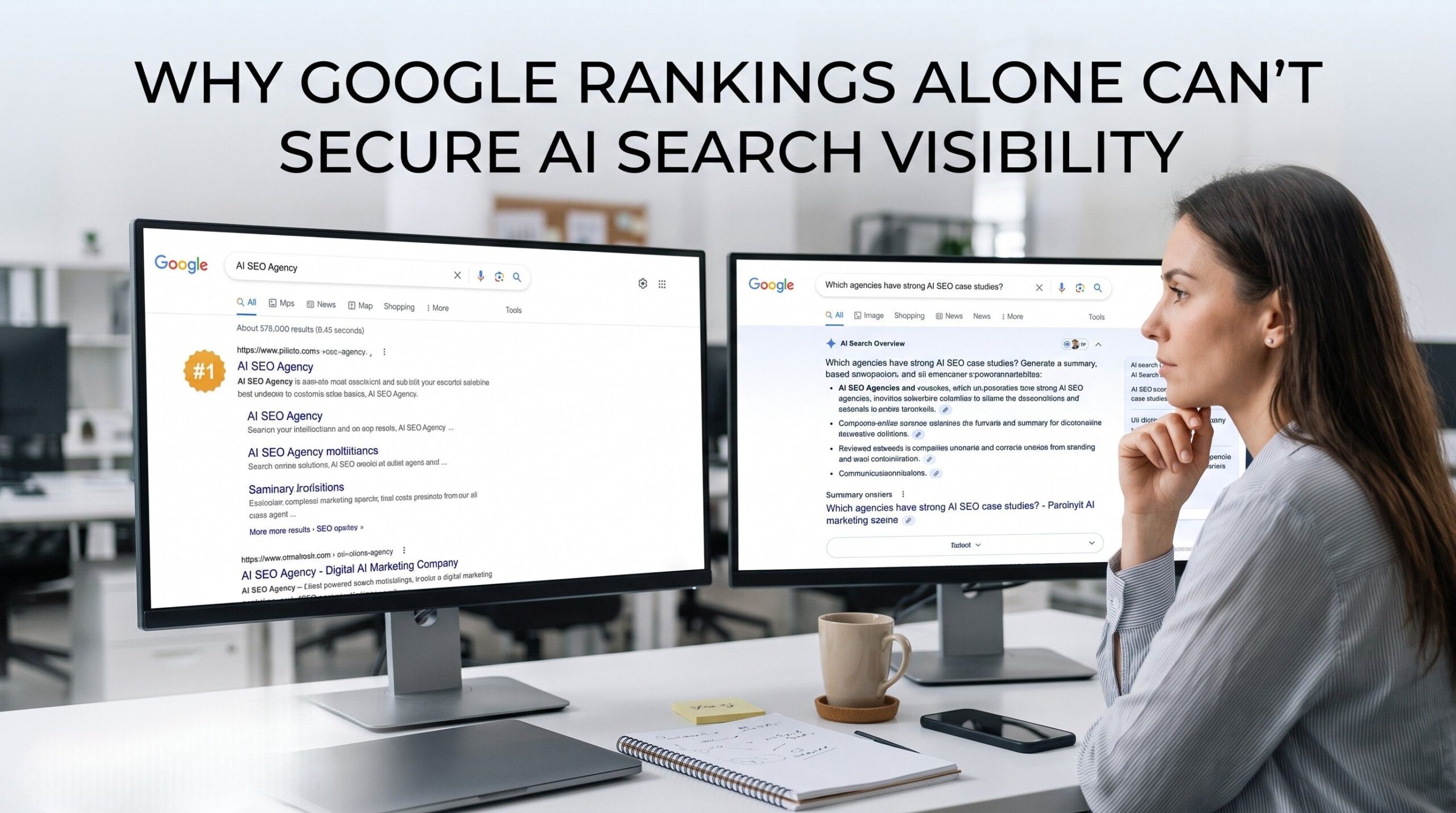
For years, a high Google ranking was treated as the clearest sign that a brand had won search. But AI-powered search is changing what “visibility” actually means. A page can rank strongly and still be absent from an AI-generated answer, overlooked during conversational research, or replaced by better-supported sources that search systems consider more useful.
That is why modern brands need to think beyond rankings. A strong SEO company in India can help build conventional search visibility, but AI Search requires a broader approach involving content depth, entity clarity, credibility, technical accessibility, and evidence of relevance across the wider web.
The Search Result Is No Longer the Whole Destination
Traditional Google Search generally gives users a collection of links. The familiar goal is therefore straightforward: get a page onto page one, ideally near the top, and earn the click.
AI Search changes the journey.
Instead of presenting ten blue links and asking the user to investigate them individually, AI-powered experiences can interpret a complicated question, combine information from multiple sources, and provide a synthesized response with supporting links. The user may still visit websites, but the decision-making process increasingly happens before that click.
Google itself describes this shift as a more conversational search experience. In 2026, Google reported that AI Mode had surpassed one billion monthly active users globally, while AI Mode queries had more than doubled every quarter since launch.
That doesn’t mean traditional rankings have suddenly become irrelevant. Quite the opposite. Google says its generative AI search features continue to rely on core Search quality and ranking systems. But ranking is now one part of a much larger visibility equation.
Why a #1 Ranking May Still Be Invisible to AI
Imagine that your article ranks first for “best CRM for small businesses.” That’s useful. But now imagine a potential customer asking an AI search engine:
“I’m a 20-person SaaS company with a small sales team. Which CRM should I choose if I need automation, simple onboarding, and reasonable pricing?”
That is not the same query.
The AI system may need to compare several concepts, interpret the buyer’s constraints, evaluate product information, and construct an answer from multiple sources. The page ranking first for the shorter keyword isn’t automatically the page that contributes the most useful evidence.
This is one of the biggest mindset changes in modern search: ranking answers a visibility question, while AI Search introduces a representation question.
Can the system understand your brand? Can it identify what you are known for? Does it find consistent information about you? Are your claims supported elsewhere? Is your content specific enough to contribute something meaningful to a complex answer?
AI Search Evaluates Context, Not Just Position
Traditional SEO often revolves around a relatively visible set of signals: keywords, links, content relevance, technical accessibility, authority, and search intent.
AI-powered search still needs those fundamentals, but the context around a brand becomes increasingly important.
Consider a hypothetical cybersecurity company. It might rank first for “cybersecurity services for startups.” Yet an AI system answering “Which cybersecurity companies are trusted by healthcare organizations?” may look for a different set of evidence: industry experience, regulatory expertise, case studies, independent mentions, technical documentation, and credible third-party references.
The first company has ranking visibility. The second may have stronger AI visibility for that particular question.
Neither position is permanent. Both depend on the question being asked.
Entity Clarity Is Becoming More Important
Search engines need to understand what a brand actually is. AI systems have an even more practical reason to do so because they are constantly connecting concepts while generating answers.
If a company describes itself as an SEO agency on one page, a digital consultancy on another, an AI company somewhere else, and a software provider on a third-party directory, the differences may look harmless to humans. To machines trying to establish a coherent entity, they can introduce ambiguity.
Strong entity clarity means your important facts are consistent across the digital ecosystem.
- Who are you? Your organization, people, locations, and areas of expertise should be clearly defined.
- What do you offer? Services and products should be described consistently without artificial keyword variations.
- Who do you serve? Industry, audience, geography, and use cases should be understandable.
- Why should anyone trust you? Experience, evidence, original research, reviews, publications, and credible references can reinforce the picture.
This is not about creating a special “AI profile” for your company. It is about making your existing digital footprint easier to interpret.
Third-Party Evidence Can Influence Brand Representation
One of the more uncomfortable truths about AI Search is that your own website does not control the entire narrative about your brand.
A company website naturally talks about the company from the company’s perspective. AI systems can also encounter information through publishers, industry websites, directories, reviews, forums, research papers, interviews, social platforms, and other independent sources.
That creates a broader concept of authority.
Suppose your website says you are an expert in enterprise SEO. If independent industry publications, conference pages, customer stories, professional profiles, and other credible sources repeatedly associate your organization with enterprise SEO, the broader evidence becomes more convincing.
On the other hand, a website full of self-declared expertise with almost no external validation may provide a much weaker signal.
This is particularly important as Google expands mechanisms for surfacing trusted sources in AI experiences. Google now allows selected preferred sources to appear with a preferred badge in both AI Mode and AI Overviews, reinforcing the importance of recognizable, trusted publishing sources.
AI Search Rewards Useful Specificity
There is a temptation to respond to AI Search by producing more content.
More articles. More FAQs. More landing pages. More variations of the same keyword.
That approach can easily become counterproductive.
Google’s current guidance specifically emphasizes valuable, unique, non-commodity content and warns against scaled content created primarily to manipulate search systems. Its spam policies apply to attempts to manipulate both conventional rankings and generative AI responses.
Think about it from the perspective of a reader. Would another 1,000-word article saying essentially the same thing help? Probably not.
A genuinely useful piece might instead include original research, a firsthand observation, an unusual comparison, a detailed process, a transparent case study, proprietary data, or a practical framework that answers questions competitors have ignored.
That kind of content gives AI systems something meaningful to work with—and gives humans a reason to trust and remember the source.
Conversational Queries Change the Content Game
People don’t always speak to AI Search the way they type into Google.
They ask follow-up questions. They add constraints. They explain their circumstances. They challenge an answer. They ask for comparisons.
For example, a traditional query might be:
“best Shopify SEO agency”
A conversational follow-up could become:
“Which one would you recommend for a mid-sized fashion ecommerce brand with international customers and a large product catalog?”
The second question demands contextual understanding. A generic service page may not provide enough evidence.
This is where content architecture becomes important. Brands should build topic clusters around real customer problems rather than simply building pages around isolated keywords.
Build content around decisions, not just searches
A useful content ecosystem can answer the questions customers ask before, during, and after a purchase:
- What problem does this product or service solve?
- Who is it actually suitable for?
- What alternatives should buyers consider?
- What are the limitations or trade-offs?
- How does implementation work?
- What evidence demonstrates that the solution works?
This approach creates much stronger topical depth than publishing dozens of pages that merely rearrange the same keyword.
GEO Is Not a Replacement for SEO
The rise of generative search has naturally produced a new vocabulary: AEO, GEO, AI SEO, LLM optimization, and more.
But businesses should be careful not to treat these as magic alternatives to conventional SEO.
A sensible geo strategy should extend the work already being done across technical SEO, content quality, authority, entity optimization, and digital reputation.
Google’s own 2026 documentation makes essentially this point: optimizing for generative AI search is still fundamentally about creating useful content and making the website accessible to Search systems. There is no special shortcut that guarantees inclusion in AI-generated responses.
So, rather than asking, “How do I trick an AI into mentioning my brand?” a better question is:
“What evidence would make my brand genuinely useful to mention?”
That question leads to much healthier marketing decisions.
Traditional SEO Metrics Need a Wider Lens
Rankings, impressions, clicks, and organic traffic remain valuable. But they cannot tell the entire AI Search story.
A brand can maintain excellent rankings while losing visibility inside synthesized answers. Conversely, a company may receive fewer traditional clicks for some informational searches while gaining recognition during AI-assisted research.
Google has been expanding Search Console reporting and controls to help website owners understand performance in AI-powered Search. Google also says AI Mode data is now incorporated into Search Console’s overall performance reporting.
For marketers, the practical lesson is to monitor a broader collection of signals.
- Traditional visibility: Rankings, impressions, clicks, organic landing pages, and non-brand search growth.
- AI visibility: Whether the brand appears in relevant AI-generated responses and which topics or questions trigger that visibility.
- Brand representation: Whether AI systems describe the company, products, expertise, and differentiators accurately.
- Authority signals: Quality and consistency of independent mentions, citations, reviews, publications, and references.
- Business outcomes: Qualified leads, assisted conversions, branded demand, and revenue—not vanity metrics alone.
The Technical Foundation Still Matters
There is another misconception worth clearing up: AI Search does not mean technical SEO can be ignored.
Google’s current guidance explicitly reinforces the continuing relevance of SEO fundamentals for generative AI features. Crawlability, indexability, useful page structure, clear content, internal linking, page experience, and accurate structured information still help search systems understand websites.
In fact, technical weaknesses can become even more frustrating when a brand is trying to build AI visibility.
If important content is difficult to crawl, key information exists only inside inaccessible interfaces, pages are inconsistent, or important entities are poorly connected, the content has less opportunity to contribute to search experiences.
AI Search may feel futuristic, but it still needs a reliable web underneath it.
What Brands Should Do Differently Now
The answer is not to abandon SEO and start chasing every new AI acronym. Instead, build a stronger search ecosystem.
- Keep technical SEO clean and continuously monitored.
- Create original content that demonstrates genuine expertise.
- Build recognizable entities around brands, products, people, and services.
- Earn credible mentions beyond your own website.
- Answer complex customer questions rather than only short keywords.
- Keep important business information accurate and consistent across platforms.
- Measure visibility across both traditional search and AI-assisted discovery.
This is where a broader digital growth approach becomes valuable. Even a company positioning itself as a no.1 digital marketing company in India cannot rely on one channel forever. Search, content, reputation, paid media, social proof, and AI discovery increasingly influence the same customer journey.
Frequently Asked Questions
Can a website rank #1 on Google and still have poor AI Search visibility?
Yes. A strong ranking is an important signal, but AI-generated responses can depend on the specific question, context, supporting evidence, source selection, entity understanding, and other factors. Ranking well does not guarantee that a page or brand will be cited or mentioned in every AI response.
Does GEO replace traditional SEO?
No. GEO should be viewed as an extension of modern search optimization rather than a replacement for SEO. Google’s current guidance continues to emphasize foundational SEO and helpful, reliable content for its generative AI Search experiences.
What type of content performs well for AI Search?
There is no guaranteed content format. However, original, specific, well-supported content that directly addresses real user needs can be more useful than repetitive, generic pages. Expert explanations, original research, comparisons, case studies, and detailed practical resources can all contribute meaningful information.
Should businesses track AI mentions separately from Google rankings?
Yes. Rankings remain important, but they do not capture every form of AI-assisted discovery. Businesses should increasingly examine how their brand is represented in relevant AI responses, which topics generate visibility, what sources are associated with the brand, and whether that visibility contributes to qualified demand.
Final Thoughts
Google rankings are still valuable. They simply no longer tell the whole story.
The search journey is becoming more conversational, comparative, and synthesized. A customer may encounter your brand through a traditional result, an AI-generated explanation, a cited third-party source, a follow-up question, or a recommendation assembled from several pieces of information.
Winning that environment requires more than occupying position one. It requires becoming a source that search systems can understand, trust, connect with a topic, and confidently include when the right question is asked.
That is the real shift from ranking to AI Search visibility: don’t just compete to be found; build enough relevance and authority to be worth mentioning.
Blog Development Credits
This article was shaped under the direction of Amlan Maiti, developed with AI-assisted research, and professionally refined for SEO by Digital Piloto Private Limited.