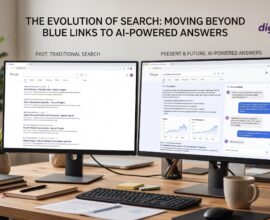
AI visibility is the ability of a brand to be discovered, cited, and recommended by generative AI systems like ChatGPT and search experiences such as Google SGE. It goes beyond traditional SEO by focusing on structured knowledge, authority signals, and context-rich content that AI models can understand and reuse in answers. For businesses working with a Digital Marketing Service Provider in Durgapur, mastering this shift is no longer optional—it’s the new competitive edge.
What Is AI Visibility in Simple Terms?
Definition
AI visibility refers to how often and how accurately your brand appears in AI-generated responses across tools like ChatGPT, Google SGE, and voice assistants. Instead of ranking on a page, your content becomes part of the answer itself.
- It prioritizes context over keywords
- It rewards structured, factual, and trustworthy content
- It depends on how well AI can interpret your brand authority
In short, if SEO was about ranking pages, AI visibility is about becoming the source AI trusts.
Why Traditional SEO Alone Isn’t Enough
Most brands still optimize for clicks, not answers. But generative search reduces clicks by providing direct responses. If your content isn’t optimized for extraction, summarization, and citation, you simply won’t appear.
Classic tactics like backlinks and keywords still matter—but they’re no longer the final game.
AI evaluates meaning, entity relationships, and topical authority at a deeper level.
The AI Visibility Blueprint (Step-by-Step)
1. Build Entity-Level Authority
AI systems recognize entities, not just keywords. Your brand must exist clearly across the web with consistent information.
- Create detailed “About” and author pages
- Maintain consistent brand mentions across platforms
- Use schema markup for organization, person, and services
2. Structure Content for AI Extraction
Write content in a way that AI can easily pull answers from. This means clarity over creativity.
- Use short, direct paragraphs
- Answer questions immediately
- Include bullet points and definitions
3. Optimize for AEO (Answer Engine Optimization)
AEO is the foundation of AI visibility. Instead of asking “How do I rank?”, ask “How do I get quoted?”
- Target question-based queries
- Use FAQ sections strategically
- Provide concise, factual answers
4. Create Multi-Format Content Signals
AI doesn’t rely on just blogs. It learns from multiple formats across the web.
- Publish blogs, videos, and social content
- Use consistent messaging across channels
- Repurpose content into summaries and insights
5. Strengthen Topical Authority
Depth beats breadth. AI favors brands that deeply cover a subject.
Working with the Best Digital Marketing Agency In India often reveals a simple truth: brands that dominate one niche win more AI visibility than those trying to cover everything.
- Build topic clusters around core services
- Interlink related content naturally
- Update content regularly with new insights
Key Factors That Influence AI Rankings
AI doesn’t “rank” like Google, but it prioritizes sources based on trust and clarity. Here’s what matters most:
- Clarity: Is your content easy to summarize?
- Authority: Are you a known expert in the topic?
- Consistency: Does your brand appear uniformly everywhere?
- Relevance: Does your content directly answer the query?
Real-World Example: AI Visibility in Action
Imagine two businesses offering SEO services. One writes long, keyword-heavy blogs. The other creates structured, question-based content with clear answers and schema markup.
When a user asks ChatGPT, “What is the best SEO strategy in 2026?”, the second brand is more likely to be referenced—even if it has fewer backlinks. Why? Because AI can easily extract and trust its content.
Common Mistakes to Avoid
- Writing content only for search engines, not AI systems
- Ignoring structured data and schema markup
- Overloading pages with keywords instead of meaning
- Failing to answer questions directly
FAQs: AI Visibility & Generative Search
1. How do I make my content appear in ChatGPT answers?
Focus on clear, structured, and authoritative content. Use direct answers, FAQs, and schema markup to improve extractability.
2. Is SEO still relevant in the age of AI search?
Yes, but it’s evolving. SEO now supports AI visibility by building authority and discoverability across platforms.
3. What is the difference between SEO and AEO?
SEO focuses on ranking pages, while AEO focuses on getting your content featured directly in answers.
4. Does schema markup help with AI visibility?
Absolutely. Schema helps AI understand your content context, improving its chances of being used in responses.
5. How long does it take to see results?
AI visibility builds over time. With consistent effort, results can appear within a few months, depending on competition and authority.
Conclusion
AI visibility isn’t a trend—it’s a structural shift in how people discover information. Brands that adapt early will dominate not just search rankings, but the answers themselves. The real question isn’t whether to optimize for AI—it’s how fast you can start.
This article was thoughtfully developed through expert guidance, combining human creativity with advanced AI tools, and refined with professional SEO insights to ensure clarity, accuracy, and real-world relevance.
Blog Development Credits:
This blog was ideated by Amlan Maiti, crafted with insights from AI platforms like ChatGPT, Gemini, and Copilot, and refined by Digital Piloto Private Limited for SEO excellence.