Have you ever wondered why industrial pipelines develop stress, vibration, or alignment problems even when they are installed correctly? Temperature changes, pressure fluctuations, and constant movement can gradually affect piping performance. Choosing the right expansion joint helps manage these challenges. But with so many suppliers available, how do you identify a manufacturer that truly understands your application?
A dependable pipe expansion joints manufacturer does more than supply a component. The right partner helps you select a solution that suits your operating conditions, installation requirements, and long-term maintenance goals.
Why Does Choosing the Right Manufacturer Matter?
Industrial piping systems rarely remain completely still. Hot fluids cause pipes to expand, cooling causes contraction, and machinery can introduce vibration. Without suitable flexibility, these movements may increase stress on connected equipment, supports, welds, and flanges.
Expansion joints are designed to accommodate specified movements and help protect piping systems when correctly selected and installed. However, not every joint is suitable for every application. A component designed for moderate temperatures may not perform adequately in a demanding steam line or chemical processing environment.
That is why manufacturer selection deserves careful attention. Technical knowledge, consistent fabrication, suitable materials, and responsive support can make a meaningful difference to equipment reliability.
5 Factors to Consider Before Selecting a Manufacturer
1. Check Technical Expertise and Customization
Start by examining the manufacturer’s ability to understand your actual operating conditions. A knowledgeable supplier should ask about pipe dimensions, design pressure, operating temperature, movement requirements, and installation space before recommending a product.
Depending on the application, you may need axial, lateral, or angular movement accommodation. Custom-engineered solutions can be particularly useful when standard dimensions or movement capacities do not match the system.
2. Evaluate Material Quality
Material selection directly affects service life. Stainless steel bellows, for example, may suit many applications involving elevated temperatures or corrosive environments, but the appropriate grade depends on the fluid, temperature, and operating conditions.
Before placing an order, ask about:
- Material grades and traceability documentation.
- Fabrication procedures and welding quality controls.
- Inspection reports and applicable testing records.
- Compatibility with the conveyed fluid and surrounding environment.
For demanding installations, documented quality processes matter more than attractive product photographs or broad performance promises.
3. Verify Design Standards and Testing
Reliable manufacturers should explain which design standards and testing procedures apply to their products. For process piping, the ASME B31.3 code addresses requirements involving design, materials, fabrication, examination, and testing. Its applicability depends on the specific system and project requirements.
You can review the official ASME B31.3 process piping reference to understand the scope of this code. Ask your supplier to clarify the relevant requirements rather than assuming every expansion joint automatically complies with every standard.
4. Look Beyond the Initial Purchase Price
A lower quotation may appear attractive, especially when purchasing multiple components. Still, the cheapest option is not necessarily the most economical over its working life. Poor material compatibility, incorrect movement calculations, or unsuitable installation details can contribute to premature failure and unplanned downtime.
Compare quotations by considering product specifications, expected service conditions, documentation, delivery commitments, warranty terms, and technical assistance. A slightly higher initial investment may be worthwhile when it provides a better-supported engineering solution.
5. Assess After-Sales and Installation Support
Even a well-designed component can underperform if installed incorrectly. Ask whether the manufacturer provides installation instructions, handling guidance, maintenance recommendations, and support for troubleshooting.
This becomes especially important in wastewater treatment, where corrosion, suspended solids, and operating conditions can create additional challenges. For further reading, explore Are Flexible Joints Non-negotiable in Wastewater Systems?
Which Expansion Joint Suits Your Application?
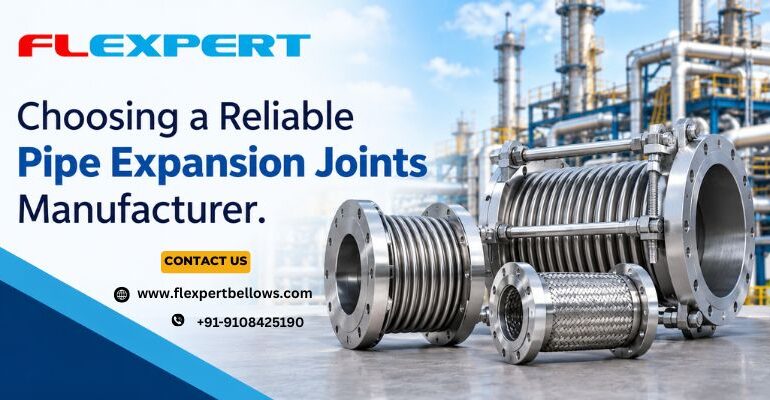
Understanding the available options makes discussions with suppliers much more productive. Common designs include:
- Metal bellows expansion joints: Often selected for industrial services requiring controlled flexibility under specified pressure and temperature conditions.
- Rubber expansion joints: Commonly used in suitable water, pumping, and vibration-isolation applications.
- Fabric expansion joints: Frequently used in compatible low-pressure gas ducts and exhaust systems.
The correct choice depends on more than the fluid being transported. Pressure, temperature, movement, fatigue life, corrosion resistance, and pressure-thrust management must all be considered.
When comparing piping expansion joints, give the manufacturer complete operating details. Accurate information helps engineers recommend an appropriate design instead of relying on assumptions.
A Practical Checklist Before Placing Your Order
Before approving a supplier, take a moment to confirm these details:
- Share the design and operating pressure, temperature, and fluid details.
- Specify the required movement, pipe size, connection type, and available space.
- Request technical drawings, material specifications, and relevant quality documents.
- Confirm installation requirements, delivery schedules, and after-sales support.
This simple preparation can prevent misunderstandings and make quotations easier to compare on equal terms.
Frequently Asked Questions
1. What does a pipe expansion joints manufacturer do?
A manufacturer designs or produces expansion joints that accommodate specified piping movements. Depending on its capabilities, it may also provide engineering guidance, testing documentation, customization, and installation support.
2. Which material is best for pipe expansion joints?
There is no single best material for every application. Stainless steel, rubber, and fabric designs serve different operating conditions. Selection should consider temperature, pressure, fluid compatibility, corrosion, and required movement.
3. How can I check a manufacturer’s reliability?
Review its technical experience, manufacturing capabilities, quality procedures, product documentation, applicable standards, customer references, and willingness to discuss your operating requirements in detail.
4. How often should expansion joints be inspected?
Inspection frequency depends on the application, operating conditions, manufacturer recommendations, and applicable maintenance requirements. Establish a documented inspection schedule and investigate visible damage, leakage, abnormal movement, or changes in system performance promptly.
Final Thoughts
Choosing the right pipe expansion joints manufacturer is ultimately about finding a partner who understands your piping system, not simply a supplier offering a competitive quotation. Prioritize sound engineering, suitable materials, documented quality, and dependable support. When these elements come together, you can make a more informed purchasing decision and build a stronger foundation for long-term piping reliability.
Listen Here: Click Now