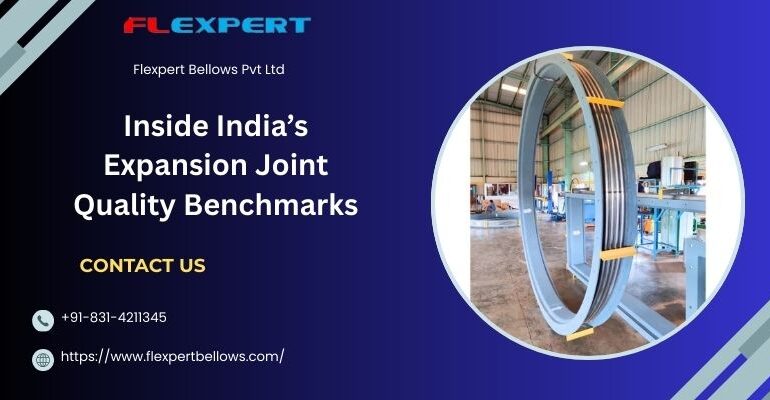
In heavy industries, small components often carry enormous responsibility. Axial expansion joints, for instance, quietly absorb thermal movement, pressure fluctuations, and vibration in pipelines that operate under punishing conditions. But how do you know if they’ll actually perform when it matters most? The answer lies in the quality standards followed by every serious axial expansion joint manufacturer in India.
Behind every reliable piping system is a disciplined approach to design validation, material testing, and manufacturing precision. Let’s unpack what truly separates industry leaders from average fabricators.
Compliance with International Design Codes
Reputable manufacturers don’t rely on guesswork. They design axial expansion joints in accordance with globally accepted codes such as EJMA (Expansion Joint Manufacturers Association) standards and ASME guidelines. EJMA, widely recognized in the piping industry, provides formulas and best practices for bellows design and fatigue life calculations (see ejma.org).
Why does that matter? Because axial movement isn’t just about flexibility it’s about controlled flexibility. Without accurate calculations, joints may fail prematurely due to over-compression or excessive stress.
Key Design Parameters Verified
- Cycle life based on pressure and temperature ratings
- Axial movement capacity and spring rate
- Pressure thrust calculations
- Material thickness and convolution geometry
It’s a bit like engineering a suspension system for a high-speed train precision is everything.
Material Selection and Traceability
Leading manufacturers treat raw material sourcing with almost obsessive care. Stainless steels such as SS 304, SS 316, and high-nickel alloys are commonly used in industrial bellows manufacturing due to corrosion resistance and high-temperature durability.
According to data from the Bureau of Indian Standards (bis.gov.in), material certification and traceability are critical for industrial safety compliance. Every sheet or coil used in fabrication must carry mill test certificates (MTCs), ensuring chemical composition and mechanical properties meet defined specifications.
Without traceability, quality becomes a gamble and in high-pressure piping systems, that’s a risk no plant operator wants to take.
Advanced Manufacturing and Welding Standards
Here’s where craftsmanship meets engineering. Bellows are typically formed through precision cold-forming or hydroforming processes. These techniques ensure uniform convolution shapes and consistent wall thickness.
A trusted axial expansion joint manufacturer also follows stringent welding procedures qualified under ASME Section IX standards. Welders are certified, and procedures are documented.
Critical Quality Checks Include:
- Non-destructive testing (NDT) such as dye penetrant or radiographic inspection
- Hydrostatic pressure testing
- Pneumatic leak testing
- Dimensional inspection for flange alignment and fitment
These tests simulate real-world operating conditions before the product ever leaves the factory floor.
Fatigue Testing and Lifecycle Validation
Expansion joints are dynamic components they move repeatedly throughout their lifespan. Fatigue testing ensures they can survive thousands of operational cycles.
Manufacturers often conduct simulated movement testing to replicate thermal expansion and contraction scenarios. For plant engineers, understanding wear patterns is crucial. In fact, industry professionals frequently reference resources like How to Spot the Early Signs of Bellows Fatigue to identify early warning signs in operational systems.
It’s not just about selling a product; it’s about ensuring long-term reliability.
Quality Management Systems and Certifications
Top-tier manufacturers typically operate under ISO 9001-certified quality management systems. ISO standards emphasize documented procedures, corrective action processes, and continuous improvement (details available at iso.org).
Here’s what structured quality management ensures:
- Consistent production standards across batches
- Clear documentation for audits and inspections
- Continuous performance evaluation and process refinement
In industries such as power plants, oil & gas, and chemical processing, these certifications are often mandatory for vendor approval.
Application-Specific Customization
No two piping systems are identical. Temperature ranges, pressure loads, and movement requirements differ dramatically. That’s why experienced manufacturers provide tailored solutions rather than one-size-fits-all products.
Customization may involve:
- Internal liners for high-velocity media
- External covers for abrasive environments
- Tie rods or limit rods to control movement
Such engineering adaptability reflects a deeper understanding of industrial expansion joints beyond textbook specifications.
Frequently Asked Questions
1. Which standards are followed by leading axial expansion joint manufacturers in India?
They commonly follow EJMA guidelines, ASME codes, and ISO-certified quality management systems.
2. Why is material traceability important?
Traceability ensures the raw materials meet required chemical and mechanical standards, enhancing safety and reliability.
3. What tests are performed before dispatch?
Manufacturers conduct hydrostatic tests, leak tests, dimensional checks, and non-destructive testing to ensure product integrity.
4. How long do axial expansion joints typically last?
With proper design and installation, high-quality expansion joints can withstand thousands of operational cycles under specified conditions.
Final Thoughts
Quality standards are not marketing buzzwords they’re the backbone of safe and efficient industrial piping systems. From material traceability to fatigue testing, leading axial expansion joint manufacturers in India operate with disciplined precision. When these standards are followed diligently, industries gain more than just a component they gain reliability, safety, and long-term operational confidence.