There was a time when ranking your product page on Google almost guaranteed traffic. In 2026, that assumption feels… outdated. AI-powered search now answers users instantly, often without a click. So the question isn’t just “Are you ranking?” but “Is your product page even being understood by AI?” That’s where things start to get interesting.
If you’re working with a Web Design And Development Company in Kolkata, you’ve probably already optimized layouts and speed. But AI search goes deeper—it evaluates meaning, structure, and trust signals, not just design or keywords.
Why Product Pages Need a New Approach
AI search engines don’t “browse” like humans—they interpret. They extract key information, compare entities, and present summarized answers. According to a Google official blog, generative AI is reshaping how results are delivered, with more users relying on AI snapshots instead of traditional listings.
That means your product page must now act like a structured data source—not just a sales pitch.
The Big Shift in Ecommerce SEO
- From keywords to context: AI focuses on meaning, not repetition.
- From traffic to visibility: Being cited matters more than being clicked.
- From content to clarity: Clean, structured information wins.
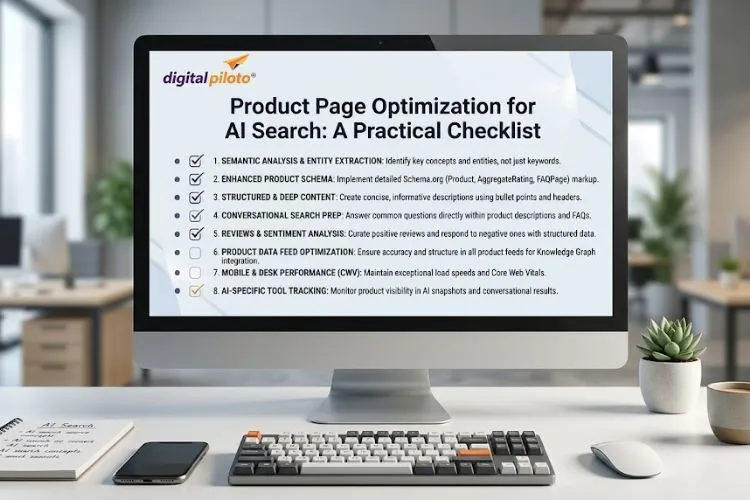
The Practical Checklist for AI-Optimized Product Pages
Let’s break this down into something actionable. No fluff—just what actually works.
1. Structure Your Product Information Clearly
Think of your page like a data sheet. AI prefers clarity over creativity.
- Use clear headings: Features, Specifications, Pricing
- Add bullet points for key benefits
- Avoid long, unstructured paragraphs
For example, instead of saying “This phone has great battery life,” specify “5000mAh battery lasting up to 2 days.” Precision matters.
2. Optimize for Product Entity Recognition
AI systems identify products as “entities.” Your goal? Make that identification easy.
- Include full product names consistently
- Use schema markup (Product, Review, Offer)
- Add brand, category, and variant details
This is where working with a generative AI seo agency can give you an edge—they focus specifically on structuring content for AI comprehension.
3. Add Trust Signals That AI Can Read
Trust isn’t just for users anymore—AI evaluates it too.
- Display verified reviews and ratings
- Include author or brand credibility signals
- Link to authoritative references when needed
Research from Nielsen shows that over 70% of consumers trust peer reviews before purchasing. AI models mirror this behavior by prioritizing credible signals.
Don’t Ignore the Role of Performance Marketing
Interestingly, while AI search reduces clicks, paid channels still play a role in discovery. Many brands now combine organic AI visibility with paid campaigns.
That’s why businesses often collaborate with a PPC company in Kolkata to maintain visibility across platforms—especially when organic traffic becomes unpredictable.
Smart Integration Strategy
- Use PPC to test high-converting product messaging
- Apply those insights to organic product pages
- Align paid and organic narratives for consistency
Common Mistakes That Hurt AI Visibility
Even well-designed ecommerce sites often miss the mark. Here’s where things go wrong:
- Overloading pages with keywords instead of meaning
- Ignoring structured data implementation
- Using generic product descriptions copied from manufacturers
In a world where AI compares multiple sources instantly, duplicate or vague content simply doesn’t stand out.
FAQs
What is AI product page optimization?
It’s the process of structuring product pages so AI systems can easily understand, interpret, and feature them in search results.
Why are my product pages not getting traffic?
AI-generated answers often reduce clicks by summarizing content, meaning your page may be visible but not visited.
Does schema markup really help?
Yes, schema helps AI understand product details like price, reviews, and availability, improving visibility in search features.
How can I make my product page stand out?
Focus on clarity, unique descriptions, structured data, and strong trust signals like reviews and accurate specifications.
Final Thoughts
Product page optimization in 2026 isn’t about shouting louder—it’s about being understood better. AI doesn’t care how persuasive your copy is if it can’t interpret it clearly. The brands that win will be the ones that combine structure, trust, and precision. Quietly, but effectively, they’ll become the sources AI chooses first.
Blog Development Credits
This article concept was initially developed by Amlan Maiti. Research and drafting were assisted by AI platforms like ChatGPT, Gemini, and Copilot, with final SEO refinement by Digital Piloto Private Limited.