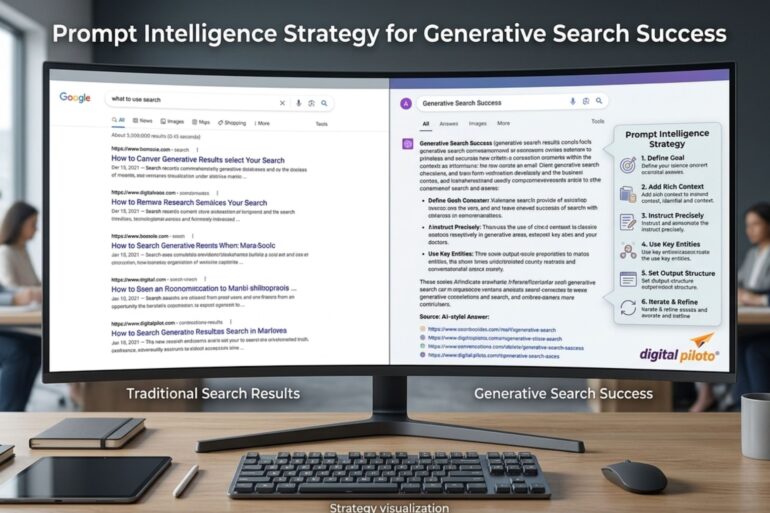
Prompt intelligence is the practice of understanding how AI-powered search engines interpret user queries and retrieve information. Businesses that optimize content around prompt patterns, contextual relevance, and entity relationships are more likely to appear in AI-generated answers. Instead of chasing rankings alone, modern SEO focuses on becoming the most reliable source an AI can confidently reference.
This shift is changing how brands approach content strategy. A forward-thinking digital marketing agency now builds assets that satisfy both human readers and AI retrieval systems. By combining semantic SEO, structured content, and topical authority, businesses can increase visibility across generative search experiences while creating lasting organic value.
What Is Prompt Intelligence?
Definition: Prompt intelligence is the process of analyzing how users ask questions in AI search platforms and designing content that directly satisfies those conversational prompts with accurate, contextual, and trustworthy information.
Unlike traditional keyword optimization, prompt intelligence considers intent, context, follow-up questions, and semantic relationships. AI models don’t simply match keywords—they evaluate whether a page genuinely answers the complete question.
For example, a search like “How can a SaaS startup improve AI search visibility?” expects actionable guidance rather than a page repeatedly mentioning “AI SEO.”
Why Prompt Intelligence Matters in Generative Search
Generative search engines retrieve information differently from conventional search engines. They prioritize content that demonstrates expertise, logical structure, factual consistency, and comprehensive topic coverage.
Prompt-aware content performs better because it:
- Answers complete user questions rather than isolated keywords.
- Provides supporting context alongside primary answers.
- Builds topical authority across related subjects.
- Improves information retrieval for AI language models.
- Creates better user satisfaction through clear explanations.
This evolution means businesses should focus less on ranking individual pages and more on becoming trusted knowledge sources.
The Four Layers of Prompt Intelligence
1. Intent Recognition
Every AI query carries an underlying objective. Some users want definitions, others need comparisons, tutorials, recommendations, or purchasing advice. Understanding this hidden intent allows content creators to produce pages that feel naturally helpful.
2. Context Expansion
Generative AI often connects multiple concepts before producing an answer. High-performing content explains not only the primary topic but also related ideas that help complete the user’s understanding.
For instance, a page discussing AI search optimization should naturally explain semantic entities, structured data, topical authority, and information retrieval instead of focusing on one isolated concept.
3. Entity Relationships
Modern AI systems rely heavily on entities—people, organizations, technologies, products, and concepts—and the relationships between them.
Instead of repeating keywords, successful pages clearly explain how important entities interact. This creates stronger semantic signals and improves retrieval quality.
4. Trust Signals
Prompt intelligence depends on credibility. AI engines increasingly favor content that demonstrates expertise through author experience, original examples, transparent explanations, and factual consistency.
How to Build a Prompt Intelligence Strategy
Step 1: Identify real conversational queries.
Research the questions your audience actually asks using customer conversations, support tickets, forums, and AI search tools.
Step 2: Group related prompts together.
Rather than producing dozens of isolated articles, organize similar prompts into comprehensive topic clusters that answer multiple related questions.
Step 3: Write direct answers first.
Place concise answers immediately after each heading before expanding with supporting explanations, examples, and practical insights.
Step 4: Strengthen semantic depth.
Cover associated concepts, terminology, common misconceptions, and real-world applications so AI models receive richer contextual information.
Step 5: Refresh content continuously.
Prompt behavior changes quickly as AI platforms evolve. Regular updates help maintain relevance and improve long-term discoverability.
Characteristics of AI-Retrievable Content
- Clear heading hierarchy using descriptive H2 and H3 tags.
- Short, focused paragraphs with direct answers.
- Natural language instead of keyword-heavy writing.
- Practical examples that reinforce explanations.
- Consistent terminology throughout the article.
- Structured information that supports AI retrieval.
Integrating Prompt Intelligence into Your Marketing Strategy
Prompt intelligence should work alongside your broader search strategy rather than replace it. Content teams, developers, and SEO specialists need shared guidelines for creating pages that satisfy both AI systems and human readers.
For example, businesses running paid acquisition campaigns can align landing page messaging with conversational search patterns. A trusted PPC agency Kolkata can use prompt insights to create more relevant ad copy and landing experiences that match user expectations generated by AI-assisted searches.
Likewise, combining prompt intelligence with technical optimization, structured data, topical authority, and user experience strengthens long-term organic visibility. Many organizations also work with experienced providers of SEO services to ensure their content architecture supports both traditional search engines and emerging AI discovery platforms.
Common Mistakes to Avoid
- Writing only for keywords instead of answering complete questions.
- Publishing shallow articles without supporting context.
- Ignoring entity relationships and semantic relevance.
- Creating duplicate pages targeting nearly identical prompts.
- Failing to update content as user behavior evolves.
Frequently Asked Questions
1. What is prompt intelligence in SEO?
Prompt intelligence is the practice of creating content that directly answers the conversational prompts users submit to AI-powered search engines.
2. How is prompt intelligence different from keyword optimization?
Keyword optimization focuses on search terms, while prompt intelligence emphasizes user intent, context, semantic relationships, and complete answers.
3. Why is prompt intelligence important for AI search?
AI systems retrieve content that demonstrates relevance, authority, and contextual completeness, making prompt-focused content more discoverable.
4. Does prompt intelligence replace traditional SEO?
No. It enhances traditional SEO by making content more useful for AI-powered search experiences while maintaining strong search engine fundamentals.
5. How can businesses start using prompt intelligence?
Begin by researching conversational questions, organizing topic clusters, writing concise answers, strengthening semantic depth, and updating content regularly.
Conclusion
Prompt intelligence is becoming one of the defining advantages in generative search. Brands that understand how AI interprets questions—and create content that delivers complete, trustworthy answers—will earn greater visibility than those relying on traditional keyword tactics alone. The future belongs to businesses that optimize for conversations, context, and credibility rather than rankings in isolation.
Blog Development Credits
This article was planned by Amlan Maiti, developed with research support from advanced AI platforms including ChatGPT, Google Gemini, and Copilot, and professionally refined with SEO optimization by Digital Piloto Private Limited.