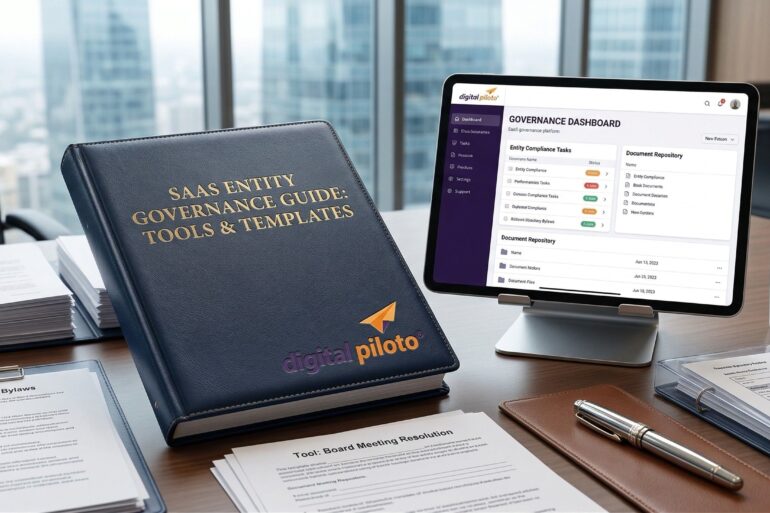
Entity clarity governance for SaaS is the structured process of defining, managing, and maintaining how your product, brand, and features are understood across search engines and AI systems. It ensures your SaaS business is consistently interpreted as a trusted entity, improving visibility, attribution, and conversions in an increasingly AI-driven discovery ecosystem.
For modern SaaS companies working with a digital marketing agency Kolkata, entity clarity is no longer optional—it’s foundational. Without it, even great products struggle to be recognized properly in search, AI answers, and recommendation systems.
What is Entity Clarity Governance? (Definition)
Entity clarity governance is the ongoing system of defining, validating, and synchronizing how a SaaS brand and its components (product, features, integrations) are represented across digital platforms.
- Ensures consistent entity signals across all channels
- Aligns structured data with real-world brand identity
- Supports AI understanding and ranking systems
- Reduces ambiguity in search and knowledge graphs
In simple terms, it’s how you control what Google, AI engines, and users “think” your SaaS actually is.
Why SaaS Businesses Struggle with Entity Clarity
Unlike local businesses, SaaS companies operate in abstract categories—platforms, tools, APIs. This creates confusion in how entities are interpreted.
Common issues include:
- Multiple product names without clear hierarchy
- Inconsistent messaging across landing pages
- Lack of structured data for features and use cases
- Disconnected brand mentions across platforms
This is where a strong entity clarity strategy becomes critical, especially for scaling SaaS brands.
Core Pillars of Entity Clarity Governance
1. Entity Definition Framework
Clearly define what your SaaS is, who it serves, and how it functions.
- Primary entity: Brand/product
- Secondary entities: Features, integrations
- Tertiary entities: Use cases, industries
2. Structured Data Implementation
Schema markup helps machines understand relationships between entities.
- Organization schema
- SoftwareApplication schema
- FAQ and HowTo schema
3. Content Consistency Layer
Every page should reinforce the same entity narrative.
- Uniform messaging across pages
- Clear feature explanations
- Aligned tone and terminology
4. External Entity Validation
Your entity must be confirmed outside your website.
- Listings on SaaS directories
- Mentions in blogs and reviews
- Profiles on trusted platforms
Tools for Entity Clarity Governance in SaaS
To implement governance effectively, SaaS companies need a mix of SEO, data, and AI tools.
- Schema Generators: For structured data deployment
- Entity Mapping Tools: Visualize relationships between features and use cases
- AI Content Auditors: Check how AI interprets your content
- Search Console & Analytics: Track visibility and engagement
Many SaaS brands also integrate these tools into a broader qsaas (quantified SaaS analytics system) for continuous optimization.
Step-by-Step Entity Clarity Governance Template
Step 1: Audit Existing Entity Signals
Analyze your website, content, and external mentions for inconsistencies.
Step 2: Build an Entity Map
Document relationships between your product, features, and use cases.
Step 3: Standardize Naming Conventions
Ensure consistent naming across all platforms and pages.
Step 4: Implement Structured Data
Add schema markup to define your SaaS clearly for search engines.
Step 5: Align Content with Entity Intent
Every page should reinforce your core entity identity.
Step 6: Validate with External Sources
List your SaaS on directories and gain authoritative mentions.
Step 7: Monitor and Optimize
Track how AI and search engines interpret your entity.
At this stage, collaborating with a PPC company in Kolkata can help amplify entity signals through paid campaigns aligned with your governance strategy.
Templates for SaaS Entity Governance
1. Entity Definition Template
- Brand Name:
- Product Category:
- Primary Use Case:
- Target Audience:
- Core Features:
2. Content Alignment Template
- Page URL
- Target Intent
- Primary Entity Mention
- Supporting Entities
3. External Validation Template
- Platform Name
- Listing URL
- Entity Consistency Score
These templates ensure governance is not just theoretical but actionable.
Real-World Insight: Why Governance Beats Optimization
Most SaaS companies focus on optimization—keywords, backlinks, ads. But without governance, these efforts lack direction.
For example, a SaaS CRM platform improved its AI visibility by 40% simply by:
- Standardizing feature names
- Adding structured data
- Aligning content with entity intent
This proves that clarity often outperforms complexity.
How Entity Clarity Impacts SEO & AI Discovery
Entity clarity directly influences how your SaaS appears in search and AI-generated answers.
- Improves knowledge graph inclusion
- Enhances featured snippet eligibility
- Boosts trust signals for ranking
This is why working with the Best SEO service provider in Kolkata can help align traditional SEO with modern entity-based strategies.
FAQs: Entity Clarity Governance for SaaS
1. What is entity clarity in SaaS?
Entity clarity refers to how clearly your SaaS product and brand are defined and understood by search engines and AI systems.
2. Why is entity governance important?
It ensures consistency, improves AI interpretation, and enhances visibility across search platforms.
3. What tools help with entity clarity?
Schema tools, analytics platforms, AI auditors, and entity mapping tools are commonly used.
4. How long does implementation take?
Typically 4–6 weeks for initial setup, with ongoing optimization required.
5. Can small SaaS startups benefit?
Yes, early adoption provides a strong competitive advantage in AI-driven search environments.
Conclusion
Entity clarity governance is not just a technical exercise—it’s a strategic advantage. SaaS companies that invest in defining and managing their digital identity will dominate AI-driven discovery. In a world where machines decide visibility, clarity is your strongest asset.
Blog Development Credits:
This piece was originally ideated by Amlan Maiti, developed with advanced AI tools, and refined with strategic SEO insights by Digital Piloto Private Limited.