The strongest search strategy for business growth now combines SEO, AEO, and GEO rather than treating them as separate disciplines. SEO builds discoverability in traditional search, AEO makes information easy for answer engines to extract, and GEO improves a brand’s visibility within generative AI experiences. Together, they create a search presence built for both rankings and recommendations.
A modern SEO service provider in Kolkata therefore needs to think beyond keywords and rankings. The real objective is to make a business easy to find, understand, trust, cite, and recommend across an increasingly fragmented search ecosystem.
What Is the GEO + AEO + SEO Framework?
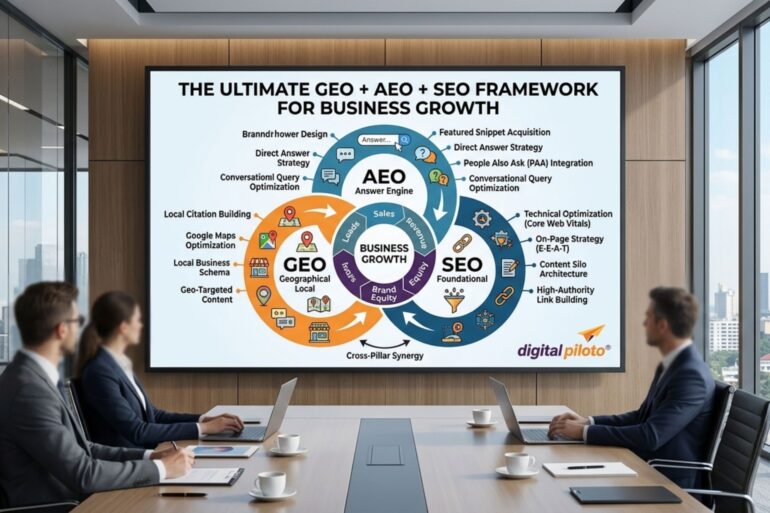
The GEO + AEO + SEO framework is a unified search optimization model that improves a brand’s visibility across search engines, answer engines, and generative AI platforms.
Each layer solves a different problem:
- SEO: Helps search engines discover, understand, and rank your website.
- AEO: Structures information so direct-answer systems can identify and present useful responses.
- GEO: Helps increase the likelihood that generative AI systems understand, retrieve, cite, and mention your brand in relevant answers.
The important point is that these layers overlap. Strong SEO creates discoverable content. Strong AEO makes that content easier to interpret. Strong GEO strengthens the brand and information signals that AI systems can use when constructing answers.
Why Businesses Need All Three
Search behavior is no longer limited to typing a query into a conventional search engine and clicking a blue link.
A buyer might discover a company through Google, ask an AI assistant for recommendations, compare providers through an AI-generated answer, and finally return to the company’s website before contacting sales.
This creates a new challenge: visibility is becoming multi-surface.
A business can rank well and still have weak visibility in AI-generated answers. Conversely, a brand may be mentioned by AI systems but have a poor website experience that fails to convert the resulting interest.
The framework addresses both problems by treating search visibility as a connected ecosystem.
Layer 1: Build the SEO Foundation
SEO remains the foundation because search engines and AI systems still depend heavily on accessible, relevant, structured information.
Before worrying about generative visibility, businesses should make sure their digital assets are technically sound and genuinely useful.
What should the SEO layer cover?
- Technical crawlability and indexability
- Search-intent-aligned content
- Clear site architecture and internal linking
- Topic and entity coverage
- Original expertise and useful information
- Page experience and mobile usability
- Relevant authority and third-party references
But there is an important strategic shift here. Do not build a content library simply because keywords have search volume. Build a knowledge base around the questions, problems, entities, and decisions that matter to your customers.
Layer 2: Make Content Answer-Ready
AEO is the practice of structuring content so search and answer systems can quickly identify accurate, useful responses to specific questions.
This means removing unnecessary ambiguity. If a user asks, “What is enterprise SEO?” the page should provide a concise definition before expanding into examples and details.
How to make a page AEO-friendly
- Answer the primary question early.
- Use descriptive headings that mirror real questions.
- Provide concise definitions before detailed explanations.
- Use numbered steps for processes.
- Use tables or bullets where comparison improves clarity.
- Support claims with evidence, examples, or credible sources.
This structure benefits humans as much as machines. A visitor should be able to scan the page and understand its key points without reading every paragraph.
Layer 3: Build Generative Search Visibility
GEO focuses on improving a brand’s representation and discoverability within generative search environments, where AI systems synthesize information from multiple sources rather than simply displaying ranked pages.
This changes the optimization question.
Traditional SEO asks, “Can we rank for this query?” GEO increasingly asks, “Does the AI system understand our brand well enough to include us when answering this question?”
That is why brand entities, consistent business information, expert authorship, original research, reviews, industry references, and relevant third-party mentions become increasingly important.
A generative engine optimization agency should therefore focus not only on optimizing individual pages but also on strengthening the broader information ecosystem surrounding the brand.
How the Three Layers Work Together
Imagine a cybersecurity company wants to become known for cloud security solutions.
SEO might target searches around cloud security services, implementation, compliance, and solutions.
AEO could create clear answers to questions such as “What is cloud security compliance?” or “How does cloud security monitoring work?”
GEO would strengthen the company’s entity signals through expert content, original research, credible references, consistent business information, and authoritative mentions across the web.
The result is not three separate campaigns. It is one connected visibility strategy.
Step-by-Step: Build the Framework
Step 1: Map the customer questions
Start with the questions customers ask before, during, and after choosing a solution. Include informational, comparison, commercial, and problem-solving queries.
Step 2: Map topics to entities
Identify the people, products, services, organizations, technologies, locations, and concepts that define your market.
Step 3: Create content clusters
Build comprehensive topic coverage instead of isolated blog posts. Connect educational pages with service pages and supporting resources.
Step 4: Add answer-ready structures
Use definitions, direct answers, step-by-step explanations, FAQs, comparisons, and concise summaries where appropriate.
Step 5: Strengthen authority signals
Publish original insights, expert commentary, case studies, research, statistics, and evidence that other reputable sources can reference.
Step 6: Connect visibility to business goals
Measure not only rankings but qualified traffic, branded searches, AI visibility, citations, leads, conversions, and assisted revenue.
The Most Important Concept: Information Consistency
One of the most overlooked parts of modern search optimization is consistency.
If your website describes your company one way, business directories describe it another way, industry profiles use different service terminology, and third-party sources contain outdated information, machines have a harder time building a confident understanding of the entity.
Think of your online presence as a distributed business profile. The clearer and more consistent the information, the easier it becomes for systems to connect the signals.
What Should Businesses Measure?
The framework needs broader measurement than conventional SEO reporting.
- Organic rankings and qualified organic traffic
- Featured snippets and direct-answer visibility
- Brand mentions in AI-generated responses
- AI citations and source inclusion where measurable
- Branded search growth
- Engagement with commercial content
- Qualified leads and conversions
AI visibility is also difficult to measure with one universal metric because different platforms produce different answers for different users and contexts. Treat it as a developing measurement layer rather than replacing established SEO analytics overnight.
Common Mistakes to Avoid
Businesses often make the framework unnecessarily complicated. The biggest mistakes are surprisingly basic.
- Creating separate content strategies for SEO, AEO, and GEO
- Writing generic AI-generated content without original expertise
- Chasing mentions without strengthening the underlying brand entity
- Optimizing for questions while ignoring commercial intent
- Measuring visibility without connecting it to business outcomes
The goal is integration, not another collection of acronyms.
FAQs
What is the difference between SEO, AEO, and GEO?
SEO focuses primarily on search engine visibility, AEO focuses on being selected for direct answers, and GEO focuses on visibility within generative AI search and recommendation experiences.
Is SEO still important for GEO?
Yes. Strong technical SEO, useful content, structured information, authority, and discoverability provide an important foundation for broader AI search visibility.
How can a business optimize for AI search?
Build authoritative content, answer real customer questions clearly, maintain consistent entity information, publish original expertise, and strengthen credible references and mentions across relevant sources.
Does AEO replace traditional SEO?
No. AEO complements SEO by making information easier for answer systems to extract while traditional SEO continues to support search discovery and rankings.
What is the best starting point for a GEO, AEO, and SEO strategy?
Start with customer search intent, audit the technical and content foundation, identify important entities, and then build structured content that answers questions while supporting commercial goals.
Conclusion
The future of search optimization is not SEO versus AEO versus GEO. It is SEO plus AEO plus GEO working as one system.
Businesses that succeed will not simply publish more content. They will build clearer digital identities, answer important questions better, demonstrate genuine expertise, and create information that both people and intelligent systems can understand.
That is the real opportunity: becoming not just searchable, but understandable, trustworthy, and recommendable.
Blog Development Credit
This article was conceptualized by Amlan Maiti, researched with AI-assisted tools, and refined through SEO expertise from Digital Piloto Private Limited.