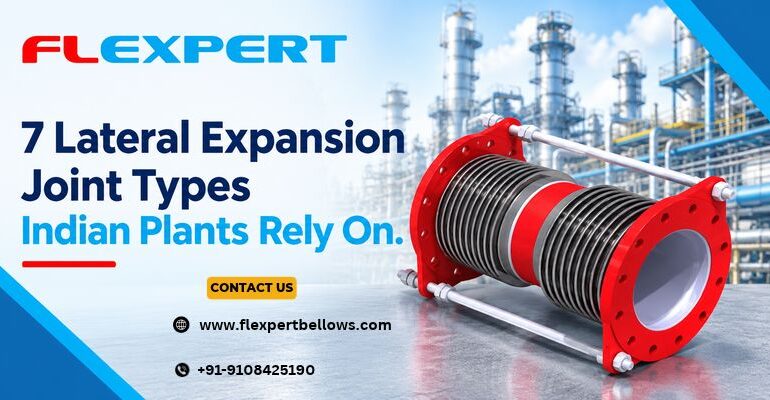
Walk through any refinery, fertiliser unit or thermal plant in India and you’ll spot pipes doing something quietly dramatic: growing, shrinking and shifting with every temperature swing. Lateral expansion joints soak up that sideways movement so welds don’t crack. Here are seven types worth knowing about before your next planned shutdown sneaks up.
Choosing the right design isn’t a catalogue exercise, though. A reliable lateral expansion joint manufacturer will ask about your media, pressure, movement and available space before quoting anything. I’ll use that same lens below.
Why Lateral Movement Deserves More Attention?
Coal-based units alone account for roughly 2,24,158 MW of India’s 5,51,995 MW installed capacity, around 40 percent, according to the Central Electricity Authority’s July 2026 report. Plants of that scale run long steam and flue lines at high temperatures. Even a modest pipe run can shift several millimetres sideways, and that adds up quickly.
Industry design practice, including the standards published by the Expansion Joint Manufacturers Association, treats movement absorption as a calculation, not a guess. Worth remembering when someone suggests “just add a loop.”
The 7 Lateral Expansion Joint Types
1. Tied Universal Joint
Two bellows joined by a centre spool, with tie rods restraining pressure thrust. It’s the workhorse for steam headers because it handles large lateral offsets without loading nearby equipment.
2. Untied Universal Joint
Same two-bellows idea, minus the tie rods. It moves more freely, but your anchors must take the full pressure thrust. Fine for low-pressure lines, risky elsewhere.
3. Hinged Joint
Hinges force movement into one plane. Paired in a Z-shaped layout, two hinged units absorb lateral offset neatly, and I’ve seen them save a lot of steelwork on crowded racks.
4. Gimbal Joint
Think of a hinged joint that can pivot in any direction thanks to a ring-and-pin assembly. It suits three-dimensional pipe routing, such as lines turning around vessels.
5. Pressure-Balanced Elbow
Installed at a bend, it cancels pressure thrust internally. Handy where anchors are expensive or simply impossible, like on pump suction lines near delicate nozzles.
6. Swing Joint
Two hinged or gimballed bellows joined by tie bars at an elbow, built for wide arc movement. It’s quite common in long cooling water and process runs.
7. Fabric Lateral Joint
Not metal at all. Layered fabric handles lateral shifts in low-pressure flue gas ducts, where temperatures are high but pressure is almost nothing.
Picking the Right Design
A good lateral expansion bellow manufacturer will walk you through these questions first:
- What is the media? Steam, slurry and corrosive gas each demand different bellows materials and liners.
- How much movement, in which direction? Single plane, multi-plane or arc movement narrows the choice quickly.
- Can your anchors handle thrust? If not, go tied or pressure-balanced.
- How tight is the space? Universal joints are long; hinged and gimbal units are more compact.
For a broader checklist, the Pipe Joint Buying Guide: What Industries Should Never Overlook is a useful companion read.
Mistakes I See Again and Again
- Removing shipping bars too early, before the line is fully supported.
- Forgetting guides, so the bellows twist instead of flex.
- Ignoring cycle life. A joint rated for 1,000 cycles won’t last a decade of daily start-ups.
- Treating a metal bellows expansion joint like a pipe fitting rather than a precision component.
Frequently Asked Questions
What does a lateral expansion joint do?
It absorbs sideways pipe movement caused by heat, vibration or settlement, protecting welds, nozzles and supports from stress.
Which type suits high-pressure steam lines?
Tied universal joints are usually preferred, since the tie rods carry pressure thrust while the bellows handle the movement.
How long does an expansion joint last?
It depends on cycles, temperature and media. Well-specified metal units often run for years, but design cycle life should be confirmed in writing.
Can lateral joints be customised?
Yes. Materials, liners, flanges and movement ratings are routinely tailored to a plant’s layout and operating conditions.
Final Thoughts
Pipes move whether we plan for it or not. The plants that stay out of trouble are the ones that matched joint type to real operating conditions instead of reaching for whatever was in stock. Spend an hour on selection now and you’ll save a weekend of emergency repairs later.
Listen Here: Click Now