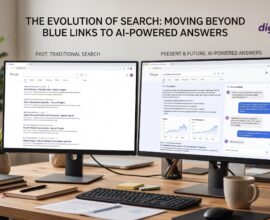
Funding gives a startup capital, credibility, and pressure to grow quickly. But when customers increasingly ask AI platforms for recommendations, being visible in generated answers can become just as important as ranking on a search results page. A practical GEO audit helps funded startups discover where their brand is understood, cited, recommended, or quietly overlooked.
What Is GEO for a Funded Startup?
Generative Engine Optimization, or GEO, is the practice of improving a brand’s digital presence so AI-powered search and answer systems can understand, retrieve, summarize, and reference its information more effectively.
For a funded startup, the stakes are slightly different. Investors expect growth, acquisition costs need watching, and the company is usually building authority in a crowded category. An AI system describing your company incorrectly—or failing to mention it at all—can create a visibility gap that traditional SEO reports may never reveal.
A good digital marketing consultant India can help turn GEO from an experimental marketing idea into a repeatable workflow connected to content, SEO, PR, and brand strategy.
Step 1: Audit How AI Understands Your Brand
Start with a surprisingly simple exercise: ask AI platforms questions that your prospects would realistically ask.
Do not begin with “Tell me about our company.” That is too easy. Test category-level and problem-based prompts where your competitors are likely to appear.
- “What are the leading platforms for solving [customer problem]?”
- “Which companies offer [specific solution] for startups?”
- “What should a business consider before buying [product category]?”
- “Compare [your category] providers based on features and pricing.”
- “What are alternatives to [major competitor]?”
Record whether your startup appears, which competitors are mentioned, what sources are cited, and whether the description is accurate. Run the same prompts periodically because generated answers can change.
Step 2: Check Your Entity and Information Footprint
AI systems need consistent information to build a reliable picture of a company. If your homepage says one thing, your LinkedIn profile says another, and industry publications describe you differently, ambiguity creeps in.
Audit the basics:
- Company name and product names
- Founders and leadership information
- Product category and primary use cases
- Geographic markets served
- Customer segments
- Key differentiators and proof points
- Third-party mentions and authoritative references
For funded startups, this is particularly important after a major funding round, repositioning, product launch, or market expansion. Your public information should evolve as quickly as the business does.
Step 3: Strengthen Evidence, Not Just Content
One of the biggest GEO mistakes is producing endless AI-friendly articles without giving AI systems much trustworthy evidence to work with.
Think of your website as a startup’s evidence room. Product documentation, original research, case studies, founder expertise, technical explainers, customer stories, and credible company information give external systems more substance to interpret.
A useful content audit should ask:
- Does each important claim have a clear source or explanation?
- Does the website demonstrate genuine experience rather than generic advice?
- Are important product and industry concepts explained consistently?
- Are original statistics, examples, research, or customer outcomes clearly presented?
- Can an AI system easily identify which page supports a particular claim?
This is also where a generative engine optimization agency can help connect technical website improvements with content and entity-building work.
Step 4: Audit Technical Accessibility
GEO is not an excuse to ignore technical SEO. If important information is difficult for crawlers to access, poorly structured, duplicated, or hidden behind unnecessary barriers, your content has a harder job being discovered and interpreted.
Review page structure, internal links, canonicalization, structured data where appropriate, crawlability, mobile usability, page performance, and content accessibility.
Also examine whether your most valuable information lives on pages that are easy to discover. A brilliant case study buried five clicks deep is not doing much strategic work.
Step 5: Measure AI Visibility Like a Business Metric
GEO reporting should go beyond screenshots of AI answers. Funded startups need metrics that can eventually connect visibility with growth.
Track indicators such as:
- Prompt visibility: Percentage of priority prompts where the brand appears.
- Competitive visibility: Frequency with which competitors are recommended.
- Citation rate: How often your website or content is referenced.
- Message accuracy: Whether AI descriptions match your actual positioning.
- Commercial impact: Changes in branded demand, qualified traffic, leads, and conversions.
Do not obsess over a single score. GEO is still an evolving discipline, and different AI systems can produce different results. Trends across a carefully designed prompt set are more useful than one impressive screenshot.
Step 6: Turn the Audit Into a 90-Day Workflow
An audit becomes valuable when it leads to action. A practical three-month cycle might look like this:
- Month one: Establish the baseline, identify information gaps, and map priority prompts.
- Month two: Improve core pages, strengthen evidence, resolve technical issues, and publish genuinely useful supporting content.
- Month three: Re-test prompts, compare competitors, measure citations, and connect visibility changes with business outcomes.
Traditional organic search still matters in this process. Working with a best SEO agency in India can help strengthen the technical and content foundations that support both conventional search visibility and emerging AI discovery.
Frequently Asked Questions
What should a startup check first in a GEO audit?
Start by testing realistic customer prompts across relevant AI search platforms. Check brand mentions, competitor recommendations, citations, and the accuracy of your company’s description.
Is GEO the same as SEO?
No. They overlap in areas such as content quality, technical accessibility, and authority, but GEO focuses more directly on visibility and representation within AI-generated answers and recommendations.
How often should funded startups conduct a GEO audit?
A quarterly full audit is a sensible baseline, with lighter prompt monitoring between audits. Major product launches, funding announcements, or repositioning can justify an additional review.
What makes content useful for GEO?
Useful GEO content is specific, trustworthy, well-structured, experience-led, and supported by evidence. It should answer real customer questions rather than simply repeating keywords.
Final Thoughts
For a funded startup, GEO should not become another shiny marketing project with a complicated dashboard and little commercial relevance. Treat it as an intelligence loop: test how AI sees your company, fix what is unclear, strengthen the evidence behind your claims, and measure whether visibility improves. That discipline can turn AI search from an unknown variable into a manageable growth channel.
Blog Development Credit
Conceived by Amlan Maiti, this article was researched with AI tools and refined for SEO and optimization by Digital Piloto Private Limited.