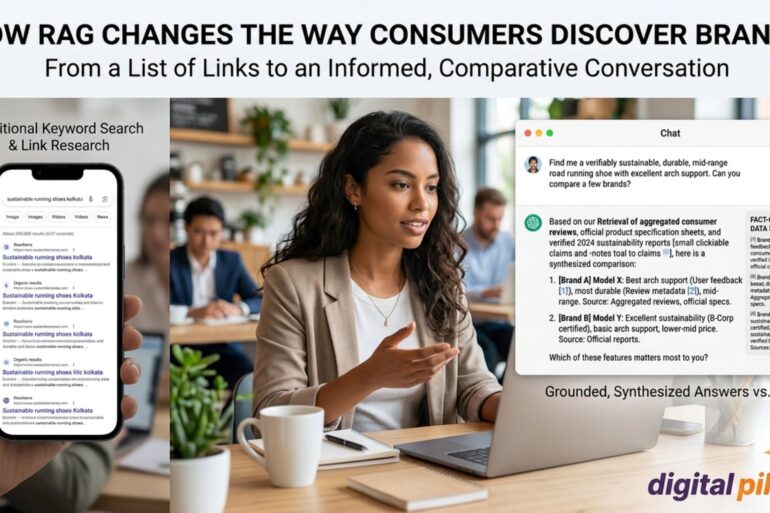
Consumers are no longer discovering brands only by typing keywords into a search engine and scanning a page of results. AI-powered search can retrieve information from multiple sources, combine it with a language model, and present a synthesized answer that influences which brands a person notices, compares, and ultimately considers. Retrieval-Augmented Generation, or RAG, is becoming an important part of that shift.
For businesses, this changes the visibility equation. The goal is no longer simply to rank for a keyword. Your website, product information, expertise, reviews, comparisons, and third-party mentions all need to provide clear, trustworthy information that can be discovered, interpreted, and used in the right context. Whether a company works with a digital marketing agency India or manages its own growth team, the underlying challenge is becoming the brand that both people and AI systems can understand.
What Is RAG in Simple Terms?
Retrieval-Augmented Generation is an approach in which an AI model retrieves relevant information from an external source before generating an answer. Instead of relying exclusively on knowledge encoded during model training, the system can retrieve current or specialized information and use it as grounding context.
The basic concept can be expressed as:
User question → Retrieval → Relevant evidence → AI-generated response
The original RAG research, published at NeurIPS in 2020, combined a language model with an external retrieval mechanism and found that RAG could produce more specific, diverse and factual language than a parametric-only baseline on knowledge-intensive tasks.
Modern RAG systems can use different retrieval technologies, including keyword search, semantic search, vector indexes and hybrid retrieval. Google Cloud describes RAG as combining retrieval with generative models so responses can be grounded in relevant data, while Microsoft describes it as a pattern that retrieves information, supplies it as grounding data, and then generates a response.
For marketers, however, the important point is not the vector database. It is the retrieval decision.
If an AI system retrieves information about your category, product, company or competitors, that information can influence the answer a consumer receives. If your information is absent, unclear, outdated or contradicted by stronger sources, the AI-generated answer may represent the market without you.
RAG Does Not Mean Every AI Search Engine Works the Same Way
It is tempting to describe every AI search experience as a single RAG pipeline. That would be misleading. Google AI Search, ChatGPT Search, Microsoft Copilot, Perplexity and other systems can use different retrieval, ranking, indexing and generation techniques.
Google’s current documentation explicitly says its generative Search experiences can use retrieval-augmented generation to retrieve relevant pages from its Search index. Google also emphasizes that traditional SEO fundamentals remain relevant and that there are no special technical requirements or secret AI-specific markup required to appear in AI Overviews or AI Mode.
That distinction matters because brands should not chase an imaginary universal “RAG ranking factor.” The more durable strategy is to make information technically accessible, semantically clear, useful, current, authoritative and easy to verify.
How RAG Changes Brand Discovery
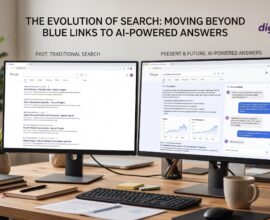
Traditional search largely presents consumers with a set of documents. AI-assisted search increasingly presents a synthesized answer that may contain recommendations, comparisons, explanations and selected sources.
That changes the consumer journey from:
Search → Results → Click → Research
toward a journey that can look more like:
Question → Retrieval → Synthesis → Shortlist → Validation → Action
The consumer may still visit websites. But some of the early research can happen inside the search or AI interface itself.
Google’s 2026 Search developments illustrate this direction. Google says AI Mode has surpassed one billion monthly users globally, with queries more than doubling every quarter since launch. Its AI Search experiences are also becoming increasingly conversational and multimodal.
OpenAI has similarly expanded product discovery in ChatGPT, allowing users to describe requirements conversationally, compare products and refine options based on factors such as price, features and reviews.
The result is a new competitive environment: brands increasingly compete to be included in the answer, not merely to appear beneath it.
The Retrieval Gate: The First Battle for Visibility
Before an AI system can use a piece of information, it generally needs a way to access or retrieve that information. This creates what marketers can think of as a retrieval gate.
A page can fail at this stage for ordinary reasons:
- The page is not indexable.
- Important information exists only in difficult-to-access interfaces.
- Product or service details are vague.
- The website contains outdated information.
- Important claims are unsupported.
- Different pages provide contradictory information.
- The brand has little independent evidence outside its own website.
- The content does not adequately answer the questions consumers actually ask.
This is why technical SEO still matters. Google recommends crawlability, internal linking, useful textual content, good page experience and accurate structured data for AI Search experiences just as it does for conventional Search.
For brands exploring best SEO service India, the strategic question should therefore extend beyond rankings: can search systems reliably discover, understand and connect the important facts about the business?
From Ranking Pages to Brand Shortlists
One of the biggest changes created by AI-assisted discovery is the compression of choice.
Imagine a consumer asking:
“What are the best project management platforms for a 50-person remote company that needs strong automation but does not want a complicated implementation?”
A conventional search may return articles, category pages, software directories and vendor websites.
An AI system can potentially synthesize information from several sources and return a smaller set of recommendations with explanations.
The competitive objective has therefore changed from simply being visible among many results to becoming a credible candidate for inclusion in the generated shortlist.
This does not mean AI recommendations are necessarily correct. They can be incomplete, outdated or wrong. It means the interface can influence what the consumer considers before they visit a brand’s website.
Why Product and Brand Data Matter More
AI-driven discovery depends heavily on information quality.
For an ecommerce business, that may include:
- Product names and variants
- Specifications
- Dimensions and compatibility
- Prices
- Availability
- Shipping information
- Warranty terms
- Reviews and ratings
- Use cases
- Frequently asked questions
Google’s 2026 shopping updates demonstrate how deeply product information is being integrated into conversational discovery. Google says its Shopping Graph contains more than 50 billion product listings in the India experience it described, with roughly two billion product updates every hour.
OpenAI’s shopping experiences similarly use merchant product data and publicly available information to support product discovery and comparison.
This means the product page is no longer merely a destination after discovery. It can become part of the information infrastructure that enables discovery.
Content Is Becoming Retrieval Infrastructure
This is one of the most important implications for content teams.
Content is often evaluated through familiar metrics such as rankings, impressions, clicks and engagement. In AI-assisted discovery, another question becomes important:
Can the information be retrieved and reused accurately when someone asks a relevant question?
Consider two statements.
Weak: “We provide innovative, world-class solutions for modern businesses.”
Useful: “Our platform supports SSO, role-based permissions, audit logs and automated provisioning for enterprise teams.”
The second statement is much more useful because it contains specific, verifiable information. It can answer a question.
That is the direction content strategy should move toward: less promotional fog and more structured evidence.
What Makes Brand Information Easier to Retrieve?
There is no single guaranteed formula for being retrieved by every AI system. However, several principles consistently improve information quality and machine comprehension.
1. State important facts clearly
Do not force readers or machines to infer basic information. Explain what the company sells, who it serves, what makes the product different and which problems it solves.
2. Use descriptive headings
Headings create semantic organization. A section called “Pricing and Plans” is more informative than a generic heading such as “Why Choose Us.”
3. Answer specific questions
Create useful explanations around compatibility, pricing, use cases, implementation, limitations, alternatives, comparisons and common objections.
4. Support important claims
Use credible sources, original research, documented methodology, specifications, expert authorship and transparent evidence where appropriate.
5. Keep information consistent
If one page says a product supports a particular feature while another says it does not, the contradiction creates unnecessary ambiguity.
6. Keep high-value information current
Pricing, product specifications, service offerings, availability, policies and technology capabilities can change quickly.
Third-Party Evidence Becomes Part of Brand Discovery
A brand’s own website is only one source of information.
Consumers may encounter a company through:
- Industry publications
- Independent reviews
- Expert comparisons
- Customer reviews
- Research reports
- Forums and communities
- Partner websites
- Marketplaces
- Professional associations
- News coverage
This creates an important distinction between brand-controlled information and independent information about the brand.
The strongest discovery ecosystem combines both.
Your website explains what you do. Independent sources help establish whether the market recognizes those claims.
RAG Makes Search Intent More Important
Traditional keyword research often begins with a phrase. AI-assisted search makes the underlying need even more important because consumers can express that need conversationally.
Compare:
- Keyword: “CRM software”
- Conversational need: “What CRM is easiest for a small B2B sales team that needs automation but has no dedicated operations person?”
The second question contains several layers of intent:
- Business size
- Industry context
- Operational constraints
- Desired capabilities
- Implementation tolerance
- Purchase criteria
This is why content strategies based only on isolated keywords are increasingly insufficient.
Brands should map content to questions, problems, constraints, use cases and decisions.
How AI Search Can Change the Consumer Decision Journey
Google’s research on AI Search describes a move toward more fluid customer journeys in which consumers simultaneously search, browse, watch and shop. AI Search is becoming an interactive layer for discovery and decision-making rather than a simple list of links.
That produces a journey with several overlapping stages:
- Problem recognition: “I need a better solution.”
- Exploration: “What options exist?”
- Shortlisting: “Which brands fit my requirements?”
- Evaluation: “How do they compare?”
- Validation: “Can I trust this company?”
- Action: “Where can I buy, subscribe, book or enquire?”
RAG-supported discovery can influence several of these stages because retrieved information can be synthesized into a single response.
AI Recommendations Do Not Eliminate Human Trust
One mistake marketers can make is assuming that consumers will simply accept whatever an AI recommends.
Gartner’s May 2026 survey found that only 11% of surveyed U.S. consumers were willing to let AI make purchase decisions, although substantially larger shares were willing to let AI help narrow product choices.
The implication is subtle but important.
AI may increasingly create the shortlist, while humans still perform the final validation.
That means brands need content for both stages.
AI-facing discoverability requires clear, retrievable information. Human-facing conversion requires proof, transparency, usability, trust and a convincing reason to choose the brand.
Where GEO Fits Into a RAG-Driven Discovery Model
Generative Engine Optimization, or GEO, is best understood as a broader discipline for improving how brands and their information are represented across generative search environments.
It should not be treated as a collection of secret prompts or artificial tricks designed to force an AI system to mention a brand.
Google’s current guidance explicitly warns against simplistic AI-optimization myths and says that foundational SEO remains relevant for its generative Search features.
For organizations evaluating generative AI search engine optimization, the practical opportunity is to connect traditional SEO with a broader information strategy:
- Make important information discoverable.
- Build strong topical relevance.
- Clarify entities and relationships.
- Publish useful, non-commodity content.
- Support important claims with evidence.
- Maintain accurate product and company information.
- Build credible third-party recognition.
- Monitor how AI systems represent the brand.
Why Traditional SEO Still Matters
RAG does not make SEO obsolete.
Google explicitly states that the same foundational SEO practices remain relevant for AI Overviews and AI Mode. A page must still meet the normal technical requirements for Google Search, be indexable and be eligible for a Search snippet before it can potentially appear as a supporting link in these AI experiences.
Google also recommends crawlability, internal links, useful textual content, good page experience and structured data that accurately represents visible content.
So the correct strategic model is not:
SEO → obsolete → GEO
It is:
SEO foundation → stronger information architecture → broader AI discoverability.
AI Search Changes What “Visibility” Means
Historically, marketers could define visibility through rankings, impressions and clicks.
AI interfaces introduce additional questions:
- Was the brand mentioned?
- Was the brand cited?
- Which page was cited?
- Which competitors appeared alongside it?
- For which user questions did the brand appear?
- Was the brand described accurately?
- Was the context positive, neutral or negative?
- Did the AI response create a site visit?
- Did that visit produce a meaningful business action?
Bing’s AI Performance reporting is an early example of this new measurement layer. It provides cited-page and grounding-query information while explicitly cautioning that citation activity should not be interpreted as ranking, authority, traffic or importance.
Google has also introduced generative-AI performance reporting in Search Console, providing dedicated visibility data for AI Search experiences.
Build an AI-Ready Brand Knowledge Layer
A useful way to approach this change is to think of your website as a brand knowledge layer.
It should clearly answer:
- Who are you?
- What do you sell?
- Who is it for?
- What problems does it solve?
- How does it work?
- What does it cost?
- What are the limitations?
- How does it compare with alternatives?
- What evidence supports your claims?
- What do customers say?
- What makes you different?
- How can someone take the next step?
This approach benefits humans as much as machines.
That is precisely why it is more sustainable than writing content exclusively for an algorithm.
What Brands Should Publish in the RAG Era
Generic awareness articles are not enough by themselves. Brands should build content around the decisions consumers need to make.
For SaaS companies
- Feature comparisons
- Implementation guides
- Integration documentation
- Alternative comparisons
- Security and compliance information
- Use-case pages
- Pricing explanations
For ecommerce brands
- Detailed product information
- Comparison guides
- Buying guides
- Compatibility information
- Care instructions
- Real customer questions
- Product-specific FAQs
For B2B companies
- Industry use cases
- Technical explainers
- Implementation resources
- ROI frameworks
- Buyer guides
- Vendor comparisons
- Methodology and research
For professional services
- Service explanations
- Process documentation
- Pricing frameworks
- Decision guides
- Industry-specific solutions
- Credentials and evidence
- Common client questions
RAG Raises the Value of Comparison Content
Comparison content is especially important because many consumer questions are inherently comparative.
Consider queries such as:
- “Which platform is better for a small team?”
- “What are the best alternatives to this product?”
- “Which option has the lowest implementation complexity?”
- “What is the difference between these two services?”
- “Which product is best for a specific use case?”
An AI system can use comparison-oriented information to construct a shortlist. That makes the quality of your differentiation more important.
Instead of simply saying “we are the best,” explain when your solution is the best fit, when it is not, and what criteria buyers should use to decide.
That is more credible, more useful and easier to validate.
Don’t Confuse Being Cited With Winning the Customer
AI visibility is not the same thing as conversion.
A brand can be cited in an AI answer and still lose the customer because:
- The website is difficult to use.
- The offer is unclear.
- The pricing is confusing.
- The product does not match the consumer’s requirements.
- Reviews are weak.
- The competitor has stronger proof.
- The purchase process has too much friction.
This creates a useful distinction:
Retrieval earns consideration. Conversion earns revenue.
The two should be connected rather than treated as separate marketing projects.
How to Measure RAG-Driven Brand Discovery
A practical measurement model should connect AI visibility with business outcomes.
- Prompt coverage: Which important consumer questions are you monitoring?
- Brand inclusion: How often does your brand appear?
- Citation frequency: How often are your pages used as sources?
- Source quality: Which URLs are being cited?
- Competitor presence: Which brands appear alongside yours?
- Accuracy: Is the AI description of your brand correct?
- Referral traffic: Are AI-generated experiences sending visitors?
- Engagement: Do those visitors engage meaningfully?
- Conversions: Do they submit forms, buy, book or subscribe?
- Pipeline/revenue: Does AI-assisted discovery influence qualified business?
Do not reduce the entire program to one “AI visibility score.” AI systems change, queries change and citation behavior varies by platform. Measurement is most useful when it is connected to actual commercial outcomes.
A Practical RAG Brand-Discovery Framework
Stage 1: Define the questions
List the real questions customers ask before choosing your category, product or service.
Stage 2: Map the decision criteria
Identify the attributes that determine the shortlist: price, performance, reliability, implementation, location, compatibility, support, reputation or another category-specific factor.
Stage 3: Audit your information
Check whether your website clearly answers those questions.
Stage 4: Strengthen evidence
Add credible data, methodology, documentation, reviews, expert input, case studies where genuinely available and third-party recognition.
Stage 5: Improve technical accessibility
Make sure important content is crawlable, indexable, internally linked and available in useful text formats.
Stage 6: Build decision content
Create comparison, alternative, use-case, implementation, pricing and buyer-guide content where it matches genuine search demand.
Stage 7: Monitor AI representation
Test important prompts across relevant AI search platforms and record brand inclusion, citations, competitors and factual accuracy.
Stage 8: Connect discovery to conversion
Make the transition from AI-assisted research to your website as frictionless as possible.
Common Mistakes Brands Should Avoid
Publishing hundreds of generic AI-written pages
Volume does not automatically create authority. Google continues to emphasize useful, original and people-first content.
Chasing artificial AI mentions
Adding unnatural brand mentions or attempting to manipulate AI outputs is not a sustainable visibility strategy.
Ignoring technical SEO
AI search does not eliminate crawling, indexing, internal linking or page quality.
Optimizing only the homepage
Consumers ask detailed questions. Your product pages, documentation, comparison content, service pages and educational resources may all matter.
Publishing claims without evidence
“Best,” “leading,” “fastest” and “most trusted” are weak information unless they are supported by something meaningful.
Measuring only mentions
Visibility is useful, but the ultimate objective remains qualified demand and business growth.
Confirmed Development vs Emerging Trend vs Prediction
Confirmed current development
- Google AI Search uses retrieval techniques and says SEO fundamentals remain relevant.
- Google AI Mode has surpassed one billion monthly users globally.
- Google has introduced dedicated generative-AI visibility reporting in Search Console.
- ChatGPT provides conversational product discovery and comparison experiences.
- Bing provides AI citation and grounding-query reporting.
Emerging trend
- Consumers increasingly use AI interfaces for discovery and comparison.
- AI-generated shortlists may compress consideration journeys.
- Product and brand information are becoming inputs to conversational commerce.
- Marketers are beginning to measure AI citations alongside traditional search visibility.
Professional prediction
Over time, successful brands are likely to treat their website, product data, editorial content, customer evidence and external reputation as one connected brand information system rather than separate SEO assets.
The brands that can consistently provide accurate information across these surfaces should have an advantage as AI interfaces increasingly mediate discovery.
What Businesses Should Do Now
Do not rebuild your entire marketing strategy around the assumption that RAG will replace Google rankings or website visits.
Instead, strengthen the foundations that benefit both traditional and AI-assisted discovery.
- Audit the accuracy of your brand and product information.
- Identify your highest-value consumer questions.
- Build content around decisions rather than isolated keywords.
- Improve internal linking and crawlability.
- Add evidence to important claims.
- Strengthen independent brand recognition.
- Monitor AI search representations of your brand.
- Connect AI visibility data with analytics and conversions.
The objective is not to “hack RAG.” It is to become a more useful, understandable and trustworthy source of information.
Frequently Asked Questions
What is RAG in AI search?
RAG, or Retrieval-Augmented Generation, allows an AI system to retrieve relevant external information and use it as context when generating an answer. In search environments, this can help AI systems ground responses in current or relevant web information.
How does RAG change brand discovery?
RAG can move brand discovery from a simple list of search results toward AI-generated answers, comparisons and recommendations. Brands can therefore compete to be retrieved and included in synthesized answers as well as to rank traditionally.
Does RAG replace SEO?
No. Google explicitly says its AI Search experiences continue to rely on foundational SEO practices. Crawlability, indexing, internal links, useful content and strong page quality remain important.
How can a brand improve visibility in AI search?
Start with accurate and accessible information. Strengthen technical SEO, create useful content around customer questions and decisions, support claims with evidence, maintain consistent brand information and monitor how AI systems represent the business.
Does being cited by an AI system guarantee customers?
No. A citation or mention creates visibility but does not guarantee a click, lead or purchase. The website experience, offer, trust signals, pricing, product fit and conversion journey still determine whether visibility becomes revenue.
What types of content are most useful for AI-assisted discovery?
Decision-oriented content is particularly valuable, including comparisons, alternatives, use cases, implementation guides, buying guides, pricing explanations, product documentation and detailed answers to customer questions.
Should businesses optimize separately for every AI search engine?
Not completely. Different AI platforms can use different retrieval and ranking systems. A stronger foundation is to create technically accessible, authoritative, clear and useful content, then monitor platform-specific visibility to identify additional opportunities.
How should businesses measure AI brand discovery?
Track brand inclusion, citations, cited URLs, prompt or topic coverage, competitors, factual accuracy, AI referral traffic, engagement, conversions and assisted revenue. Treat citation counts as visibility indicators rather than direct revenue metrics.
Final Takeaway
RAG changes brand discovery because it gives AI systems a mechanism for retrieving external information before constructing an answer. That turns brand visibility into something broader than traditional rankings.
A consumer may ask an AI system for the best solution, the most suitable product, the right vendor or a comparison between several options. The system can retrieve information, synthesize it and influence which brands enter the consumer’s consideration set.
For marketers, the response is not to abandon SEO. It is to build better information.
Clear content, strong technical foundations, useful product data, authoritative evidence, meaningful comparisons, trustworthy third-party recognition and accurate brand information all become increasingly valuable.
The future of discovery is not simply about ranking a page. It is about becoming a source that can be found, understood, trusted and meaningfully included in the answer.