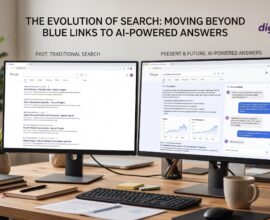
Local search is becoming more conversational, and that changes what visibility means for a local business. LLM SEO is not a replacement for Local SEO; it is a broader optimization approach that helps search and AI systems understand what a business does, where it operates, whom it serves, what makes it credible, and why it may be relevant to a particular customer question.
For businesses investing in a digital marketing service India, the opportunity is no longer limited to ranking a website or appearing in a map result. Customers can increasingly ask conversational systems for recommendations, comparisons, services, businesses nearby, or the best option for a specific need. That makes discoverability, entity clarity, reputation, content quality, and technical accessibility increasingly important.
What Is LLM SEO for Local Businesses?
LLM SEO for local businesses is the practice of improving a business’s website, business information, content, reputation and broader online presence so that large language model-powered search experiences can more easily understand and potentially mention or recommend the business for relevant local questions.
LLM SEO is often discussed alongside terms such as AI SEO, AI search optimization, Generative Engine Optimization (GEO) and Answer Engine Optimization (AEO). The terminology is still evolving, so the important thing is not the acronym. The important thing is the underlying problem: modern search systems increasingly need to interpret meaning, context, entities, location, reputation and user intent rather than simply match a short keyword to a webpage.
For a local business, that can mean being relevant to questions such as:
- Who is a reliable dentist near me?
- Which accountant in Manchester specializes in small businesses?
- What are the best wedding photographers in Kolkata?
- Where can I find a family-friendly restaurant open late?
- Which HVAC company serves my area and offers emergency repair?
These are not conventional keyword queries. They combine location, service, context, preference, urgency and decision criteria.
Why Local Business Visibility Is Changing in 2026
Search is no longer limited to a user entering a phrase into a traditional search box and selecting one of ten organic results. Google now has AI Overviews and AI Mode, while AI assistants can provide conversational answers and location-aware results.
Google’s current guidance is particularly important: its AI search features still rely on foundational Search systems, and Google does not require a special technical setup or special “AI schema” for inclusion in AI Overviews or AI Mode.
That means local businesses should not abandon the fundamentals. They should make those fundamentals stronger and more useful in an AI-mediated discovery environment.
The local discovery journey is becoming more conversational
Consider the difference between these two searches:
Traditional: “best physiotherapist Kolkata”
Conversational: “Can you recommend a physiotherapist in Kolkata who works with sports injuries and has good patient reviews?”
The second question requires a system to understand several relationships at once:
- The business category: physiotherapist
- The location: Kolkata
- The specialty: sports injuries
- The decision criterion: reputation
- The user’s objective: recommendation
This is where a well-structured local digital presence becomes valuable.
Is LLM SEO a Replacement for Local SEO?
No. LLM SEO should be treated as an extension of Local SEO and technical SEO, not a replacement for them.
Google says local ranking is primarily based on relevance, distance and prominence. Google also recommends keeping Business Profile information complete and accurate. Those fundamentals remain important even when the eventual customer discovery happens through an AI interface.
The difference is that traditional Local SEO often asks:
“How visible is this business in local search results?”
LLM SEO adds another question:
“Can an AI system understand enough about this business to include it in a useful answer?”
The two objectives overlap heavily.
Local SEO focuses heavily on
- Local relevance
- Google Business Profile
- Location signals
- Reviews
- Local landing pages
- Organic rankings
- Maps visibility
- Links and citations
LLM SEO adds greater emphasis on
- Conversational intent
- Entity clarity
- Semantic relationships
- Answer extraction
- Cross-source consistency
- AI-search visibility
- Brand context
- Evidence and corroboration
The smartest strategy is therefore not “SEO versus LLM SEO.” It is Local SEO plus AI-search readiness.
How Do AI Systems Discover a Local Business?
There is no single universal process shared by every AI system. Different products use different indexes, retrieval systems, data sources, models and ranking or recommendation mechanisms.
However, the practical pattern is clear: an AI system needs enough accessible and trustworthy information to understand what a business is and whether it is relevant to the user’s request.
A local business can therefore think about AI discovery as a chain:
- Discovery: Can the system find the business?
- Accessibility: Can it crawl or retrieve the relevant information?
- Understanding: Can it determine what the business does?
- Localization: Can it understand where the business operates?
- Relevance: Does the business match the customer’s request?
- Corroboration: Do independent sources support the same facts?
- Trust: Is there enough evidence to make a recommendation responsibly?
- Selection: Does the business fit the particular answer being generated?
This is why simply adding the words “best business in [city]” to a website is not an LLM SEO strategy.
10 LLM SEO Strategies for Local Businesses
1. Build an Unambiguous Business Entity
The first objective is simple: make it obvious who the business is.
Your website, Business Profile, social profiles, directories and other legitimate references should describe the same real-world business consistently.
Review:
- Business name
- Address
- Phone number
- Website
- Business category
- Services
- Opening hours
- Service areas
- Brand description
- Founder or professional information where relevant
Do not deliberately create slightly different business identities on different platforms for SEO purposes. Consistency makes your entity easier to understand.
2. Make Your Website Easy to Crawl and Understand
AI visibility begins with accessibility.
A page that cannot be reliably crawled, indexed or interpreted has little opportunity to become a useful source in search-driven AI experiences.
Check:
- Robots.txt accessibility
- Indexability
- Noindex directives
- Canonical URLs
- Internal linking
- XML sitemap
- Mobile usability
- Page speed and overall experience
- Important information rendered as accessible text
- Broken links and technical errors
Google’s AI-search guidance reinforces this principle: pages need to be eligible for Search before they can be supporting links in AI Overviews or AI Mode.
Technical SEO is therefore not old-fashioned work that LLM SEO can ignore. It is the infrastructure underneath it.
3. Strengthen Your Google Business Profile
For a local business, the Google Business Profile remains one of the most important sources of local business information.
Make sure the profile accurately communicates:
- Primary business category
- Relevant secondary categories
- Business hours
- Address or service area
- Phone number
- Website
- Services
- Products where applicable
- Photos
- Business description
Do not treat the profile as a one-time setup task. Business information changes. Services change. Opening hours change. Locations change. Photos become outdated.
A stale profile can create a mismatch between what your business currently offers and what search systems believe it offers.
4. Create Dedicated Service-and-Location Content
One of the strongest LLM SEO opportunities for local businesses is to answer specific customer needs rather than repeatedly publishing generic city-based pages.
Instead of creating a page called:
“Best Services in London”
build useful pages such as:
- Emergency plumbing services in North London
- Family dentistry in Central Manchester
- Commercial photography for Kolkata businesses
- Wedding photography packages in Brisbane
- Small-business accounting services in Toronto
The page should genuinely explain the service, area, customer type, process, limitations, pricing factors and next steps.
That gives search systems more meaningful relationships to interpret.
5. Write for Questions, Not Just Keywords
Local businesses should expand keyword research into question research.
Instead of only researching:
“roof repair Chicago”
also identify questions such as:
- How much does roof repair cost in Chicago?
- How quickly can a roofer respond to an emergency?
- What roofing problems require immediate attention?
- How do I choose a reputable roofing company?
- Does the company work with insurance claims?
This creates content that maps more naturally to conversational search behavior.
The objective is not to predict the exact wording a user will type into ChatGPT. It is to understand the questions customers actually have.
6. Build Evidence Around Your Claims
AI systems can summarize information, but customers still need reasons to trust that information.
If you claim that your business specializes in a particular service, support that claim with useful evidence.
Depending on the industry, that might include:
- Professional qualifications
- Licenses
- Certifications
- Years of operation
- Named team members
- Service methodology
- Before-and-after examples where legitimate
- Original research
- Customer reviews
- Professional memberships
- Independent media coverage
This is particularly important for high-trust sectors such as healthcare, legal services, financial services and professional consulting.
Never manufacture credentials or testimonials simply to create stronger AI signals.
7. Treat Reviews as Reputation Infrastructure
Reviews do more than provide star ratings.
They can describe what customers actually experienced, which services they used, what problems were solved and what characteristics they valued.
For that reason, local businesses should focus on earning genuine reviews rather than trying to manipulate review text.
A strong review strategy includes:
- Delivering an experience worth reviewing
- Making legitimate review requests easy
- Responding professionally to feedback
- Addressing recurring complaints
- Monitoring review freshness
- Never buying or fabricating reviews
BrightLocal’s 2026 research reinforces the importance of reviews: 97% of surveyed consumers reported reading reviews for local businesses, while AI use for local recommendations rose sharply in the same research.
The strategic implication is powerful: AI visibility does not remove the need for human reputation. It makes reputation more important.
8. Build Consistent Third-Party Corroboration
A business should not depend entirely on its own website to explain who it is.
Legitimate third-party references can help create a broader digital footprint.
Depending on the industry and country, relevant sources may include:
- Industry associations
- Local chambers of commerce
- Professional directories
- Established review platforms
- Local publications
- Trade publications
- Relevant business directories
- Community organizations
- Authoritative partner websites
The important word is relevant.
Do not build hundreds of low-quality directory listings simply because someone sells them as “LLM citations.” A smaller number of legitimate, accurate references can be more meaningful than a large volume of unrelated pages.
9. Use Structured Data for Clarity
Structured data can provide explicit information about what a page represents.
For local businesses, the relevant implementation may include the most specific applicable LocalBusiness subtype and appropriate properties for the business.
Depending on the site, useful information may include:
- Name
- Address
- Telephone
- Opening hours
- URL
- Logo
- Department information
- Relevant services
But avoid a common mistake: treating schema as an AI-ranking shortcut.
Google’s current guidance does not say that businesses need special AI schema to appear in generative search. Structured data is best treated as a way to communicate information clearly and accurately, while the visible content must remain truthful and consistent.
10. Measure AI Visibility Separately From Organic Rankings
This is where many LLM SEO strategies become vague.
“We optimized for AI” is not a useful performance metric.
Instead, create a measurement framework.
Traditional visibility metrics
- Organic impressions
- Organic clicks
- Rankings
- Click-through rate
- Local pack visibility
- Google Business Profile interactions
AI visibility metrics
- Brand mentions in AI answers
- AI citation frequency
- Number of target prompts where the business appears
- Source URLs cited by AI systems
- Competitor mentions
- Recommendation position where measurable
- Accuracy of AI-generated business descriptions
Business outcome metrics
- Phone calls
- Qualified leads
- Bookings
- Store visits where measurable
- Form completions
- Sales-qualified leads
- Revenue
Google’s June 2026 Search Console update is particularly relevant because Google began rolling out dedicated reporting for visibility in generative AI experiences such as AI Overviews and AI Mode.
How to Make a Local Business More AI-Readable
AI-readability is often misunderstood as “writing content for robots.” It is better understood as reducing ambiguity.
Consider this sentence:
“We provide innovative solutions for businesses looking to grow.”
It sounds polished, but it says very little.
Compare it with:
“We provide commercial air-conditioning installation and maintenance for offices, retail stores and restaurants across West London.”
The second sentence gives search systems and humans much more information:
- What the company does
- What type of customer it serves
- What services it offers
- Where it operates
That is the kind of clarity local businesses should aim for.
Entity Clarity: The Overlooked Layer of Local LLM SEO
Keywords describe topics. Entities describe things.
A local business is an entity with relationships.
For example:
Business: ABC Dental
- Located in Birmingham
- Provides general dentistry
- Offers cosmetic dentistry
- Serves adults and families
- Has named dentists
- Has defined opening hours
- Has a verified website
- Has reviews
- May be mentioned by local organizations
When those relationships are consistent across legitimate sources, the business becomes easier to distinguish from another company with a similar name.
This is especially important for businesses with:
- Common brand names
- Multiple branches
- Multiple service areas
- Franchise locations
- Practitioners with similar names
- Several websites or domains
How Local Content Should Change for LLM Search
Local content should become more useful, not simply more frequent.
A strong local service page can answer:
- What exactly does the business provide?
- Who is the service for?
- Where is it available?
- What does the process involve?
- What does the customer need before booking?
- What does the service typically cost?
- What factors influence the price?
- How long does it take?
- What are the alternatives?
- What should customers look for when comparing providers?
- Why might this business be suitable?
This is more valuable than publishing dozens of thin pages with the same paragraph and a different city name.
Use local experience, not just local keywords
Weak local content says:
“We are the best plumber in Austin and provide plumbing services in Austin.”
Useful local content might explain:
“Homes in older central Austin neighborhoods can present different plumbing challenges from newer developments. Before booking a repair, customers should ask whether the contractor handles the relevant pipe materials, permits and emergency-response requirements.”
The second approach demonstrates genuine local usefulness rather than keyword repetition.
LLM SEO for Multi-Location Businesses
Multi-location businesses have a different challenge: they need scale without creating duplicate or confusing information.
Each location should have accurate information about:
- Address
- Phone
- Opening hours
- Services actually available there
- Local staff where relevant
- Location-specific reviews
- Directions and access
- Local service areas
- Unique local information
Do not automatically publish hundreds of near-identical location pages simply to increase geographic coverage.
Each location page should earn its existence by helping the customer understand that particular branch.
How LLM SEO Works With GEO
LLM SEO and Generative Engine Optimization overlap significantly, but the terms can be used differently by different practitioners.
For a local business, GEO can be understood as the broader effort to improve visibility within generative search experiences, while LLM SEO places greater emphasis on how large language model-driven systems discover, interpret and potentially reference information.
A business working with a generative engine optimization agency should therefore avoid campaigns built around a single “AI ranking score.” The better approach is to examine the complete information ecosystem surrounding the business.
That includes the website, local profiles, reviews, content, third-party sources, technical accessibility, entity consistency and measurable AI-search presence.
LLM SEO vs Traditional SEO: What Actually Changes?
The biggest change is not that keywords suddenly became irrelevant. It is that the optimization target becomes broader.
Traditional SEO often emphasizes:
- Search demand
- Keywords
- Rankings
- Organic clicks
- Technical SEO
- Links
LLM-oriented optimization adds:
- Conversational intent
- Entity relationships
- Answer completeness
- Source corroboration
- Brand context
- AI mentions and citations
- Accuracy of machine-generated descriptions
But the foundations remain shared.
Good technical SEO, useful content, clear architecture, internal linking, trustworthy information and legitimate authority help both humans and search systems.
What About ChatGPT Recommendations?
There is no legitimate “submit my business to ChatGPT” button that guarantees recommendation placement.
ChatGPT Search can search the web, use location information for relevant results and retrieve information from websites. OpenAI states that search-result placement is not guaranteed.
That means local businesses should focus on becoming a well-documented, legitimate entity rather than trying to find a secret submission route.
For example, if someone asks:
“Who is a good family dentist near me?”
the useful information ecosystem might include:
- The dental practice website
- Its location information
- Services offered
- Professional profiles
- Reviews
- Relevant directories
- Local references
- Information about family dentistry
The exact sources and retrieval behavior will vary by platform and query.
Common LLM SEO Mistakes Local Businesses Should Avoid
1. Keyword stuffing
Repeating “best dentist in [city]” dozens of times does not create expertise.
2. Fake reviews
Artificial reputation is both ethically problematic and potentially damaging to long-term trust.
3. Mass-produced location pages
Creating hundreds of nearly identical pages can create a thin-content problem instead of genuine local relevance.
4. Invented credentials
Never add qualifications, awards, certifications or years of experience that cannot be verified.
5. Schema obsession
Structured data can help machines understand content, but it cannot compensate for weak or inaccurate information.
6. Ignoring technical SEO
An AI strategy cannot rescue a website that search engines cannot reliably access or index.
7. Measuring only traffic
AI visibility may influence discovery even when a user does not immediately click through. Track visibility, mentions and business outcomes together.
8. Testing only one AI platform
Different AI search experiences can produce different answers. A business that appears in one environment may not appear in another.
9. Optimizing for the machine instead of the customer
The strongest strategy is still customer-first. If a page is difficult for humans to understand, making it technically “AI-friendly” does not solve the underlying problem.
A 90-Day LLM SEO Roadmap for Local Businesses
Days 1–30: Fix the foundation
- Audit the website’s crawlability and indexability.
- Verify Business Profile information.
- Check business name, address and phone consistency.
- Review service categories.
- Audit existing service and location pages.
- Identify duplicate or thin local content.
- Review review profiles and reputation.
- Identify important third-party references.
Days 31–60: Improve relevance and evidence
- Build or improve priority service pages.
- Create useful location-specific content.
- Map customer questions.
- Strengthen practitioner/team information.
- Add legitimate credentials and evidence.
- Improve internal linking.
- Implement appropriate structured data.
- Build useful local resources rather than low-quality citations.
Days 61–90: Test and measure
- Create a fixed set of high-intent local prompts.
- Test relevant AI search platforms.
- Record business mentions and citations.
- Compare competitors.
- Check whether AI-generated descriptions are accurate.
- Monitor Search Console and analytics data.
- Track qualified leads and calls.
- Prioritize the next content and reputation improvements.
For businesses that need a broader technical and organic-search foundation, working with a best SEO agency in India can make sense when the project requires technical SEO, content architecture, local optimization and AI-search readiness to work together rather than as separate campaigns.
How Agencies Should Report LLM SEO to Local Clients
Client reporting should move beyond screenshots of AI answers.
A useful monthly report can include five layers.
Layer 1: Traditional search
- Visibility
- Rankings
- Clicks
- Local pack performance
Layer 2: AI visibility
- Tracked prompts
- Mentions
- Citations
- Competitor presence
Layer 3: Entity health
- Business information consistency
- Profile completeness
- Structured-data health
- Third-party references
Layer 4: Reputation
- Review volume
- Review recency
- Rating trends
- Response quality
Layer 5: Commercial outcomes
- Calls
- Leads
- Bookings
- Qualified enquiries
- Revenue
This reporting model prevents AI SEO from becoming a vanity exercise.
What Should Local Businesses Prioritize First?
If resources are limited, do not attempt every LLM SEO tactic simultaneously.
Prioritize in this order:
- Business identity: Make sure the business is accurately represented.
- Technical accessibility: Make sure important pages can be crawled and indexed.
- Business Profile: Keep local information accurate and complete.
- Service relevance: Clearly explain what you actually offer.
- Location relevance: Explain where and how you serve customers.
- Reputation: Build genuine reviews and respond appropriately.
- Evidence: Demonstrate expertise and credibility.
- Question coverage: Answer important customer questions.
- AI measurement: Track visibility across relevant prompts and platforms.
- Conversion: Make it easy for discovered customers to take action.
The Real Goal of LLM SEO Is Not Visibility Alone
Being mentioned by an AI assistant sounds impressive, but the business objective is not to collect mentions.
The real objective is to become easier for the right customer to discover and trust.
Imagine two local businesses.
Business A has a technically optimized website but little reputation, unclear service information and inconsistent business details.
Business B has clear service pages, accurate local information, authentic reviews, strong customer evidence, relevant third-party references and a website that clearly explains its expertise.
Business B has created a much stronger information ecosystem.
That ecosystem benefits traditional search, local discovery, AI search and—most importantly—the customer.
What Digital Piloto Would Prioritize
For an agency working across SEO, AI search and digital marketing, the practical lesson is straightforward: LLM SEO should not become another isolated service checklist.
It should connect:
- Business strategy
- Search intent
- Local SEO
- Technical SEO
- Content architecture
- Entity understanding
- Reputation
- Generative search visibility
- Conversion optimization
- Performance measurement
The strongest local AI-search strategy is therefore an integrated digital visibility system rather than a collection of AI tricks.
Frequently Asked Questions
What is LLM SEO for local businesses?
LLM SEO for local businesses is the practice of making a business easier for AI-powered search systems to discover, understand, verify and potentially mention for relevant local questions. It builds on traditional Local SEO rather than replacing it.
Can Local SEO help a business appear in AI search?
Yes, the foundations overlap significantly. Accurate business information, relevant content, technical accessibility, reviews, authority and strong local relevance can all contribute to a better digital presence. However, no Local SEO tactic guarantees an AI recommendation.
How do I get my business recommended by ChatGPT?
There is no guaranteed submission or ranking shortcut. Focus on maintaining a crawlable website, accurate business information, strong local relevance, legitimate reputation signals and useful information across trusted sources. ChatGPT Search can retrieve web information, but placement is not guaranteed.
Does Google Business Profile matter for LLM SEO?
It can matter greatly for local visibility because it is an important source of structured business information within Google’s ecosystem. It should be treated as one part of a broader digital presence rather than the entire AI-search strategy.
Does schema make a local business rank in ChatGPT?
No guaranteed ranking effect exists. Structured data can help search systems understand information, and Google supports LocalBusiness structured data, but Google does not require special AI schema for AI Overviews or AI Mode.
How should local businesses measure LLM SEO?
Track AI mentions and citations alongside organic visibility, local search performance, reviews, qualified leads, calls, bookings and revenue. A useful LLM SEO strategy should ultimately connect visibility with business outcomes.
Conclusion
LLM SEO is becoming relevant to local businesses because discovery itself is becoming more conversational. Customers can ask an AI system to recommend a business, compare providers, explain a service or identify the best option for a specific need.
But the answer is not to abandon Local SEO or chase every new AI acronym.
The smarter approach is to build a strong digital entity: technically accessible, clearly described, locally relevant, supported by authentic reputation, reinforced by useful third-party information and capable of answering real customer questions.
In other words, LLM SEO works best when a business becomes genuinely easy to understand and genuinely worth recommending.