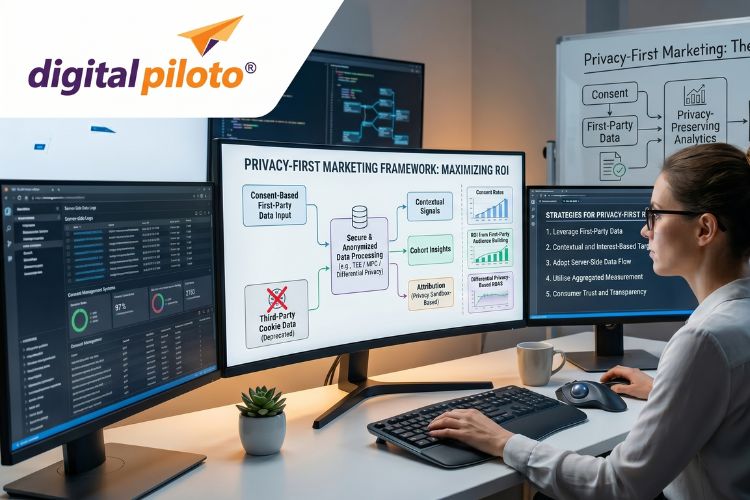
Privacy-first marketing focuses on collecting minimal user data while still delivering personalized, high-converting experiences. It replaces invasive tracking with consent-based strategies, first-party data, and contextual targeting—allowing businesses to maintain strong ROI without compromising user trust or regulatory compliance.
Today, brands working with a Digital Marketing Agency in Siliguri are shifting toward ethical data practices, realizing that trust and transparency often outperform aggressive tracking when it comes to long-term conversions.
What is Privacy-First Marketing? (Definition)
Privacy-first marketing is a strategy that prioritizes user consent, data protection, and transparent communication while still achieving marketing goals like engagement and conversions.
- Core Principle: Respect user data and privacy
- Data Source: First-party and zero-party data
- Goal: Sustainable, trust-driven ROI
Instead of relying on third-party cookies, this approach builds direct relationships with users, making marketing more reliable and future-proof.
Why Privacy-First Marketing Matters Today
With stricter data regulations and increasing user awareness, traditional tracking methods are losing effectiveness. Users now expect brands to respect their privacy.
Key Drivers of This Shift
- Decline of third-party cookies
- Stricter global data protection laws
- Growing user demand for transparency
Ignoring these changes doesn’t just risk compliance—it damages brand credibility. And once trust is lost, conversions become harder to achieve.
Can Privacy-First Marketing Still Deliver ROI?
Yes—and often better than traditional methods. When users trust a brand, they engage more deeply and convert more willingly.
Why It Works
- Higher Trust: Users feel safe sharing information
- Better Data Quality: First-party data is more accurate
- Stronger Relationships: Builds long-term customer loyalty
In reality, privacy-first marketing doesn’t reduce performance—it improves the quality of engagement, which leads to better ROI.
Key Privacy-First Marketing Strategies (Step-by-Step)
Step 1: Focus on First-Party Data
Collect data directly from your audience through website interactions, forms, and subscriptions.
Step 2: Use Consent-Based Tracking
Implement clear opt-ins and allow users to control their data preferences.
Step 3: Leverage Contextual Targeting
Target users based on the content they are viewing rather than their personal data.
Step 4: Build Transparent Communication
Explain how and why you collect data. Transparency builds trust.
Step 5: Invest in CRM and Data Management
Organize and utilize your first-party data effectively for personalized campaigns.
Step 6: Optimize Content Personalization
Use behavioral insights ethically to deliver relevant experiences without invading privacy.
Best Channels for Privacy-First Marketing
Not all channels rely heavily on personal data. Some naturally align with privacy-first strategies.
- Email Marketing: Based on user consent and subscriptions
- SEO & Content Marketing: Driven by intent, not tracking
- Social Media Engagement: Builds relationships organically
Businesses leveraging Digital Marketing Services in India are increasingly prioritizing these channels to maintain performance while respecting privacy norms.
Privacy-First vs Traditional Marketing
Key Differences
- Data Collection: Consent-based vs invasive tracking
- User Trust: High vs often compromised
- Longevity: Sustainable vs short-term gains
Traditional marketing may deliver quick wins, but privacy-first strategies build long-term value and resilience.
Real-World Example of Privacy-First Success
Consider a brand that replaces third-party tracking with email-based personalization. Instead of targeting anonymous users, it builds a subscriber base that willingly shares preferences.
The result? Higher open rates, better engagement, and improved conversions—without violating privacy expectations.
This approach proves that ethical marketing can be both effective and scalable.
Common Mistakes to Avoid
Even well-intentioned strategies can fail if not implemented correctly.
- Overcomplicating Consent Forms: Confuses users
- Lack of Transparency: Reduces trust
- Ignoring Data Security: Risks compliance issues
Privacy-first marketing is not just about compliance—it’s about creating a better user experience.
FAQs: Privacy-First Marketing
1. What is privacy-first marketing?
It is a strategy that prioritizes user consent, data protection, and transparency while achieving marketing goals.
2. Does privacy-first marketing reduce ROI?
No, it often improves ROI by building trust and using higher-quality data.
3. What is first-party data?
First-party data is information collected directly from your audience through your own platforms.
4. How can I start privacy-first marketing?
Focus on consent-based data collection, transparent communication, and ethical personalization.
5. Why is user trust important in marketing?
Trust increases engagement, loyalty, and conversions, making it a critical factor for long-term success.
Conclusion
Privacy-first marketing isn’t a limitation—it’s an opportunity. When you respect your audience’s data, you build trust, and trust drives conversions. In a world where users value transparency, the brands that prioritize privacy will ultimately win.
Blog Development Credits:
This article was originally envisioned by Amlan Maiti, developed through advanced AI-assisted research, and strategically refined with expert SEO insights by Digital Piloto Private Limited.