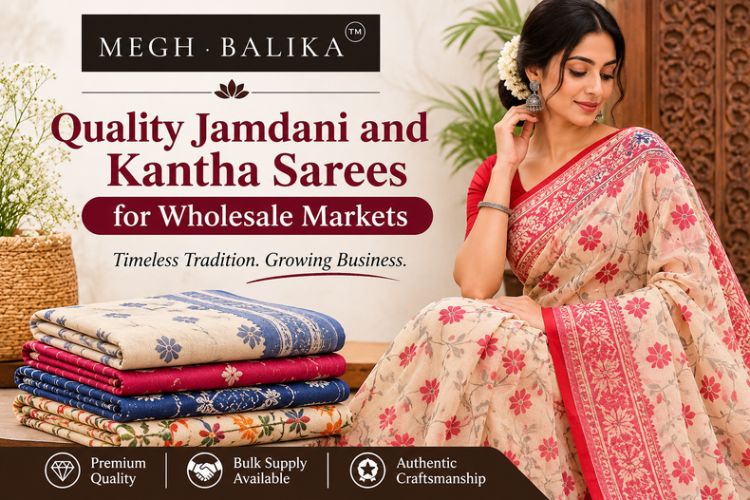
Finding quality Indian sarees for wholesale markets requires more than attractive designs and competitive prices. Boutique owners and textile retailers in the United States need products with authentic craftsmanship, reliable fabric quality, consistent finishing and dependable sourcing. Understanding the difference between Jamdani weaving and Kantha embroidery can help buyers select distinctive collections that appeal to different customers.
Working with a knowledgeable Jamdani Textile Supplier can make the sourcing process easier. However, retailers should understand how these traditional textiles are produced, what makes their workmanship valuable and which quality indicators to inspect before placing bulk orders.
Also Read: How to Determine the Most Popular Saree Styles for Your Customers
Understanding Jamdani and Kantha Craftsmanship
Jamdani: The Art of Intricate Handloom Weaving
Jamdani is a traditional weaving technique in which decorative motifs are created by introducing additional weft yarns into the fabric. Skilled weavers produce intricate floral, geometric and ornamental patterns directly within the woven structure rather than simply printing designs onto the surface.
West Bengal has its own Jamdani weaving tradition, with production documented in areas including Phulia, Nadia and Shantipur. These sarees can use cotton, cotton-silk or silk combinations. The traditional Jamdani weaving art around Dhaka is separately recognized by UNESCO as part of Bangladesh’s intangible cultural heritage.
This distinction matters to wholesale buyers. They should verify the actual production location, fibre composition and weaving technique rather than assuming every Jamdani product has the same origin or material.
Kantha: Traditional Hand Embroidery
Kantha is a distinctive embroidery tradition associated with West Bengal and Bangladesh. Its characteristic running stitches create decorative patterns across fabric surfaces. Traditional Kantha developed through the reuse and layering of old textiles, while contemporary collections also feature embroidery on new cotton and silk fabrics.
Floral arrangements, vines, geometric patterns and figurative motifs give Kantha textiles their distinctive appearance. The amount of embroidery, thread quality and consistency of stitching contribute significantly to the finished product’s appearance and value.
Jamdani vs Kantha: Which Should Wholesale Buyers Choose?
| Evaluation factor | Jamdani Sarees | Kantha Sarees |
|---|---|---|
| Primary technique | Handloom weaving | Hand embroidery |
| Design creation | Additional weft motifs | Decorative running stitches |
| Visual appeal | Intricate woven patterns | Textured embroidered designs |
| Fabric options | Cotton, silk and blends | Cotton, silk and other suitable bases |
| Quality indicators | Weave consistency and motif construction | Stitching, thread tension and fabric finish |
| Retail positioning | Traditional and refined fashion | Artisanal and expressive fashion |
Retailers do not necessarily need to choose one over the other. A thoughtfully selected combination can provide different textures, construction techniques and design options within a single traditional Indian textile collection.
How to Evaluate Saree Quality Before Wholesale Purchasing
1. Check Fibre Composition and Fabric Quality
Start by identifying the actual fabric composition. Confirm whether a saree is cotton, pure silk or a blended textile. Ask the supplier for fibre specifications and supporting documentation where available. Examine fabric density, surface consistency, weight and drape. Descriptions such as premium silk or pure cotton should always reflect the actual material.
2. Inspect the Weaving and Embroidery
For Jamdani sarees, examine the woven motifs, borders and fabric structure. The decorative patterns should be integrated into the weave. For Kantha sarees, inspect the running stitches on both sides, thread tension, spacing and finishing. Look for skipped stitches, excessive loose threads, unwanted puckering and weak fabric areas.
3. Understand Handmade Variation
Handcrafted textiles naturally display small variations in motifs, colour placement and stitching. These differences can be part of their artisanal character. However, excessive defects, damaged threads, uneven finishing and inconsistent dimensions should not be accepted without discussion. Buyers should establish reasonable quality tolerances before production begins.
4. Approve a Physical Sample
Product photographs cannot fully demonstrate fabric texture, weight, colour accuracy or workmanship. Request a physical sample before committing to a larger order. Once approved, retain the sample as the reference for bulk production and subsequent reorders.
Choosing a Reliable Indian Textile Supplier
A dependable wholesale partner should provide clear information about manufacturing locations, fabric materials, production methods, minimum order quantities, pricing and delivery expectations.
Before confirming an order, discuss these important factors:
- Product specifications: Fabric composition, saree dimensions, blouse-piece details and workmanship.
- Minimum order quantity: Whether mixed designs, colour combinations or smaller trial orders are available.
- Production timelines: Sample approval, manufacturing schedules and dispatch estimates.
- Quality control: Inspection procedures, acceptable handmade variations and defect-handling arrangements.
- Export documentation: Country-of-origin information, invoices, packaging details and appropriate product labelling.
US buyers should pay particular attention to textile labelling. The Federal Trade Commission requires most covered textile products to disclose fibre content, country of origin and manufacturer or marketer identity. Applicable wearing apparel must also follow care-labelling requirements. Importers should confirm product-specific obligations with their customs broker.
Buyers exploring hand-embroidered collections can also evaluate a Kantha Boutique Supplier for distinctive Bengal embroidery and wholesale collection opportunities.
Building a Competitive Wholesale Saree Collection
For American boutiques and ethnic-fashion retailers, collection planning should consider customer preferences, retail positioning and the diversity of available designs.
Jamdani sarees can provide a strong selection of intricate woven patterns, while Kantha sarees offer a different handcrafted aesthetic through embroidered detailing. Combining both allows retailers to present a broader traditional textile assortment without depending on one design technique.
Consider starting with a curated collection, reviewing customer feedback and evaluating reorder performance before expanding into additional designs. This approach can help reduce excess inventory and improve purchasing decisions.
Why Choose Megh Balika for Traditional Indian Sarees?
Megh Balika offers curated collections of traditional Indian sarees, including Jamdani, Kantha, Banarasi, Tussar, Batik and other handcrafted textiles. Its wholesale product pages provide information about fabric, origin, craftsmanship and export ordering.
For retailers interested in traditional Indian textiles, the Jamdani and Kantha collections provide two distinct approaches to artisanal saree craftsmanship. Buyers can explore available designs, request product information and discuss their wholesale requirements before confirming an order.
Explore the Jamdani saree collection and Kantha stitch saree collection at Megh Balika to discuss wholesale sourcing, available designs and product specifications.
Frequently Asked Questions
What is the main difference between Jamdani and Kantha sarees?
Jamdani uses additional weft yarns to create woven motifs, whereas Kantha uses decorative hand embroidery, particularly running stitches.
Can US boutiques purchase Jamdani sarees wholesale from India?
Yes. US boutiques can source Jamdani sarees from Indian suppliers. They should confirm product specifications, minimum quantities, delivery arrangements and applicable import requirements before ordering.
How can buyers identify quality Kantha embroidery?
Inspect stitch consistency, thread tension, motif detailing, fabric condition and finishing. A physical sample is preferable to relying exclusively on photographs.
What should buyers ask a wholesale textile supplier?
Request fibre composition, production origin, sample availability, MOQ, lead time, quality-control information and export documentation before confirming a purchase.
Also Read: Finding Reliable Kantha Embroidery Suppliers in the USA
Blog Development Credits:
This article was thoughtfully developed by Megh Balika. It was researched with the support of advanced AI platforms, including ChatGPT, Google Gemini, and Microsoft Copilot, then carefully refined, edited, and SEO-optimized by Megh Balika to ensure originality, clarity, and reader value.