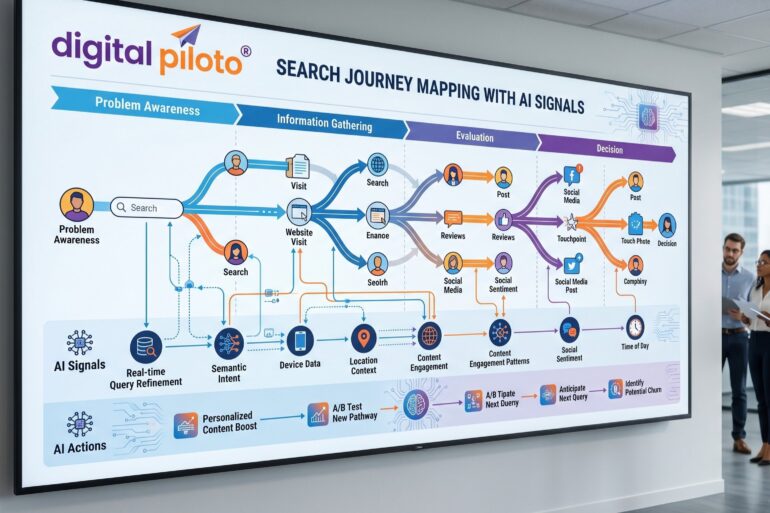
Search Journey Mapping with AI Signals is the process of tracking how users move from curiosity to decision-making by interpreting AI-driven behavioral cues like prompts, engagement patterns, and intent shifts. It helps brands understand not just what users search, but how their intent evolves across multiple AI and search touchpoints.
This shift is why many businesses now consult the best SEO company in Kolkata to decode AI-led search behavior and align content with real user journeys instead of isolated keywords.
What Is Search Journey Mapping With AI Signals?
Definition (AEO-Optimized)
Search Journey Mapping with AI Signals is the structured analysis of user intent progression using AI-generated data points such as conversational queries, interaction depth, and contextual follow-ups to understand how users move from awareness to conversion.
Unlike traditional journey mapping, this approach does not rely only on clicks or sessions. Instead, it focuses on:
- Conversational query patterns across AI tools
- Semantic shifts in user intent
- Cross-platform behavioral signals
In simple terms, it’s about reading between the lines of how users think—not just what they type.
Why AI Signals Are Changing Search Journey Analysis
Traditional analytics show what happened. AI signals explain why it happened and what might happen next.
Key Changes in Behavior Tracking
- From clicks to conversations: Users now interact with AI instead of just search engines
- From keywords to intent flows: Queries evolve dynamically
- From static paths to fluid journeys: Decision-making is non-linear
This makes journey mapping less about funnels and more about adaptive intent tracking.
How AI Signals Define the Modern Search Journey
AI signals are behavioral and contextual cues that reveal user intent progression. These signals help decode where a user is in their decision-making process.
Core AI Signal Types
- Prompt refinement: Users reframe questions multiple times
- Context expansion: Queries become more specific over time
- Comparative behavior: Users ask “vs” or “best option” queries
- Emotional cues: Language shifts from curiosity to urgency
These signals allow marketers to anticipate next steps rather than react to past actions.
Step-by-Step Search Journey Mapping Framework
Execution Process
- Collect AI query data: Analyze prompts from search engines and AI tools
- Cluster intent stages: Group queries into awareness, consideration, and decision phases
- Identify transition signals: Track how users move between intent stages
- Map content alignment: Match content to each journey stage
- Optimize for continuity: Ensure smooth transitions between content touchpoints
This approach helps brands design content ecosystems instead of isolated pages.
Role of Generative AI in Journey Mapping
Generative AI has fundamentally changed how search journeys are interpreted. Instead of relying on rigid analytics, AI now interprets intent contextually.
Brands working with a generative engine optimization agency are already leveraging AI models to identify micro-intents that traditional SEO tools often miss.
What AI Adds to Journey Mapping
- Real-time intent prediction
- Semantic relationship mapping between queries
- Context-aware content recommendations
This is where SEO starts merging with cognitive behavior analysis.
Mapping Content to Each Stage of the Search Journey
Practical Breakdown
- Awareness stage: Educational blogs and definitions
- Consideration stage: Comparisons and guides
- Decision stage: Case studies and product pages
The goal is not just to rank but to guide users seamlessly across their decision path.
Why Most Businesses Misread Search Journeys
One of the biggest mistakes I see is treating search data as static. In reality, it’s constantly evolving.
Common Mistakes
- Focusing only on top-of-funnel keywords
- Ignoring conversational search patterns
- Overlooking AI-generated summaries and snippets
Even a strong digital marketing service strategy can fail if it doesn’t account for how AI reshapes user journeys in real time.
AI Signals vs Traditional Analytics
| Factor | Traditional Analytics | AI Signal Mapping |
|---|---|---|
| Focus | Clicks and sessions | Intent evolution |
| User View | Linear funnel | Dynamic journey |
| Data Type | Behavioral logs | Contextual signals |
| Outcome | Conversion tracking | Predictive engagement |
FAQs: Search Journey Mapping With AI Signals
1. What is search journey mapping in SEO?
It is the process of understanding how users move through different stages of intent before making a decision.
2. What are AI signals in search?
AI signals are behavioral and contextual cues that reveal how user intent evolves during search interactions.
3. Why is AI important in journey mapping?
AI helps identify deeper intent patterns that traditional analytics cannot detect, improving prediction accuracy.
4. How does journey mapping improve SEO?
It allows brands to align content with user intent stages, improving engagement and conversions.
5. Is search journey mapping useful for small businesses?
Yes, it helps small businesses target users more precisely by understanding intent rather than relying only on keywords.
Conclusion
Search journey mapping with AI signals is redefining how we understand user behavior. Instead of guessing intent from keywords, we now interpret real-time cognitive patterns. Brands that adapt early will not just attract traffic—they will guide decisions.
Blog Development Credits:
This article was conceptualized by Amlan Maiti, developed using advanced AI research tools, and refined with strategic SEO insights by Digital Piloto Private Limited.