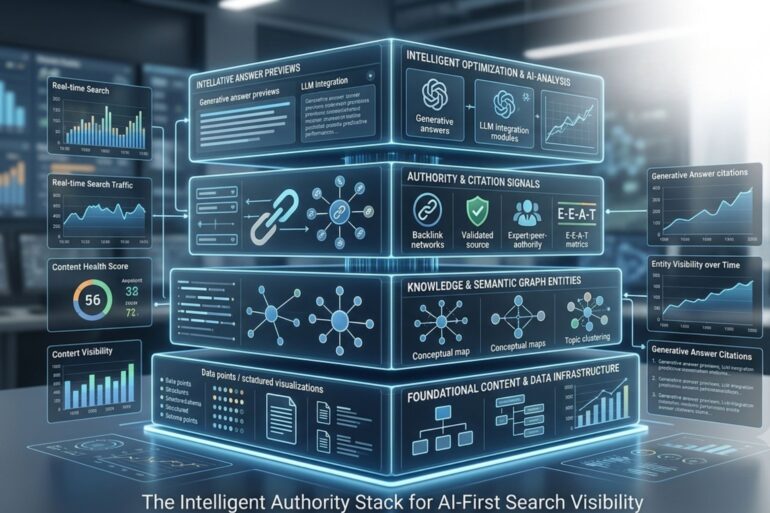
AI-first search visibility is no longer achieved by ranking for a handful of keywords. Modern AI search engines evaluate authority by connecting entities, expertise, trust signals, topical depth, and user value into a unified knowledge model. Businesses that build an intelligent authority stack become far more likely to appear in AI-generated answers, recommendations, and conversational search experiences.
This shift explains why every forward-thinking digital marketing company in Kolkata is moving beyond traditional SEO tactics. Instead of chasing isolated rankings, successful brands are developing authoritative digital ecosystems that AI systems can confidently understand, verify, and recommend.
What Is an Intelligent Authority Stack?
Definition: An Intelligent Authority Stack is a structured collection of trust, expertise, content, technical optimization, and entity signals that collectively increase a brand’s credibility across AI-powered search platforms.
Rather than relying on backlinks alone, AI models evaluate how consistently your expertise appears across your website, external mentions, structured data, customer interactions, and topical coverage.
The stronger these signals reinforce each other, the more confidence AI systems have when selecting your brand as a reliable source.
Why AI Search Values Authority Differently
Traditional search engines largely rewarded pages based on relevance, authority, and backlinks. AI-powered search introduces another layer—confidence.
Before citing or recommending content, AI models attempt to determine whether the information appears accurate, consistent, well-supported, and produced by a credible source.
Key AI evaluation signals include:
- Consistent entity recognition across multiple platforms
- Topical depth rather than isolated keyword targeting
- Author expertise and transparent authorship
- Reliable citations and trustworthy references
- Structured content that machines can easily interpret
- Positive user engagement and behavioral signals
These combined signals create confidence—not just rankings.
The Five Layers of an Intelligent Authority Stack
1. Entity Authority
Your business, products, executives, and services should exist as clearly identifiable entities instead of disconnected webpages.
Consistent business information, schema markup, author profiles, and branded mentions help AI systems establish entity relationships.
2. Knowledge Authority
Publishing one excellent article rarely establishes expertise anymore.
Instead, AI evaluates how thoroughly your website covers an entire subject through connected topic clusters, supporting resources, FAQs, research content, and practical implementation guides.
3. Experience Authority
First-hand insights increasingly separate trusted content from generic summaries.
Case studies, campaign lessons, client experiences, implementation challenges, performance comparisons, and measurable outcomes demonstrate genuine expertise that AI systems value highly.
How to Build an AI-Friendly Authority Stack
Step 1: Define your primary business entities and their relationships.
Step 2: Build comprehensive topical clusters instead of isolated blog posts.
Step 3: Publish original research, practical examples, and implementation frameworks.
Step 4: Strengthen technical SEO with schema, internal linking, crawl optimization, and structured metadata.
Step 5: Continuously update important resources as your industry evolves.
This systematic process creates a stronger foundation for long-term AI visibility than publishing large volumes of similar content.
Content Alone Is No Longer Enough
Many organizations continue investing heavily in content production while overlooking authority development.
Publishing hundreds of articles without reinforcing expertise often creates fragmented topical signals that AI systems struggle to interpret.
A better approach combines educational content, technical optimization, expert authorship, structured knowledge architecture, digital PR, and strategic brand mentions.
This integrated strategy is why businesses increasingly work alongside a generative AI SEO agency capable of optimizing visibility across both traditional search engines and emerging AI-powered answer platforms.
Common Mistakes That Weaken AI Authority
Even well-designed websites can lose visibility if authority signals are inconsistent or incomplete. AI search systems look for coherence across every touchpoint, not isolated optimization efforts.
Avoid these common mistakes:
- Publishing thin articles that repeat existing information without adding original insights.
- Creating disconnected content instead of building topic clusters.
- Using inconsistent business information across websites and directories.
- Ignoring structured data and entity markup.
- Failing to update evergreen resources as industries evolve.
One comprehensive, continuously updated resource often delivers more long-term value than dozens of low-impact blog posts.
Where Traditional SEO Fits into the Authority Stack
Traditional optimization still matters, but it now serves as the foundation rather than the final objective. Technical performance, keyword relevance, crawlability, and internal linking remain essential.
However, combining those fundamentals with entity optimization, knowledge graphs, topical authority, and expert-led content creates a stronger competitive advantage. Businesses investing in professional SEO services are increasingly expanding their strategies to include AI search optimization, semantic search, and digital authority management.
Preparing Your Brand for AI-First Discovery
Brands that consistently appear in AI-generated responses share one characteristic: they are easy for machines to understand and easy for users to trust.
Focus on building an ecosystem where your content, authors, services, customer proof, structured data, and external recognition reinforce one another. Over time, these connected signals create an authority profile that AI systems can confidently reference.
Conclusion
The future of search belongs to brands that invest in authority rather than visibility alone. An Intelligent Authority Stack transforms isolated SEO activities into a connected trust framework that benefits both users and AI systems. As search continues evolving beyond rankings, businesses that prioritize expertise, entity clarity, and consistent value will be best positioned for sustainable visibility.
Frequently Asked Questions
1. What is an Intelligent Authority Stack?
It is a combination of entity optimization, topical authority, technical SEO, structured data, expert content, and trust signals that helps AI search engines identify credible brands.
2. Why is authority more important for AI search?
AI platforms prioritize reliable, verifiable information. Strong authority signals increase the likelihood of your content being selected for AI-generated answers.
3. How is AI-first SEO different from traditional SEO?
Traditional SEO focuses mainly on rankings, while AI-first SEO emphasizes entities, expertise, semantic relevance, structured knowledge, and trust across multiple sources.
4. Can small businesses build AI authority?
Yes. Consistent branding, expert content, structured data, customer reviews, and topical depth help businesses of all sizes strengthen their AI visibility.
5. How long does it take to build authority for AI search?
Authority develops gradually through consistent publishing, technical optimization, digital PR, and ongoing improvements rather than one-time SEO activities.
Blog Development Credits
This article was conceived by Amlan Maiti, developed with research support from AI platforms including ChatGPT, Google Gemini, and Copilot, and refined through strategic SEO optimization by Digital Piloto Private Limited.