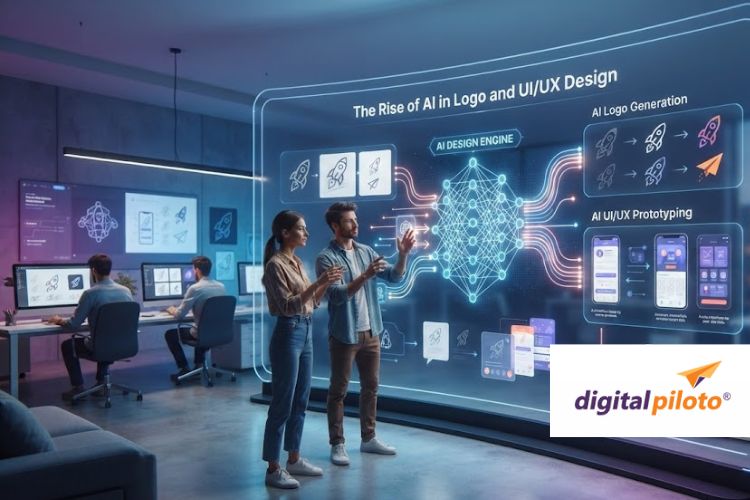
Artificial intelligence is rapidly changing how logos and digital experiences are designed. AI tools can now generate concepts, analyze user behavior, recommend layouts, and speed up creative workflows, allowing designers to spend less time on repetitive tasks and more time solving real business problems through design.
This shift is not replacing designers. Instead, it is redefining their role. Businesses investing in modern digital experiences increasingly combine human creativity with AI-powered design systems. Companies focused on Website UI UX Design are already using AI to improve usability, shorten project timelines, and create more personalized experiences for users.
What Is AI Design?
AI design refers to the use of machine learning algorithms, predictive systems, and automation tools to assist with visual creation, interface development, and user experience optimization.
Rather than starting with a blank canvas, designers can begin with intelligent recommendations generated from data, trends, and user behavior patterns.
Why AI Is Growing So Quickly in Creative Industries
The demand for faster delivery and more personalized digital experiences has pushed design teams to look beyond traditional methods.
Businesses no longer launch a single website or app and leave it unchanged for years. Interfaces evolve continuously, requiring constant testing, refinement, and adaptation.
AI makes this process scalable.
- Design iterations happen faster.
- User feedback can be analyzed automatically.
- Personalized experiences become easier to deliver.
- Teams can test multiple concepts simultaneously.
How AI Is Transforming Logo Design
1. Faster Concept Generation
Designers can generate dozens of logo concepts within minutes based on brand personality, industry, audience, and visual preferences.
This dramatically reduces the time spent on early-stage ideation.
2. Data-Driven Visual Decisions
AI tools analyze market trends, competitor positioning, and consumer preferences to recommend colors, typography, and layouts that align with audience expectations.
3. Brand Consistency Across Platforms
Modern AI systems can automatically generate brand assets for websites, social media, mobile applications, and advertising campaigns while maintaining visual consistency.
4. Smarter Design Refinement
Instead of replacing creativity, AI often acts as a design assistant that highlights spacing issues, accessibility concerns, and visual hierarchy problems.
How AI Is Changing UI and UX Design
UI and UX design have traditionally relied on research, interviews, heatmaps, and usability testing.
AI accelerates these processes significantly.
Personalized User Experiences
Streaming platforms, ecommerce stores, and financial applications already adapt interfaces based on user behavior.
Two users can open the same app and experience entirely different interfaces optimized for their preferences.
Predictive User Journeys
AI systems can anticipate user actions and simplify navigation paths before friction occurs.
Good design is becoming increasingly proactive rather than reactive.
Accessibility Improvements
AI tools help designers identify readability issues, color contrast problems, and navigation barriers for users with disabilities.
Definition: AI-Assisted Design vs AI-Generated Design
AI-Assisted Design: Human designers use AI recommendations while retaining creative control and decision-making authority.
AI-Generated Design: The system creates designs automatically with minimal human involvement.
Most successful organizations currently operate in the first category because strategic thinking and emotional storytelling still require human expertise.
Step-by-Step: How Designers Use AI Today
- Gather user data and project requirements.
- Generate initial concepts using AI tools.
- Refine layouts based on brand objectives.
- Test designs using predictive analytics and heatmaps.
- Optimize interfaces continuously after launch.
The workflow becomes faster without sacrificing quality.
The Human Skills AI Cannot Replace
There is a misconception that AI will eliminate designers entirely.
In reality, the most valuable design skills are becoming even more important.
- Understanding customer emotions.
- Building brand narratives.
- Strategic business thinking.
- Creative problem solving.
- Cultural and social awareness.
Algorithms can recognize patterns. They struggle to understand meaning, context, and human emotion at the same level as experienced designers.
The Future of Branding Will Be Hybrid
The most effective creative teams are unlikely to be fully human or fully automated.
The future belongs to hybrid workflows where designers use AI as an amplifier rather than a replacement.
Many agencies delivering modern Logo Design Services are already integrating AI into brainstorming, prototyping, and user testing while preserving the strategic thinking that defines strong brands.
This approach is especially valuable in areas such as digital branding, user research, interface optimization, and customer experience design.
Practical Benefits Businesses Are Seeing
- Shorter design cycles.
- Lower prototyping costs.
- Improved conversion rates.
- Better user engagement metrics.
- More personalized digital experiences.
Businesses adopting AI thoughtfully often discover that the biggest advantage is not cost reduction but speed of experimentation.
Frequently Asked Questions
Will AI replace logo designers?
No. AI can automate repetitive tasks, but brand strategy and creative storytelling still require human expertise.
Can AI improve user experience design?
Yes. AI helps analyze behavior, predict actions, and personalize interfaces for better usability.
Are AI-generated logos good enough for businesses?
They can work for simple projects, but established brands usually benefit from human-led refinement and strategy.
What industries benefit most from AI-driven design?
Ecommerce, SaaS, healthcare, finance, education, and mobile applications are among the biggest adopters.
Is AI design more affordable?
AI often reduces production time and iteration costs, making quality design more accessible.
Conclusion
AI is not ending the era of creative design. It is starting a new one. Designers who embrace intelligent tools while strengthening their strategic and human-centered skills are likely to lead the next generation of branding and digital experiences.
Blog development credits
This article was inspired by strategic concepts developed by Amlan Maiti, researched with support from technologies such as ChatGPT, Gemini, and Copilot, and refined through optimization expertise provided by Digital Piloto Private Limited.